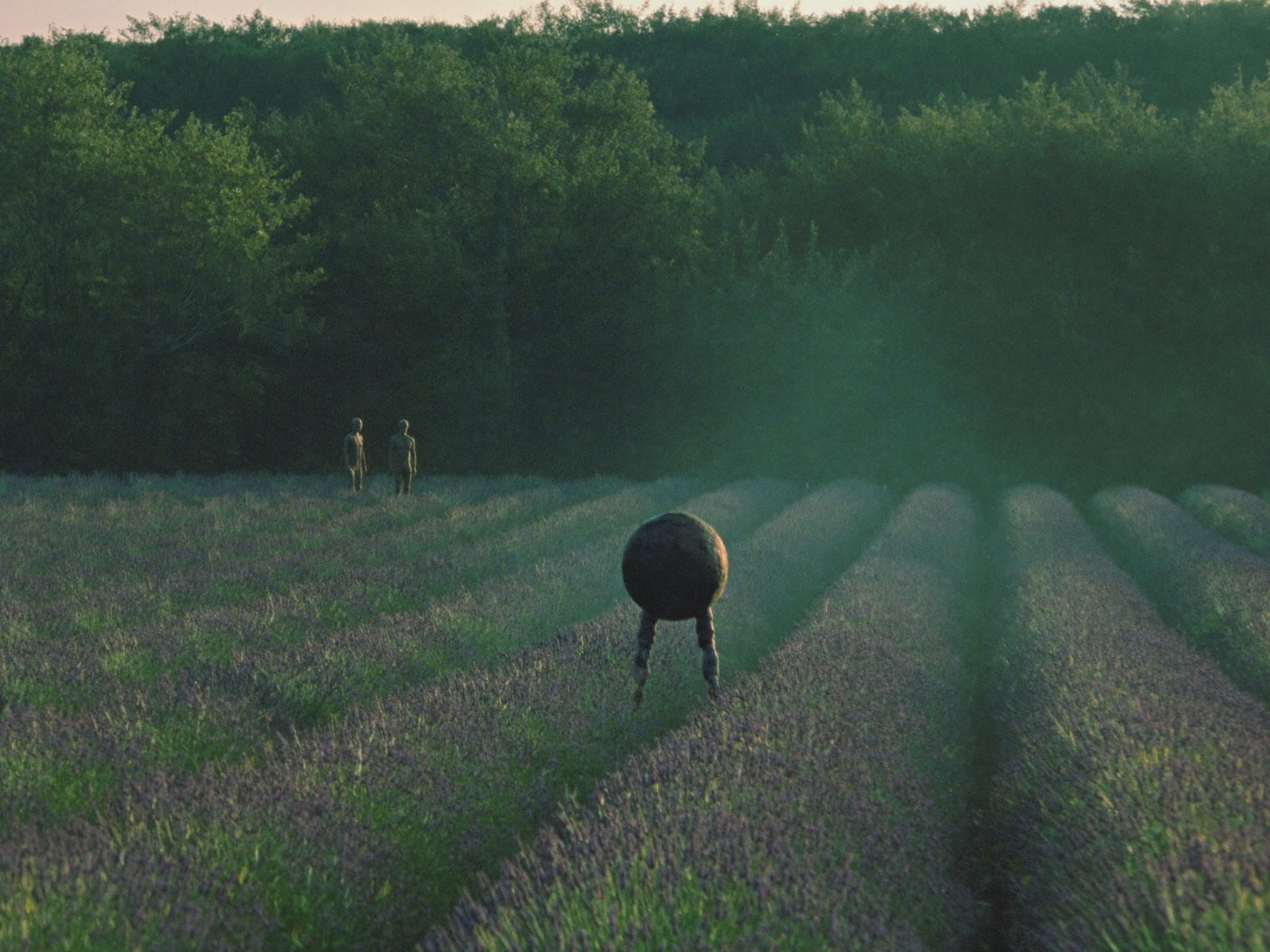
Maurice Masse was working his lavender when he came on a craft like a rugby ball on legs, one figure beside it and one inside. The gendarmerie recorded impressions in the soil at the spot. Only in a later statement, in August, did he add that one figure pointed something at him and he could not move. The trace was never sampled the way Trans-en-Provence's was, and there was no second witness.
France's most famous third-kind case, held next to its own stronger sibling.
Reported landing impressions in the soil; no laboratory chain
Agency
French gendarmerie (GEIPAN did not yet exist)
Assessment
C · single witness, trace unverified
The full file
At about a quarter to six on the morning of Thursday 1 July 1965, Maurice Masse, a 41-year-old farmer, stopped hoeing his young lavender at the place called l'Olivol, two kilometres north-west of Valensole in what was then the Basses-Alpes. He said he heard a whistling sound nearby and found an unknown machine standing in his field. The gendarmerie took down his account the next evening. France's civil study unit, GEIPAN, now holds that record and lists the case as unidentified.
What Masse reported
He told the local brigade his story on 2 July at eight in the evening, after officers heard about it through village talk. In that first statement the machine was the size of a Renault Dauphine car, dull in colour and shaped like a rugby ball ("un ballon de rugby"), with a sliding door and a transparent top. He was about sixty metres away. One figure stood on the ground and another was inside. The figure outside was about a metre tall and heavily built, and Masse said both seemed "de type européen". When the craft left, it left almost at once towards Manosque. In a second statement that night he said it vanished "pire qu'un éclair" (faster than lightning), and described six legs that made it look like a spider, and a central pivot driven into the ground.
On 18 August he came back to the gendarmes with a much longer account. He said he had held back because the event was so extraordinary that he feared being thought mad and shut away. In this version he had walked to within seven metres of two beings crouched by a lavender plant. They were under a metre tall, with very large heads, no chins, and smooth skin. One pointed an object from a holster at him, and he could not move for perhaps fifteen minutes after the craft left. He added that since 3 July he had been sleeping nearly twice as long as before. No other witness was found.
The evidence and where it is
The physical evidence is a mark in the ground. Masse said he found a star-shaped trace in soaked earth, with a hole in the middle. When he returned with his daughter that evening, the earth had become "dure comme du ciment" (hard as cement). By the time the gendarmes saw it at ten that night, the site had been trampled by sightseers. The search brigade measured it that night and checked the measurements the next morning: a shallow bowl about 1.20 metres across, a cylindrical hole 18 centimetres wide and about 40 deep at its centre, and four shallow furrows about two metres long forming a cross. Masse himself had put the hole at around 80 centimetres deep. The officers photographed the site, drew a plan and found nothing else nearby. Their file does not record any sampling or laboratory analysis.
The three gendarmerie reports are numbered 445, 105 and 145. GEIPAN published them in 2015, with names blacked out, together with the photographs. Copies went at the time to the prefect at Digne and to the military commander of the département.
What investigators concluded
The first press verdict went against the story. On 4 July 1965 an ORTF lunchtime news report from Valensole said that the inquiry pointed to a military helicopter rather than a flying saucer. The gendarmes did not reach a conclusion. GEPAN, the forerunner of GEIPAN, was not set up until 1977. In its 2015 note, GEIPAN said that it had never published an in-depth investigation of its own and that one would probably have achieved little so long afterwards. It named Pierre Guérin and Jacques Vallée among the private investigators who had studied the case. It classes the case "D", unidentified, but says that this was done "par défaut" (by default) because of how strange the account is. That is weaker than a finding.
The leading conventional explanation
The usual explanation, reported on television three days after the event, is a military helicopter. In its favour, a whistling engine and a machine with a transparent top standing on legs are roughly what a light helicopter would present from sixty metres, and the first statement describes the occupants as European-looking men. Against it, no aircraft was ever shown to have landed there, and in August Masse compared the craft's departure with a jet taking off, not a helicopter. A cross of furrows around a deep central hole is also hard to match to any helicopter undercarriage. Neither the helicopter nor any other explanation has been tested against the gendarmes' measurements in any published official work.
What remains open
The main question is how much the account grew in the first seven weeks. The beings and the paralysis appear only in the August statement. Masse gave his own reason for that: he feared ridicule. Others read the change as embellishment. The ground mark was real, measured and photographed, but nothing in the official file explains how it was made. Interviewed in 2015 for France 3, Masse's grandsons said he was not a man who told stories, and a local ufologist pointed to inconsistencies. Both views still stand.
Sources
VALENSOLE (04) 01.07.1965(archived) — GEIPAN/CNES, case 1965-07-00050. Case summary: timeline of the hearings, trace description, no other witness, and the "D" classification.
Gendarmerie procès-verbaux n° 445, 105 and 145(archived) — Gendarmerie nationale, Basses-Alpes, 2 July to 23 August 1965 (published by GEIPAN). Masse's three statements, the trace measurements, photographs and distribution of the reports.
Corrected The full file: The rugby-ball description was an English translation shown in quotation marks. It is now paraphrased, with the gendarmerie report's French words quoted.
Corrected The full file: The gendarmes recorded the trace's measurements on the night of 2 July and checked them the next morning, according to report 105. The text had said they first measured it the next morning.
Corrected The full file: GEIPAN's 2015 note says it never published an in-depth investigation of its own, not that it never investigated. It also says only that an inquiry would probably have achieved little. The text now gives both points as GEIPAN put them.
Corrected The full file: A sentence saying that later accounts quote Le Monde in support of the helicopter explanation was removed: no cited source supports it.
Corrected The full file: Several unsupported claims were removed: that the helicopter was probably an Alouette, that army exercises were under way in Provence that week, that Masse told the regional press it was not a helicopter, and that sceptics proposed farm machinery or a hoax. In their place the text gives a point from Masse's August statement: he compared the craft's departure with a jet taking off.
Corrected His first statement described a craft like a rugby ball, with one figure beside it and one inside; the file previously said a sphere on legs with two figures beside it.
Corrected The pointed object and his paralysis appear only in a later statement, in August; the file previously gave them as part of the original account. His wife's remark about hallowed ground has been removed as untraceable.
Sources The source on file is now GEIPAN's case file, with the gendarmerie reports, rather than an encyclopedia article.
Added The full file, a long-form write-up with its sources, added.

 INDEPENDENT FIELD ARCHIVE