The full file
At about a quarter to six on the evening of Friday 24 April 1964, Lonnie Zamora, a Socorro city police officer, broke off chasing a speeding car on the south side of town. He had heard a roar and seen a flame in the sky to the south-west, near a shack where dynamite was stored, and thought it might have exploded. What he described finding instead has been argued over ever since, and Project Blue Book never put a name to it.
What Zamora reported
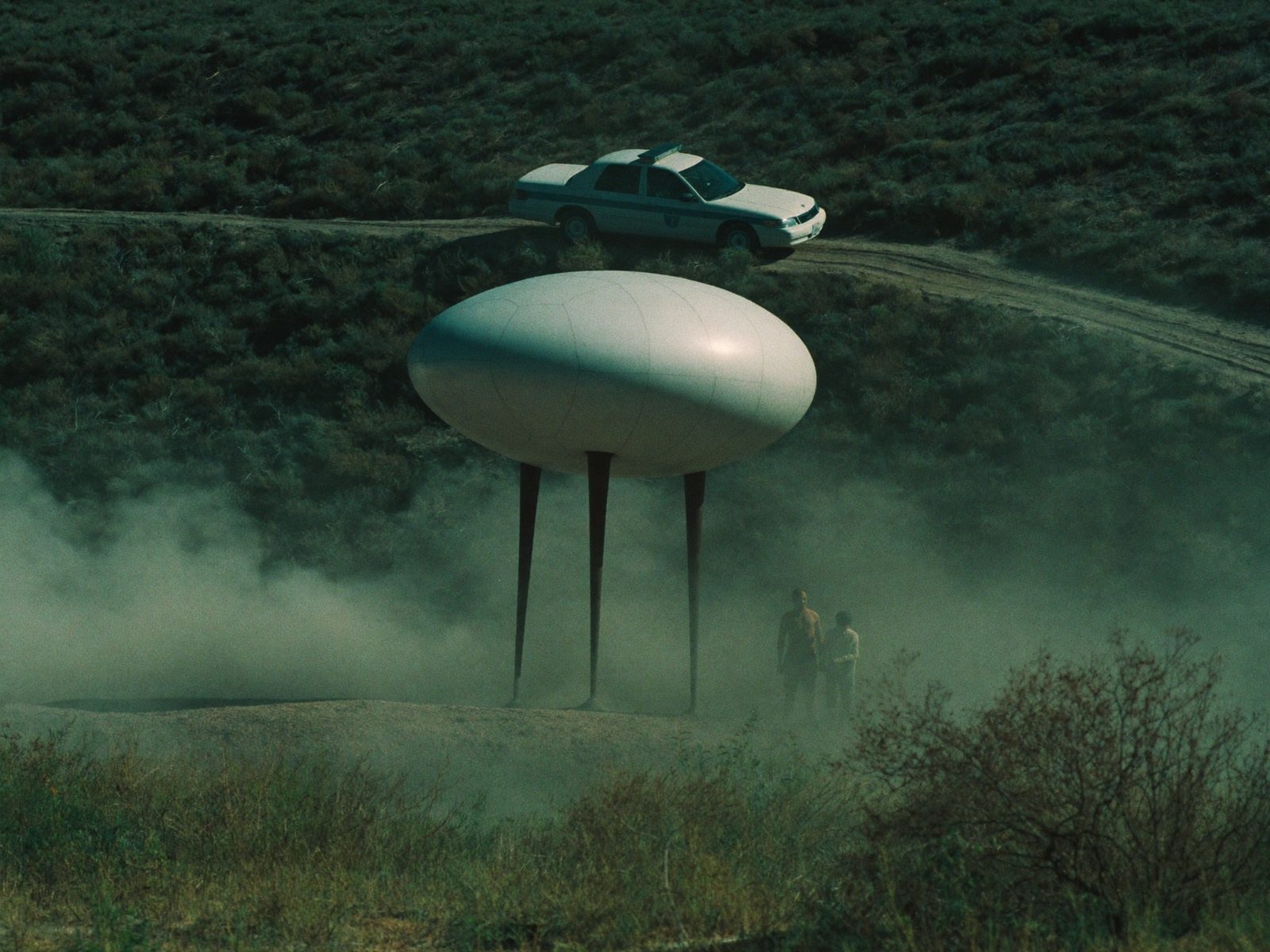
The fullest official version of his account is the one Major Hector Quintanilla, head of Project Blue Book, printed in 1966. Zamora drove slowly up a gravel track towards the flame, needing three attempts to climb a loose hill. From the top he saw a shiny object in an arroyo, perhaps 150 to 200 yards off, which he first took for an overturned car. Closer, it looked aluminium-coloured and oval, "like a football", standing on two legs that slanted outwards. Statements recorded by the FBI add two people in white coveralls beside it; the local newspaper, El Defensor Chieftain, reported that at that distance they looked small, "child-like".
He radioed in that he was checking a wreck, left the car and walked towards the object. A loud roar began and a bluish flame, orange at the bottom, appeared beneath it. Believing it was about to blow up, he ran, lost his sunglasses, and threw himself down behind the crest. When the roar stopped he heard a short whine, looked up and saw the object travelling away low and fast, clearing the dynamite shack by about three feet. He had noticed red markings on its side and drew the insignia on the spot before State Police Sergeant Sam Chavez arrived.
The evidence and where it is
The physical trace is what gives the case its standing. The FBI agent D. Arthur Byrnes Jr., who happened to be in Socorro, went to the site that evening. His memo of 8 May 1964 records four rectangular indentations, roughly sixteen by six inches and about two inches deep, with burned clumps of grass inside them and one burned patch outside. The Chieftain, whose editor photographed the site the next morning before crowds trampled it, gives the holes as about a foot long and six inches wide, and describes greasewood bushes seared "all at once". Undersheriff James Luckie and Chavez said the brush was still hot when they reached it.
No photograph of the object exists. Zamora's insignia sketch, the Blue Book case file and the FBI papers survive. The Blue Book records are at the US National Archives, read on microfilm publication T-1206. The newspaper's photographs and its 28 April 1964 report are held in its bound volumes and on microfilm in Socorro's libraries.
What investigators concluded
J. Allen Hynek, Blue Book's scientific consultant, visited at the end of April. The Chieftain dates his arrival to Wednesday 29 April. He found the ground "so trampled by the curious that little of scientific value could be obtained", but judged Zamora's account solid and not a hoax.
The Air Force checks were unusually wide. Quintanilla lists Geiger-counter readings, balloon and helicopter records, aircraft movements, radar at Holloman and Albuquerque, and enquiries to firms working on lunar vehicles. All were negative, and the soil and burned brush showed no foreign material or propellant residue. The case was carried as "unsolved" or "unidentified". Quintanilla wrote of Zamora: "He is puzzled by what he saw, and frankly, so are we." Byrnes, in a memo that states it contains no conclusions, called him "not given to fantasy".
The leading conventional explanation
The explanation most often put forward is a hoax by students at the New Mexico Institute of Mining and Technology. It rests chiefly on a 1968 note from the institute's president, the physicist Stirling Colgate, replying to Linus Pauling: "I have a good indication of the student who engineered the hoax." In its favour, Zamora had worked at the college before joining the police and is said to have been on poor terms with some students, and second-hand accounts from former staff point the same way.
Against it, no participant has ever been named, no method has been shown, and Colgate declined to say more. Even Robert Sheaffer, the sceptic who reviewed the claim in 2010, conceded that it is "difficult to see how they removed themselves from the scene" before Chavez arrived minutes later. Other readings remain in circulation. Philip Klass argued in 1968 for a town publicity scheme, and others have suggested a misperceived test of a lunar lander or an early hot-air balloon. None has been documented. The local historian Paul Harden has shown that one support for Klass's case, the claim that the site belonged to the mayor, is wrong.
What remains open
The marks and the burning were real and seen by several officers within minutes. Their cause was not established in 1964, and the samples showed nothing. Accounts of other witnesses conflict. Blue Book reported that none could be found, the Chieftain recorded a tourist who saw a low-flying craft heading for the gully, and the city's present account speaks of five tourists. Zamora gave few interviews in later life and died on 2 November 2009. His story did not change, and Blue Book's verdict still stands: an object it could not identify.
Sources
- The Investigation of UFOs (archived) — Hector Quintanilla Jr., Studies in Intelligence 10(4), CIA, 1966 (released 1993). Blue Book's account of the case, the checks made, negative laboratory results, and the "unsolved" verdict.
- FBI memorandum: Unidentified Flying Object, Socorro, New Mexico, April 24, 1964 (archived) — Special Agent D. Arthur Byrnes Jr., FBI file 62-HQ-83894, 1964 (Department of War release). Measurements of the indentations, burned patches, the insignia and the officer's reliability.
- The 1964 Socorro UFO Incident (archived) — Paul Harden, Socorro County Historical Society, 2008, reprinting El Defensor Chieftain, 28 and 30 April 1964. Newspaper photographs, hole sizes, Hynek's visit, the tourist witness, and the land-ownership rebuttal.
- Famous Socorro "UFO Landing" a Student Prank? (archived) — Robert Sheaffer, Skeptical Inquirer 34(2), 2010. The Colgate note, the student-hoax case and its weaknesses, Klass's theory, and Zamora's death.
- National Archives research guide: UFOs and Project Blue Book records (archived) — US National Archives, n.d. Where the Blue Book records are held (microfilm T-1206) and the project's closure.
- Socorro Landing: A UFO Story — City of Socorro, n.d. The town's official account, including the claim of five tourist witnesses.

 INDEPENDENT FIELD ARCHIVE