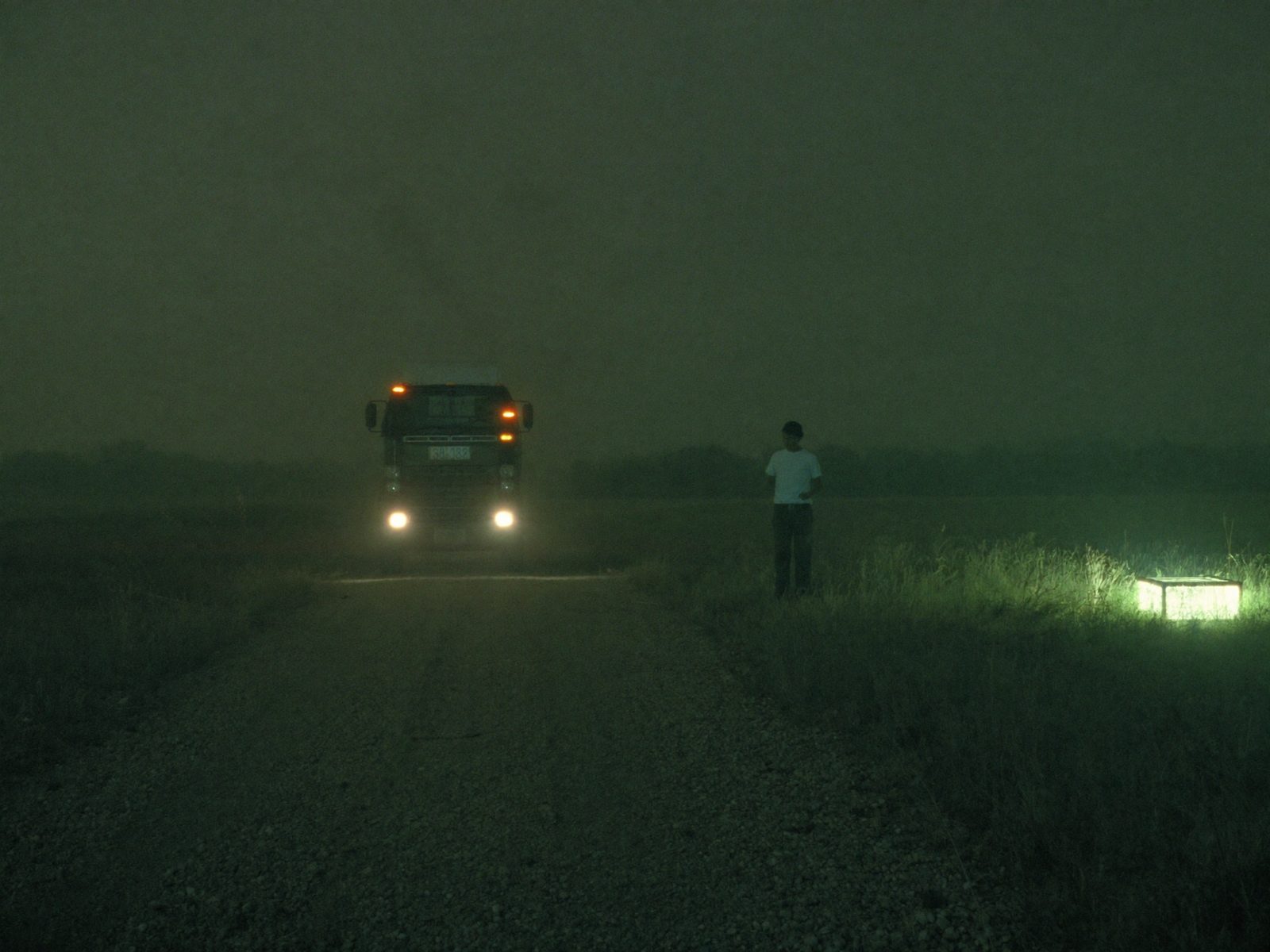
The drivers saw an illuminated object in a field about forty metres beyond the fence. As their truck came level with it it rose and crossed the road four metres above them, then came apart into two objects that left in different directions. That same month produced reports from Bahía Blanca's civil airport, pilots at the Espora naval air base and the Puerto Belgrano naval base.
The 1962 Bahía Blanca wave is the best-documented Argentine cluster, and still almost entirely a press record.
Three truck drivers on the road from Bahía Blanca to Jacinto Arauz; separate reports the same month from the civil airport and the Espora naval air base
Evidence
Contemporaneous press record; reported burnt grass, with soil analysed by the Universidad Nacional del Sur
Agency
See source record
Assessment
B · multiple witnesses, press record only
The full file
At about ten past four on the morning of Saturday 12 May 1962, a truck was travelling north on National Route 35 from Bahía Blanca towards Jacinto Aráuz, a town just across the border in La Pampa. Near kilometre 72, by the account published later that month, the men aboard saw a light in a field beside the road. They are named in the Argentine catalogues as Valentino Tomassini, Gauro Tomassini and Humberto Zenobi. It became a signature case of the month Bahía Blanca was called the country's flying-saucer capital.
What the drivers reported
The fullest version is the one Oscar Uriondo compiled from the 1962 press for a catalogue of Argentine landing reports published in Flying Saucer Review in 1972. The drivers first saw a single light, like a lantern, about 40 metres beyond the wire fence, brightening and fading in turn. As they slowed, a row of 20 to 30 lights came on, and they took it for a brightly lit railway carriage. When they were some 70 metres away the object rose, crossed the road four metres above them and went dark. A reddish flame came from its underside, with a soft hum, and it then divided into two parts that flew off in different directions. Bahía Blanca's paper later summed up their description as something "parecido a un vagón del ferrocarril", like a railway carriage.
The sources disagree. Uriondo and the Wikipedia list that follows him give three men in one truck. The researcher Carlos Ferguson, interviewed by the DIB news agency in 2021, describes four drivers in two vehicles who first took the object for a train or two buses parked together. The Wikipedia list puts the object about 100 metres from the road, against Uriondo's 40 metres from the fence. Ferguson adds a second sighting at 04:30 the same morning, in which one half of the object hovered over a car carrying four people and its glare injured one witness's eye. Only Ferguson has it.
It was a crowded fortnight. On 11 May Rear Admiral Eladio Vázquez and Captain Aldo Molinari reported a light at the Comandante Espora naval air base; on 21 May Miguel Tohmé of La Nueva Provincia photographed a luminous object over the city; Espora pilots and the Puerto Belgrano naval base reported more.
What evidence exists
There is no photograph of the Route 35 object and no instrument record. What survives is press reporting: La Nueva Provincia, which printed a drawing made from the drivers' account, and the Buenos Aires and Córdoba dailies La Nación (24 May) and Los Principios (25 May), which Uriondo cites. None has been found in an open online archive.
The case also has a physical claim. According to Uriondo, grass at the landing place was burnt over an area 60 metres across, with damp, lead-coloured patches. When later analysed at the Universidad Nacional del Sur in Bahía Blanca, these patches were found to be calcium carbonate and potassium carbonate. Ferguson gives the same findings, though he describes the burnt area as 60 metres in radius rather than in diameter. No laboratory report has been published, and the result is known only through the press. A 1962 clipping quoted by La Nueva in 2021 adds that drivers saw scorched remains on the ground and that technicians from Puerto Belgrano and the national atomic energy commission took part. It is not clear from that report whether the clipping concerns this site.
What investigators concluded
No official finding is on record. Papers collected by a Navy officer's family show the Navy approving a standard questionnaire for pilots' sightings in March 1963, a step taken after the wave. A civilian group, CEFORA, has asked the Navy for its 1962 files under Argentina's freedom-of-information law. According to reports in 2021 and 2024, the Navy has not acknowledged that such files exist, and Navy sources have said many records from the period were lost in a fire. The government record of the month most often cited, an AFP wire item in CIA files that La Nueva reported in 2016 as newly declassified, concerns the 21 May photograph, not Route 35.
The conventional explanation
The leading explanation, not formally proposed by any investigator but implicit in the drivers' own first reading, is misidentification. On this view the men saw a lit vehicle, most plausibly a train, and the sighting was then shaped by the excitement of a wave. A railway branch from Nueva Roma, near Bahía Blanca, served Jacinto Aráuz, the road's destination. A row of 20 to 30 lit windows at night is close to what a passenger train looks like, and the drivers said so. Reports in a wave also draw on one another.
The weakness is that the train does not fit what followed. The drivers described the lights crossing the road above them and the object dividing in two, and the burnt grass and residues are not explained by a passing train. No one is recorded as checking the timetables or the track's position at kilometre 72.
What remains open
The disputed points are basic ones: how many witnesses there were, how far away the object was, and whether a second car saw it. The soil analysis is known only from newspaper reports, and the original press reports have not been republished in full. Claims made since 2019 of a crash near Puerto Belgrano rest on anonymous or late testimony and should not be read back into this case.
Sources
Preliminary Catalogue of Type 1 cases in Argentina — Oscar A. Uriondo, Flying Saucer Review Case Histories no. 12, 1972. Names, time, kilometre 72, distances, the soil analysis, and the citations to La Nación and Los Principios.
Corrected The full file: The AFP item about the 21 May photograph had been described as released by the CIA in 1978; La Nueva's 2016 report says only that the CIA had recently declassified it, and the text now says that.
Corrected The full file: The text said Ferguson gives the same figures for the burnt grass as Uriondo; Uriondo gives an area 60 metres in diameter and Ferguson a 60-metre radius, and the text now notes the difference.
Corrected The object sat about forty metres beyond the fence, not a hundred metres off the verge.
Corrected The same month's other reports came from Bahía Blanca's civil airport and from pilots at Espora, a naval air base; the file previously described Espora as an air base.
Corrected The evidence is now reported burnt grass, with soil analysed by the Universidad Nacional del Sur; the file previously cited a page-one photograph taken nine days later.
Corrected The note no longer cites a 1965 scramble of three Meteors, since the research on that case found no scramble took place.
Sources The source on file is now a 2021 DIB article on the May 1962 Bahía Blanca wave rather than an encyclopedia article.
Added The full file, a long-form write-up with its sources, added.

 INDEPENDENT FIELD ARCHIVE