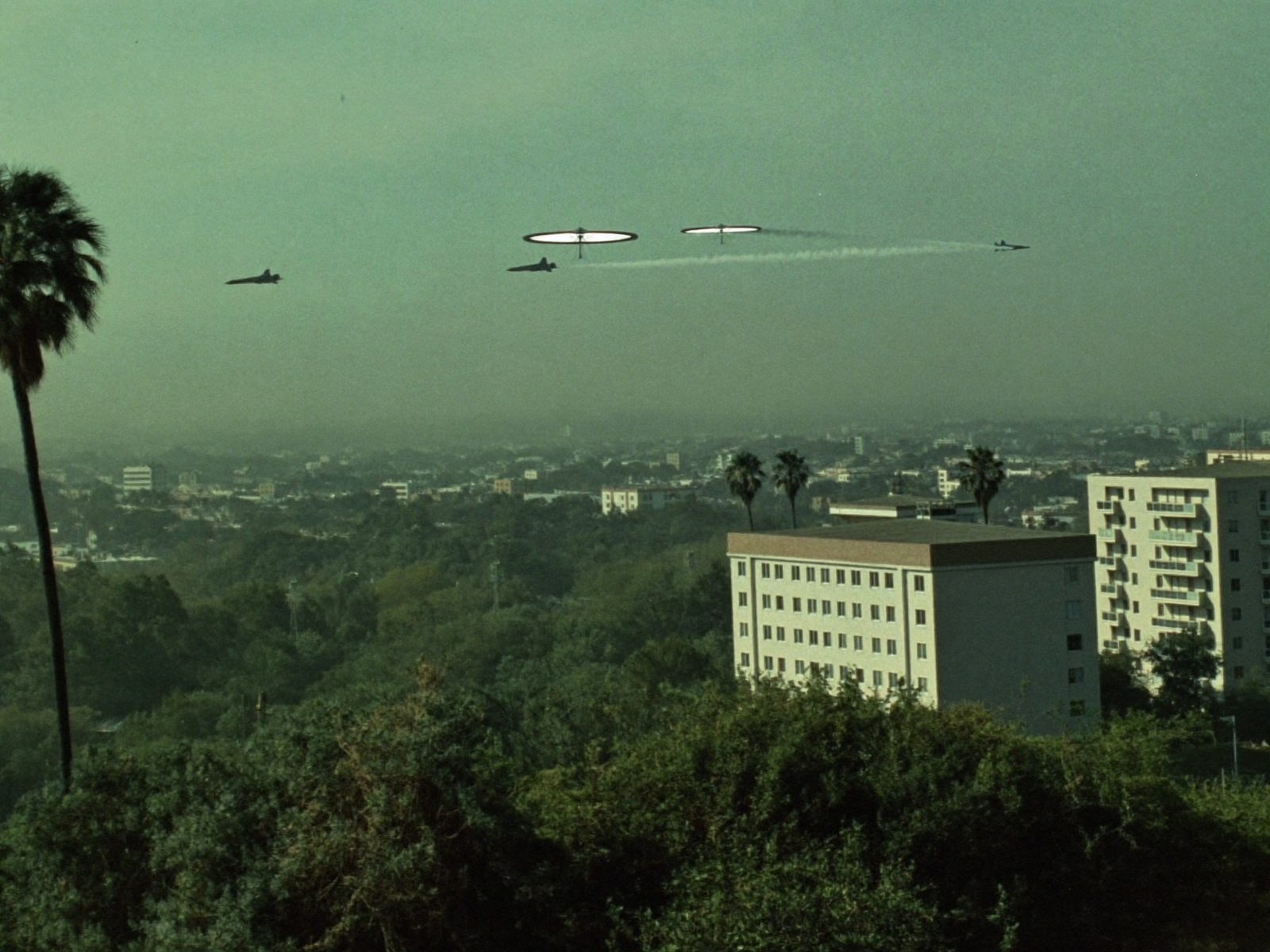
Two bright lights hung low over the capital at dusk for about fifteen minutes while a crowd and the press watched, then turned north-west and faded. Three Gloster Meteors already flying night exercises were asked to look and found nothing. No Air Force file survives; the case rests on the press. The positions and setting times of Venus and Mercury that evening match the reports.
The aircraft were asked to look. The evening sky had already answered.
A civilian crowd and the press in Buenos Aires; three Gloster Meteor crews already on night exercises
Evidence
Press photographs, civilian witnesses on the ground, and wire reports of the aircraft's search
Agency
Argentine Seventh Air Brigade
Assessment
D · a planetary explanation fits
The full file
On the evening of Friday 16 July 1965, in the middle of a month of "platos voladores" reports across Argentina, Buenos Aires watched lights in the western sky. A United Press dispatch filed the next day said witnesses broadly agreed that the lights appeared at about 18.30 and were gone by about 19.00. Nearly all the staff of the newspaper El Mundo saw the lights, as did two air force officers who happened to be visiting the newsroom, and the paper's photographer photographed them from the terrace of the Editorial Haynes building. A young man in Martínez saw two objects through binoculars, flashing red, violet and sometimes blue. Neighbours in Villa Pueyrredón said the objects "oscilaban horizontalmente", and a guard at the presidential residence at Olivos was also named as a witness. Most accounts put the lights still for about fifteen minutes, rocking gently, before they turned towards the north-west and faded.
The air force's part comes from the same dispatch. Prompted by repeated calls from residents, the Seventh Air Brigade at Morón had three aircraft already flying night exercises make "observaciones directas", and the result was "totalmente negativo". The duty officer, a Comandante Villalba, said the base had no equipment able to detect such an object, only "un radar de corto alcance" for landing jets. He confirmed that the aircraft were Gloster Meteors but insisted it had been "un vuelo de rutina". The Meteors in this case's title are those aircraft. No astronomical meteor is part of the record, and a meteor could not have hung in the sky for a quarter of an hour.
The photographs and the paper trail
The physical evidence is three time exposures taken by Carlos Ernesto Díaz, El Mundo's photographer, with a 38 cm telephoto lens. According to the later catalogue entry, the exposures lasted 70, 80 and 100 seconds. The newspaper printed them on 17 July. United Press sent one out as a radiophoto, captioned as two "discos blancos" that hung still for about ten minutes and then left "a gran velocidad". The caption also notes the long exposure of about a minute. That radiophoto ran on page 2 of the Santa Fe daily El Litoral on Saturday 17 July 1965 under the headline "Se observaron extraños objetos voladores sobre la Capital Federal". The page survives in the Hemeroteca Digital of the Archivo General de la Provincia de Santa Fe. This archive could not establish where the original negatives are now.
No Argentine Air Force file on the night has been published. The air force's present-day aerospace identification centre began, as a commission, only in 2011. Its public reports start in 2015. For now the military side of the case rests on one press statement by a duty officer.
What was concluded
At the time there was no official finding beyond the negative sortie. The same UPI report said the Observatorio de Física Cósmica at San Miguel had seen nothing abnormal in the sky. It also repeated a rumour that the Canal 13 television channel had cut its broadcast for "inconvenientes técnicos" at the moment of the sighting, and treated it as corroboration. Nobody followed that rumour up.
The fullest later review is by Vicente-Juan Ballester Olmos in his FOTOCAT catalogue of the year's Argentine UFO photographs. It adopts the Argentine analyst Juan Carlos Victorio Uranga's identification: the "objects" were Venus and Mercury, low in the west-north-west after sunset. Ballester Olmos also notes that El Mundo printed the three plates out of their true order.
The leading explanation: two planets at dusk
The planetary explanation fits the record closely. Argentina kept clocks four hours behind Greenwich in July 1965, with no summer time in force. NASA JPL's Horizons ephemeris puts Venus at about 5° above the horizon at 18.30 local time, at azimuth 294° and magnitude −3.9, far brighter than any star. Mercury, at magnitude +0.4, sat about two degrees higher and slightly to its left. Venus set at about 19.01 and Mercury about nine minutes later. That matches the witnesses' half-hour, the drift to the north-west and the lights sinking out of sight behind the buildings almost exactly. Two lights that close together suit both the binocular sighting and the two images on the plates. Flashing colours are typical of a bright planet seen through thick air near the horizon. Trails on a 70–100 second exposure are what the sky's own rotation produces.
The weaknesses are smaller. The "high speed" departure appears in the wire caption, not in the witness statements, which describe a slow turn and a fade. Mercury at magnitude +0.4 in city twilight is faint, which fits the many witnesses who reported a single light. The catalogue entry itself doubts the stated timing of the three exposures, so the plates cannot be timed precisely.
What remains open
The planets account for the main event. They do not account for everything reported that night. FOTOCAT lists a photograph from Ituzaingó at 19.30 and another near the Obelisco at 22.40, both taken after Venus and Mercury had set. The catalogue offers the Moon or camera movement for the first and no explanation for the second. Whether Morón actually diverted aircraft in response to the calls is also disputed. The press described a response, while the duty officer called the flight routine. Without an air force file, the sortie cannot be confirmed beyond one quoted officer, and nothing in the public record shows what the crews were told to look for.
Argentina, the Year 1965 in Photos (FOTOCAT Report #2) — Vicente-Juan Ballester Olmos, c. 2006. Photographer, camera and exposure details, the misordered plates, the other 16 July photographs, and Victorio Uranga's Venus–Mercury identification.
JPL Horizons ephemeris system(archived) — NASA Jet Propulsion Laboratory, queried 2026. Positions, magnitudes and setting times of Venus and Mercury seen from Buenos Aires on 16 July 1965.
UFO sightings in Argentina(archived) — Wikipedia, consulted 2026. Used as an index to the El Litoral citation; it dates that issue to 16 July, but the issue is dated 17 July.
Corrected The full file: The UPI report does not say El Mundo's staff watched from the roof; it says nearly all the staff saw the lights, with two visiting air force officers, and that the paper's photographer took his pictures from the terrace of the Editorial Haynes building. The text now says that.
Corrected The verdict is now explained, probably Venus and Mercury, rated D rather than unresolved at B: the planets' positions and setting times that evening match the reports, as Victorio Uranga identified.
Corrected The three Gloster Meteors were already on night exercises and were asked to look; there was no scramble from Morón, as the file previously said. The title and subject have changed to match.
Corrected Two lights hung low at dusk for about fifteen minutes, then turned north-west and faded; the file previously gave two discs for ten minutes, leaving at high speed. No Air Force file survives.
Sources The source on file is now El Litoral of 17 July 1965, carrying the UPI dispatches, rather than an encyclopedia article.
Added The full file, a long-form write-up with its sources, added.

 INDEPENDENT FIELD ARCHIVE