The full file
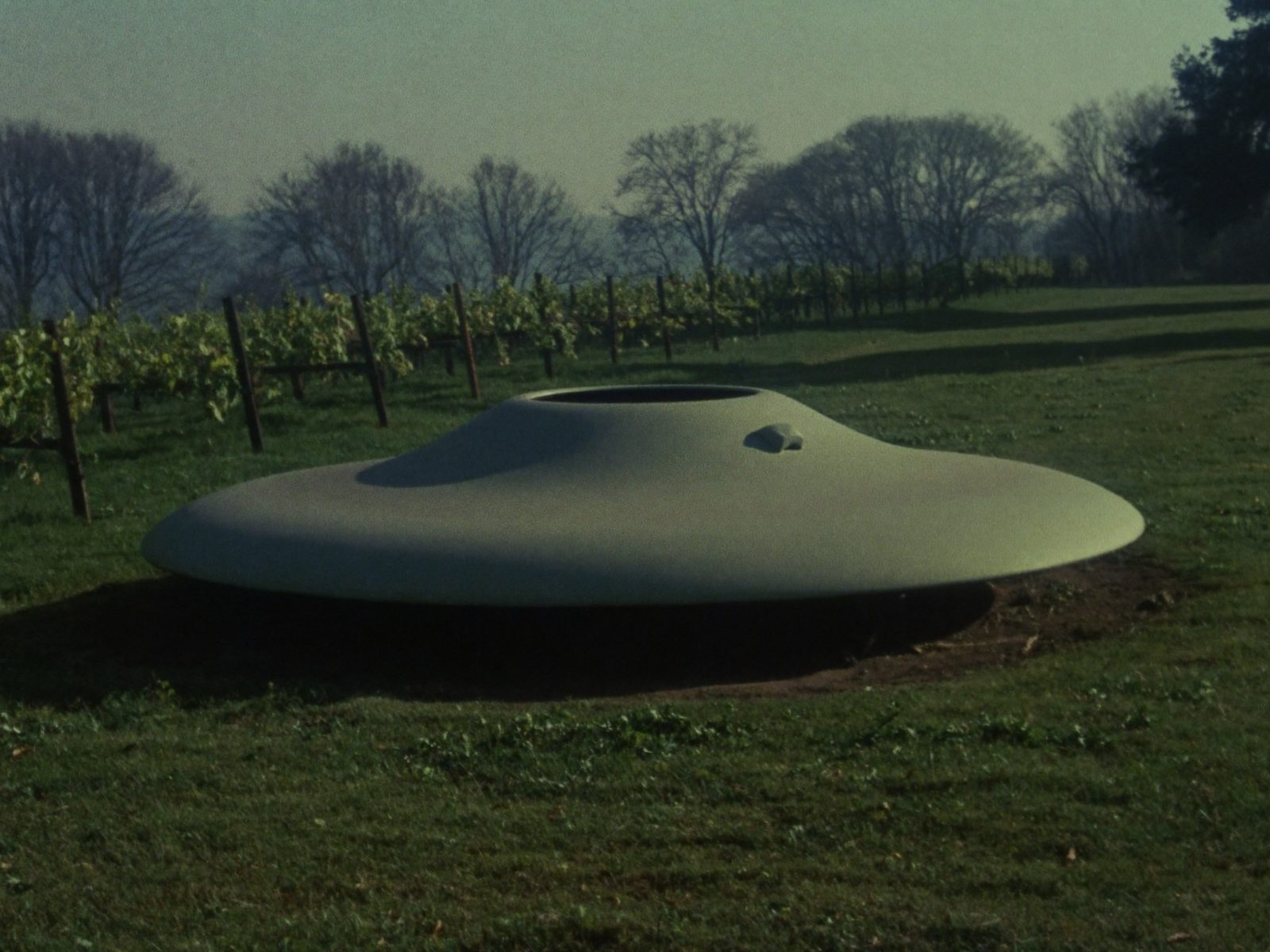
At about five in the afternoon on Thursday 8 January 1981, Renato Nicolaï, a former mason, was building a small cement shelter for a water pump on his hillside property outside Trans-en-Provence, in the Var. He said a light whistling made him turn, and he saw a small craft come down between two tall trees onto a terrace below his house, rest there a few seconds, then lift off and leave over the woods towards the north-east. He described two plates set rim to rim, the whole thing "la couleur du plomb", the colour of lead, with a ridge around its edge. The next morning he showed his wife marks on the ground, and neighbours called the gendarmerie. His age is given as 55 by L'Express and as 52 by the sceptical authors Rossoni, Maillot and Déguillaume.
What he reported, and to whom
The account shifted between tellings. The gendarmerie's telex of 9 January has the object descending to about a metre from the ground and lifting off without raising dust, seen from about 50 metres for roughly a minute, about 3 metres across. In GEPAN's later reconstruction it touched down, stood still for a few seconds and was watched from between 30 and 70 metres, for 30 to 40 seconds in all; Nicolaï now put it at 2.5 metres across and 1.7 to 1.8 metres high. GEPAN itself noted that the ratio of width to height varied widely between his sketches. GEPAN thought he may have read it at once as an unknown military machine, and the critics say he later suggested as much; one of France's largest training camps, Canjuers, lies to the north.
The evidence and where it is held
Gendarmes from Draguignan visited on the morning of 9 January, photographed the marks, took a soil sample and plant samples, and closed their procedure on 5 February 1981. Their first telex described two arcs, each about 80 cm long and 10 cm wide, "ressemblant à des traces de ripage de pneumatiques", resembling tyre-skid marks. The written report drew them as part of two concentric circles 2.2 and 2.4 metres across. Heavy rain fell on 10 and 11 January. GEPAN, the unit of the French space agency CNES, did not go to the site until 17 February, forty days on, when it took a further eight plant samples along a line from the mark. Soil went to several laboratories; the wild alfalfa went to Michel Bounias, a biochemist at INRA, the national agricultural research institute, in Avignon. The gendarmerie file and GEPAN's report, Technical Note 16 of 1 March 1983, are published by GEIPAN, CNES's present unit.
What the investigators concluded
The soil laboratories found a compacted crust, curved scoring, a thin iron deposit, traces of zinc and phosphate, and black particles that one laboratory read as combustion residue and another as possibly a primer paint based on carbon black. They judged that any heating had not exceeded 600 °C. Bounias reported that pigments in the alfalfa nearest the mark were reduced by 30 to 50 per cent, with larger losses in some carotenoids, and that several changes varied with distance from the centre. He suggested an electrical field might be involved.
The note's own conclusion was guarded. The ground did not allow a precise figure for mass, pressure or heat, and the possible interpretations were "trop diverses et vagues", too varied and vague, to confirm the witness. The analyses did, it said, point to "un événement de grande ampleur", an event of some magnitude, at the spot. It ended that the inquiry raised more questions than it answered. GEIPAN's catalogue lists the case as unidentified (category D). Later claims were firmer than the note: GEPAN investigator Jean-Jacques Velasco is recorded as putting the craft's weight at four to five tonnes, later at 500 to 700 kilograms.
The conventional explanation
The leading explanation is a vehicle: wheels skidding as it turned on the terrace, the reading the gendarmes first gave. Rossoni, Maillot and Déguillaume, in a 2007 critique of CNES's case files, set out the case for it. Two arcs about 80 cm long fit a tyre better than the landing feet Nicolaï described. Carbon black, zinc and phosphate are ordinary ingredients of tyres. Vehicle tracks ran from the access path into the marked area, and an outbuilding had been put up about twenty metres away in the previous month, which meant vehicles, materials and cement on site. The plant samples were few, taken on different dates along a single line from a centre fixed by eye, from a trampled path; the site had been walked over by visitors, and some plants were described as crushed. Michel Figuet proposed a cement mixer in 1985. The weakness of this explanation is that no one tested it: no tyre was matched, and no cement was looked for in the samples. The plant chemistry also lacks a demonstrated ordinary cause.
What remains disputed
GEPAN's note does not mention the tyre comparison, and it calls that part of the property rarely used; the critics say vehicle tracks were plain in photographs. The note's "under 600 °C" became, in later retellings, "heated to 300–600 °C", which the critics argue the analysis never supported. Whether Bounias's gradients record a single event on 8 January or local conditions on a worked plot of land is unsettled. Nicolaï's own story, the only account of a craft, changed from a hover to a landing within weeks.
Sources
- Note technique no 16: Enquête 81/01, analyse d'une trace (archived) — GEPAN, CNES, 1983. The witness statements, timeline, sampling, laboratory and biochemical results, and the note's conclusion.
- Gendarmerie telex and procès-verbal, Trans-en-Provence, January 1981 — Gendarmerie nationale, via the GEIPAN archive, 1981. The first telex: hover at one metre, 50 metres, tyre-skid comparison; procedure closed 5 February 1981.
- Les OVNI du CNES, chapter 13: Trans-en-Provence (archived) — David Rossoni, Éric Maillot and Éric Déguillaume, 2007. The vehicle explanation, the sampling critique, the outbuilding, and Velasco's changing mass estimates.
- Une soucoupe dans le jardin (archived) — Bruno D. Cot, L'Express, 2007. The witness's age and occupation and the case's standing.
- Affaire de Trans-en-Provence (archived) — French Wikipedia, consulted 2026, used as an index only. The category D listing and the Figuet critique.

 INDEPENDENT FIELD ARCHIVE