A Safe Air crew reported lights around their Argosy and Wellington radar agreed. Nine nights later a television crew flew the same newspaper run for background footage and got most of it in colour on 16 mm. The lights tracked the aircraft, above, below and ahead of it. A government science briefing on the case was submitted to the United Nations in January 1979.
Squid boats off the coast are the best candidate for the lights. The radar is the loose thread.
Two cargo crews, a three-person television crew, and Wellington air traffic control
Evidence
Colour 16 mm film, air-traffic radar tracking, and a government science briefing submitted to the United Nations in 1979
Agency
New Zealand civil aviation, the DSIR and the RNZAF
Assessment
A · instrumented (film + radar)
The full file
In the early hours of 21 December 1978, the crew of a Safe Air Armstrong Whitworth Argosy, a four-engined cargo aircraft flying newspapers down the east coast of New Zealand's South Island, reported unexplained lights around their aircraft off the Kaikōura coast. Ten days later a television crew flew the same run and filmed lights in colour. The argument over what they filmed has never quite closed.
Two nights over the Kaikōura coast
The first sightings were made by Captain Vern Powell and First Officer Ian Pirie. Most accounts give their route as Blenheim to Christchurch; a 2024 magazine account has it as Wellington to Christchurch. The crew saw lights near the aircraft, and controllers at Wellington reported unidentified returns on their radar at the same time. The Wellington controller, John Cordy, later said in interviews that a target tracked the aircraft for some 20 to 30 miles; in another account he put it at forty.
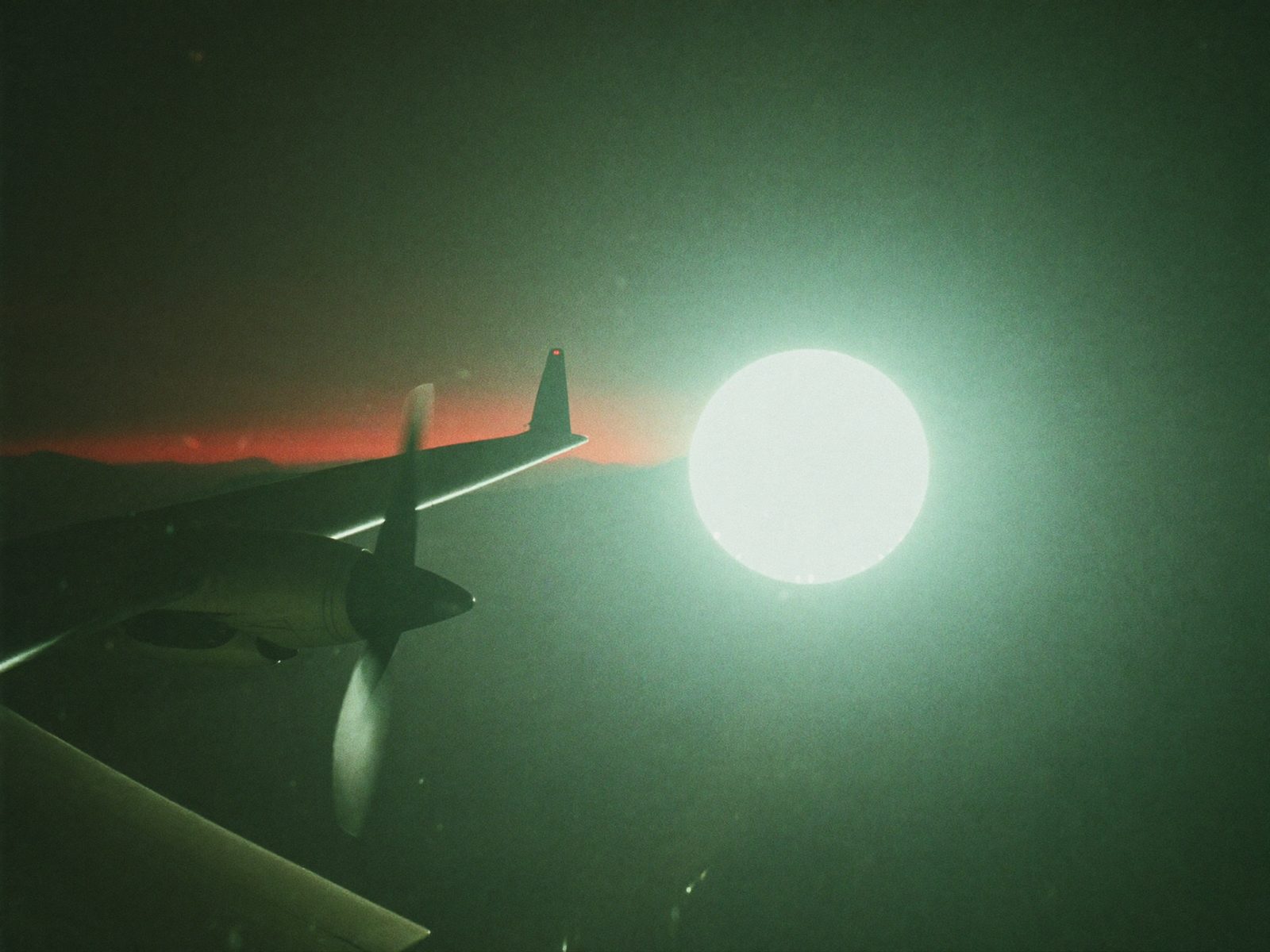
Melbourne's Channel 0 asked its reporter Quentin Fogarty, on holiday in New Zealand, for a short item on the sightings. He hired a Wellington cameraman, David Crockett, whose wife Ngaire ran the sound recorder, and arranged to ride the Safe Air newspaper flight from Wellington to Christchurch late on 30 December, with Captain Bill Startup and First Officer Bob Guard. Lights were seen on the way south. Ngaire Crockett stayed behind in Christchurch, and a TV1 journalist, Dennis Grant, took her place for the return leg. The aircraft left Christchurch at 2.16 am on 31 December. Between about 2.19 and 2.33 am, as it climbed out over Pegasus Bay, the crew watched a bright light off the right side that seemed to keep pace with them, and Crockett filmed it. The footage was shown worldwide in early January 1979.
The film, the tapes and the files
The evidence is unusually complete: 16 mm colour reversal film shot at ten frames a second through 100 mm and 240 mm lenses, Fogarty's commentary on audio tape, Grant's pencilled notes, the recorded exchanges with Wellington control, and the Argosy's own radar, which was in ground-mapping mode and showed a return like that of a large ship near the position of the light. Crockett's documentary UFO: A True Story (1979) is held by Ngā Taonga Sound & Vision; parts of the original film also appear in the BBC's 1982 Horizon programme. No public archive lists the original reels.
The official papers are with Archives New Zealand. The Defence Force released a redacted dossier in December 2010, with the originals sealed; the Otago Daily Times gave the restriction as lasting until 2050, while ABC News reported that some files are closed until 2080. Separate files from New Zealand's post at the United Nations, reported by RNZ in 2021, include a briefing from the Department of Scientific and Industrial Research (DSIR) submitted to the UN in January 1979.
What investigators concluded
The Royal New Zealand Air Force file, as reported on release, blamed a mix of causes: unusual propagation of radio and light, an unusually bright Venus, spurious returns on the Wellington radar, and the lights of a squid fishing fleet, cars and trains. Wing Commander J. B. Clements concluded that "almost all the sightings can be explained by natural but unusual phenomena". The DSIR briefing to the UN was more guarded: the objects remained "UFOs until identified", and the prospect of extraterrestrial intervention being proved was "regarded as extremely remote".
Bruce Maccabee, an optical physicist at the US Naval Surface Weapons Center, studied the film and interviewed the witnesses for the New Zealand UFO Studies Centre. In Applied Optics in August 1979 he calculated a very bright source and called it unidentified. Two DSIR scientists, William Ireland and Mark Andrews, replied in the same journal that the brightness fitted a squid boat in Pegasus Bay; Maccabee answered in 1980.
The leading explanation: squid boats
The leading conventional explanation is that the 31 December light was the deck lighting of one or more Japanese squid boats on the sea, seen from above on a dark night. Squid boats carry rows of very bright lamps, and the fleet was working New Zealand waters that summer; by Maccabee's account the co-pilot saw the fleet that night, some 130 nautical miles east of Christchurch. In 2000 Ireland re-examined the parts of the original film reproduced in the BBC's 1982 Horizon programme. He argued that Maccabee had wrongly assumed the lens was always set at 100 mm, which understated the object's size, and that the images matched small groups of boats about 22 metres long, at a minimum range of roughly six kilometres.
The explanation fits the brightness, the season and the aircraft radar's ship-like return. Its weaknesses are Maccabee's: a search of fishing records found no boat reporting from Pegasus Bay; the crew, who knew the squid fleet, did not take the light for a boat; the film shows no reflection beneath the light; and the witnesses described it pacing the aircraft. Ireland's reply was that the film-makers never let the DSIR see the original.
What remains open
The radar is the loose thread. The Air Force's "spurious" returns sit beside controllers who still describe solid targets, and no released document records a technical study of the Wellington radar. The original film has never been independently analysed in full, so the dispute between Maccabee and Ireland rests on copies and on each man's reading of the lenses.
The case of the flying squid boat(archived) — Bruce Maccabee, c. 2000 (read via the Internet Archive). Witnesses, times, lenses, frame rate, and his case against the squid-boat explanation.
Ghost squid boats in the sky(archived) — Bill Ireland, New Zealand Skeptic, 2000. The focal-length critique, the boat-group estimate and the aircraft radar return.
UFO: A True Story(archived) — Ngā Taonga Sound & Vision catalogue, 1979. Crockett's documentary and where it is held.
Corrected The full file: Controller John Cordy's account of how far a radar target tracked the aircraft now gives both figures he has used: 20 to 30 miles in one interview and forty miles in another.
Corrected The full file: The DSIR quotation now matches the document as RNZ reports it: the prospect of extraterrestrial intervention being proved was 'regarded as extremely remote'.
Corrected The full file: The co-pilot's sighting of the squid fleet is now attributed to Maccabee, who places it some 130 nautical miles east of Christchurch.
Corrected The full file: Bill Ireland's 2000 re-examination used the film as reproduced in the BBC's 1982 Horizon programme, not a 2000 Horizon programme, and nothing supports calling him retired; the text now says so.
Corrected The full file: Ireland argued that Maccabee's assumption of a 100 mm lens setting understated the object's size, not that it inflated it; the text now says understated.
Corrected The full file: The two closure dates for the original files are now attributed: the Otago Daily Times (2011) gave 2050 and ABC News (2010) gave 2080 for some files; the Otago Daily Times report has been added to the sources.
Corrected The full file: The statement that the 2010 dossier was released under the Official Information Act could not be confirmed in the cited sources and now says only that it was released in December 2010.
Corrected The document at the United Nations was a government science briefing submitted in January 1979; the file previously said New Zealand's UN mission filed it. The film's length, given as nine minutes, has been dropped as unsourced.
Sources The source on file is now RNZ's 2021 report on the released government documents rather than an encyclopedia article.
Added The full file, a long-form write-up with its sources, added.

 INDEPENDENT FIELD ARCHIVE