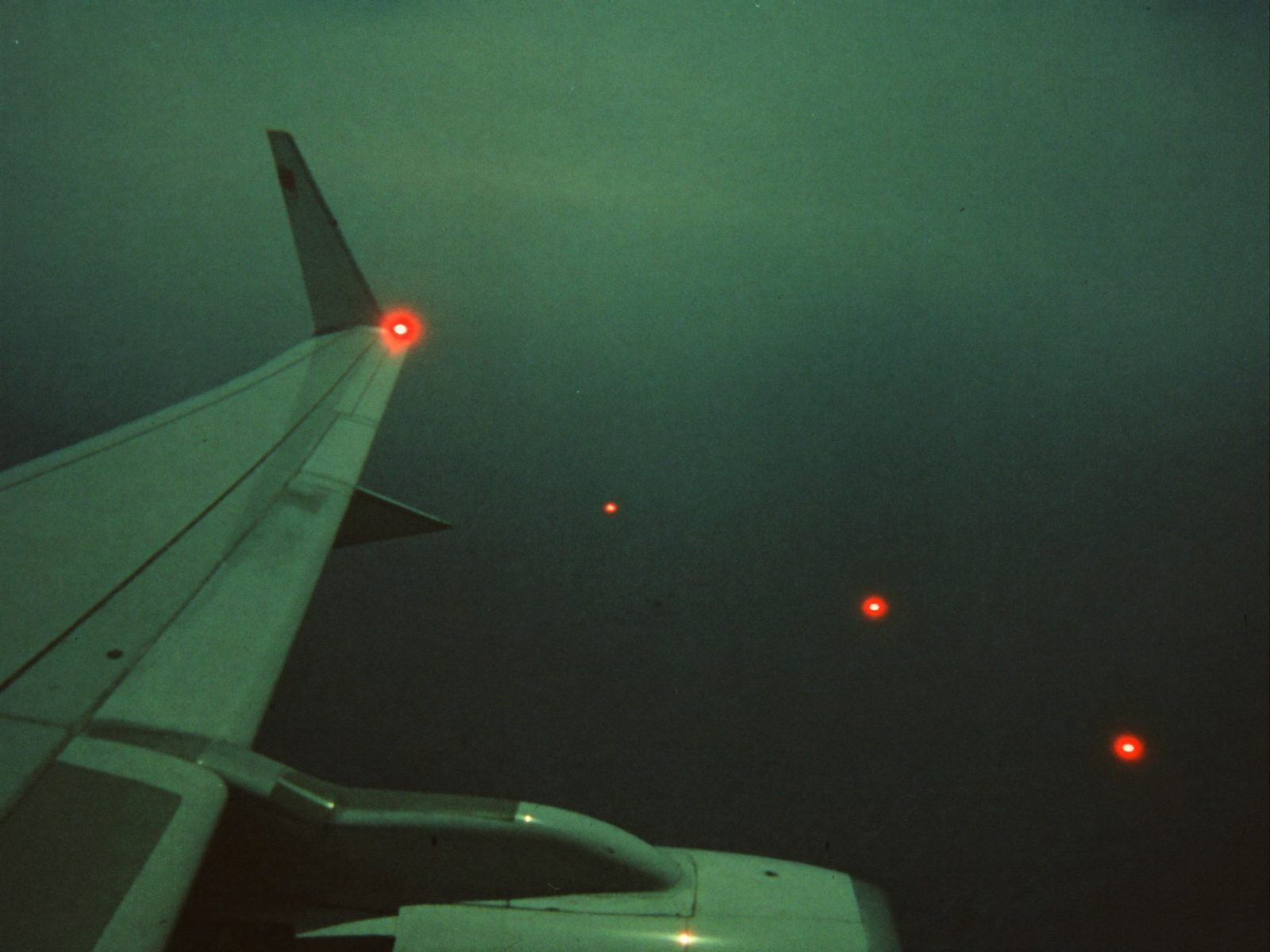
Red lights closed on the airliner over Ibiza, and neither military radar nor Barcelona control had anything that matched them. The captain changed altitude; the lights kept pace about half a mile away. He diverted to Manises, where three lights were seen from the ground; the 1979 investigation found that no radar ever held a confirmed contact.
First documented case of a commercial flight diverting because of a UAP.
The crew and 109 passengers of a Supercaravelle; a Spanish Air Force Mirage F1 pilot; airport personnel
Evidence
Barcelona control tapes, one military radar station's ambiguous returns, a Mirage intercept, and the Air Force file
Agency
Spanish Air Force, and the civil aviation authority
Assessment
B · multiple witnesses and an intercept; no confirmed radar contact
The full file
On the night of Sunday 11 November 1979 a Super Caravelle of the Spanish charter airline TAE, flight JK-297, left Palma de Mallorca for the Canary Islands with 109 Austrian and German holidaymakers on board. Their charter had begun in Salzburg. The captain was Francisco Javier Lerdo de Tejada; his co-pilot was Ramón Zuazu. Shortly after 23:00 local time, climbing out about 15 nautical miles south of Ibiza, the crew asked Barcelona control whether there was other traffic to their left. Barcelona said there was none. The crew described two intense red lights, at first three to five miles away, which seemed to close on the aircraft.
What the crew reported
The Barcelona tape, transcribed in the Air Force file, has the crew reporting two fixed red lights without flashing, and then the traffic climbing faster than they could. At one point they put it at less than half a mile and say it had dropped about 3,000 feet below them. The captain turned for Valencia. "Quiero tomar tierra en Valencia", he told control, adding that he did not like continuing with traffic that was following him. The aircraft landed at Manises at about 23:45; the 1980 parliamentary question gives 23:50. The Air Force summary records that the crew never saw an object behind the lights, and that the lights were lost as the airliner descended towards Valencia.
Speaking on Lanzarote two days later, Lerdo de Tejada was quoted by the Guardian: "I have never known such danger."
The night at Manises
After the landing, airport staff went outside and saw several unusually bright lights. The airport director reported three: one over the airport, one over the port and one towards Sagunto. At 23:26 UTC (00:26 local) the air defence command ordered a scramble of a Mirage F1 from Los Llanos air base at Albacete, flown by Captain Fernando Cámara; it was airborne at 23:40 UTC (00:40 local). The operations report written at Torrejón the next day says he chased white, then red, green and white lights without closing the distance, suffered repeated radio interference, and twice felt himself locked by a pulse radar. He landed at 01:07 UTC. Two controllers with binoculars also saw jet-like lights heading south at low altitude while the Mirage was elsewhere.
What the file holds
The Spanish Air Force file on the case, 147 pages covering Valencia, Motril and Madrid, was declassified on 11 August 1994 and is now online at the Ministry of Defence's virtual library. It holds the Barcelona transcripts, the Torrejón report, witness statements, a US letter of 15 November 1979 stating that no Sixth Fleet aircraft was airborne, and the report of the investigating officer at Manises, dated 28 November 1979.
On radar the file is thinner than the case's reputation. The Pegaso air defence radar tracked the Caravelle and nothing else. The Benidorm radar station's height discriminator reported up to five objects at 9,000 to 11,000 feet before losing them in clutter at the coast. The investigating officer states that there was no radar contact at any time in Pegaso, Barcelona control, the Valencia approach radar or the Mirage's own set. The Torrejón report says the Mirage pilot took film at some point; no film or photographs are in the released file.
What investigators concluded
The 1979 investigator treated the airliner's lights and the airport's lights as separate observations. The brightest light over the airport, he found, moved with the stars, and he accepted an astronomical body as the likely cause. For the crew's lights and the controllers' low lights he could find no source: he left all hypotheses open and wrote that the origin of the lights could not be established. In September 1980 the Socialist deputy Enrique Múgica tabled questions in the Cortes asking what had diverted the aircraft.
The conventional explanation
The fullest sceptical account is by the Valencian engineer Juan Antonio Fernández Peris, presented by the Fundación Anomalía on the case's twentieth anniversary in November 1999. He argued that the crew saw the flare stacks of the Escombreras refinery near Cartagena, made unusually visible by a strong temperature inversion on a night of exceptional clarity, and that their direction and angular separation fitted. He attributed the airport lights to stars and planets, and the Mirage's interference to electronic countermeasures from the US helicopter carrier Iwo Jima, then near the Columbretes islands.
Its strength is that it fits the file: no radar confirmation, a light that tracked the stars, an interceptor that never closed on anything, and the pilot's own remark that the interference matched what he had met near a US carrier during the CRISEX-79 exercise. Its weakness is that a fixed ground source must account for lights the crew reported changing bearing and height, closing to half a mile and dropping below them. The file is also divided on the ships: the US letter says no Navy carrier was near the area, while the 1979 investigator notes that the Iwo Jima was off Valencia and docked there the next day. Cámara has rejected the refinery explanation, saying in 2015 that he knew its flames well from the air.
What remains open
The crew's account of lights closing to half a mile and keeping pace with the aircraft has no instrument record to test it. Neither has the Benidorm return, which no one has explained. Details repeated in later retellings, among them a pursuit at Mach 1.7, do not appear in the documents released in 1994 and rest on later interviews.
'UFOs' force Spanish pilot to land — Bill Cemlyn-Jones, The Guardian, 1979, republished 2015. The captain's account two days later, and the charter from Salzburg.
Corrected The full file: An edit earlier on 10 October had turned the captain's words to Barcelona control into paraphrase; the Air Force transcript does record him saying "Quiero tomar tierra en Valencia", so the quotation has been restored.
Corrected The full file: The text now adds that the 1980 parliamentary question gives the landing as 23:50; the question does say 23:50, against 23:45 in the Air Force summary, and both are kept.
Corrected The full file: An edit earlier on 10 October presented the 00:40 Mirage take-off in later accounts as a disagreement with the file; the Torrejón report has the scramble ordered at 23:26 UTC and the jet airborne at 23:40 UTC (00:40 local), so the text now gives both times as consistent.
Corrected The full file: The text now dates Fernández Peris's study to its presentation by the Fundación Anomalía on the case's twentieth anniversary in November 1999, not to 2000; the Foundation's release confirms this and it is kept.
Corrected The full file: The captain's 'I have never known such danger' was said to have been given to the Guardian's correspondent in the Canaries; the Guardian report was filed from Madrid and quotes him speaking in Arrecife, Lanzarote, so the text now says he was quoted by the Guardian.
Corrected The full file: Later claims of three radar returns 200 metres across and a pursuit at Mach 1.4 could not be found in any cited source and have been removed; the Mach 1.7 claim, reported by ABC, remains as an example of later retellings.
Corrected The rating is now B rather than A: the 1979 investigation found that no radar ever held a confirmed contact, and the three 'returns' at Manises were lights seen from the ground.
Corrected The lights kept pace about half a mile from the airliner, not half a kilometre.
Corrected The 1979 investigator wrote that the lights' origin could not be determined; later proposals include stars, a refinery flare and a US aircraft.
Sources The source on file is now the Spanish Air Force file, declassified in 1994, in the Defence Ministry's virtual library, rather than an encyclopedia article.
Added The full file, a long-form write-up with its sources, added.

 INDEPENDENT FIELD ARCHIVE