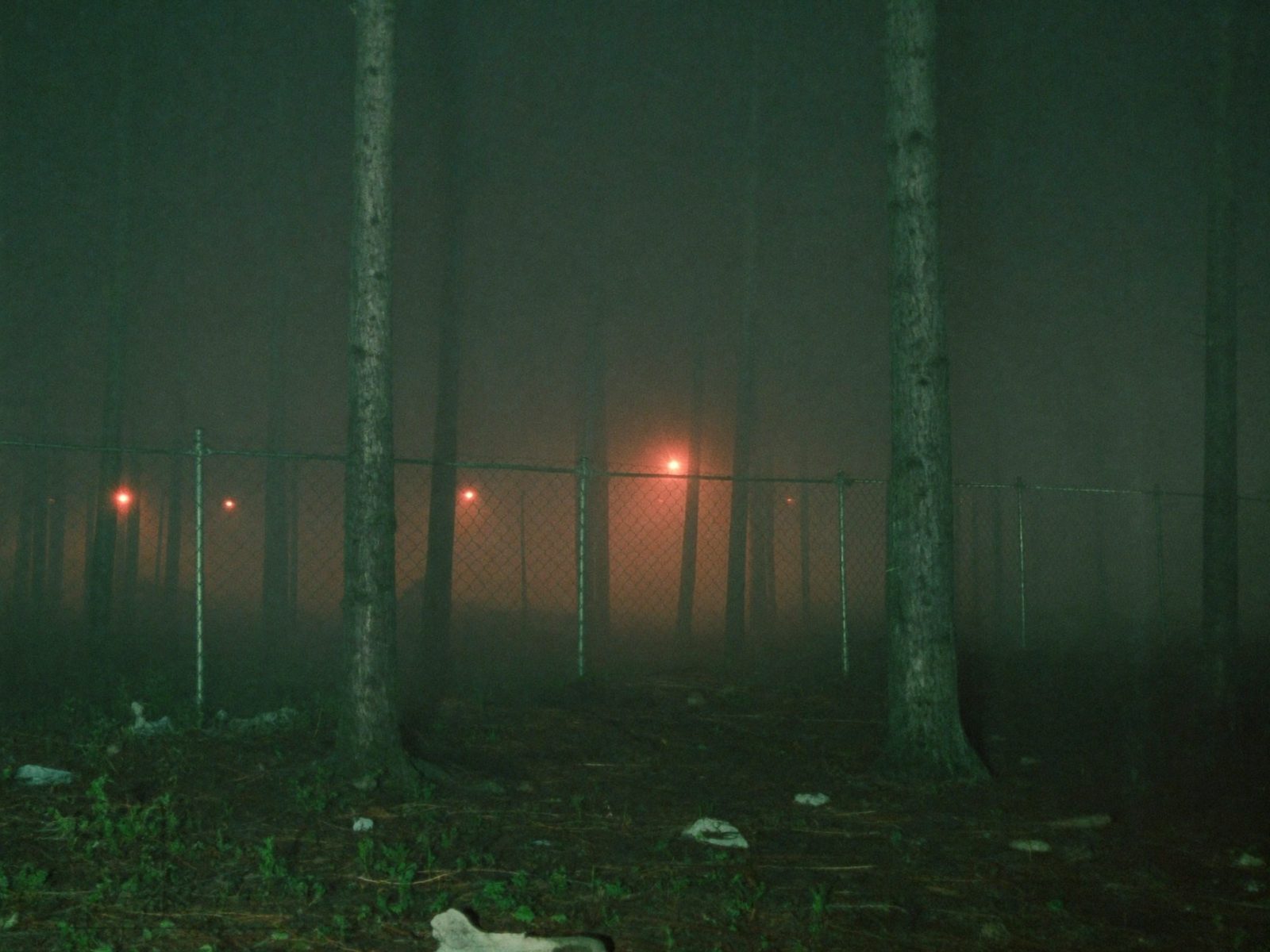
Lights came down into the trees beyond the perimeter. Two nights later the deputy base commander walked out with a team and a tape recorder; that tape is the most-quoted document in British ufology. The MoD's own file is at the National Archives; related defence-intelligence sighting files for 1980–82 were later lost, though most of what they held survives in it.
Orfordness lighthouse explains the pulse — five seconds, matching the tape. Not the ground traces.
USAF security patrols, then a party led by the deputy base commander, at a NATO base whose aircraft carried nuclear weapons
Evidence
A contemporaneous memo to the MoD, an eighteen-minute tape recorded on the second night, ground traces reported and photographed
Agency
UK MoD UFO desk, with US Air Force personnel involved
Assessment
B · documented, evidence incomplete
The full file
In the early hours of 26 December 1980, United States Air Force security police at RAF Woodbridge in Suffolk, a NATO base leased to the USAF alongside RAF Bentwaters, saw lights apparently coming down into Rendlesham Forest beyond the base's back gate. A small patrol went out on foot into the trees. Two nights later, in the early hours of 28 December, the deputy base commander, Lieutenant Colonel Charles Halt, led a second party into the same stretch of forest after reports that the lights had returned. The record is a short memo, a pocket tape, a police log and witness statements, surrounded by much later recollection.
What was reported
Halt's memo to the Ministry of Defence, dated 13 January 1981 and headed Unexplained Lights, describes the first night as patrolmen seeing a glowing object in the forest, metallic and triangular, roughly two to three metres across, which "illuminated the entire forest with a white light" and moved off through the trees as they approached. It records three depressions found the next day, 1.5 inches deep and 7 inches across, and on the later night a red, sun-like light that pulsed, appeared to shed glowing particles and broke into five white objects, followed by star-like objects in the sky to the north and south that showed coloured lights and, in the southern case, seemed to beam light down. Halt wrote from memory and got the dates wrong by a day each: the memo gives 27 and 29 December where the police log and later research place the events on 26 and 28 December.
The story became public on 2 October 1983, when the News of the World ran it on its front page.
The evidence and where it is held
The memo itself survives at The National Archives at Kew, in the Ministry of Defence file catalogued as DEFE 24/1948/1. The Archives describes that single sheet as its only record of the event itself; the other Rendlesham papers it holds are mostly later enquiries from the public and press. The USAF had released a copy to the American researcher Robert Todd in June 1983. The MoD file was released to the historian David Clarke in 2001.
Halt's tape was made on a hand-held micro-cassette recorder during the second night. It runs for just over eighteen minutes, switched on and off across several hours. It reached researchers in 1984. The written statements taken from the airmen after the first night came to light in 1997. Suffolk Constabulary's file, including its log of two calls from the base on 26 December, was released under the Freedom of Information Act in January 2005. Daylight photographs of the supposed landing marks, one showing a police officer at the site on the morning of 26 December, came to light in 2000 through the researcher Georgina Bruni.
What investigators concluded
Very little was investigated at the time. The MoD's UFO desk received Halt's memo and took it no further; no British official interviewed the witnesses. Radar logs from RAF Neatishead and RAF Watton showed nothing unusual. The department's settled position, repeated in answers to Parliament, was that the sightings were of no defence interest and posed no threat to UK airspace. The police officers who attended on the first night reported that the only lights they could see were from the Orford Ness lighthouse; an officer who examined the marks on the ground after a second call later that morning reported that they could have been made by an animal. A local forester, Vince Thurkettle, later identified the marks as rabbit diggings and the cuts on nearby trees as foresters' marks.
The leading conventional explanation
The fullest mundane account is the astronomer and writer Ian Ridpath's, first published in The Guardian in January 1985. It holds that three separate stimuli were misread in sequence. A bright fireball, reported to the British Astronomical Association at about 02.50 UT on 26 December, accounts for the first lights seen descending. The flashing light the patrols followed through the trees was the Orford Ness lighthouse, which flashed every five seconds; on Halt's tape the interval between one officer's "there it is again" and "there it is" is five seconds. The second night's star-like objects match Sirius, low in the south-west, and Deneb and Vega in the north. The radiation readings audible on the tape, three to four units with one brief spike, sit at background level.
Its strength is that each element rests on contemporaneous material: the tape, the police log, the forester's inspection. Its weakness is that it asks trained security personnel to have misread a coastal light on two nights, and it does not account for every first-night detail, notably the structured triangular object.
What remains unexplained or disputed
The object described on the first night has no agreed explanation beyond misperception. Some witnesses' accounts expanded greatly from the late 1990s, and those versions are disputed even among proponents. In March 2011 the BBC reported a gap in the released Defence Intelligence files covering the period; Clarke, who advised The National Archives on the release, said the lost files were general sighting reports for 1980 to 1982 rather than a Rendlesham file, and that their contents largely duplicated reports already held in the MoD's UFO desk files. A former Chief of the Defence Staff, Lord Hill-Norton, called the episode "puzzling and disquieting" in 1985. The paper trail is real but thin, and much of the case's fame rests on what was said afterwards.
Rendlesham Forest UFOs(archived) — David Clarke. Halt memo date, police calls of 26 December, radar logs, Thurkettle's inspection, MoD handling and file references.
UFO Files break records(archived) — David Clarke, 2011. The lost Defence Intelligence files of 1980–82 and their relation to the UFO desk files.
Corrected The full file: The National Archives describes its other Rendlesham files as mostly enquiries from the public and press; the text now uses that description.
Corrected The full file: The daylight photograph of a police officer at the landing site, taken on the morning of 26 December 1980, came to light in 2000 through the researcher Georgina Bruni, not in the MoD papers; the text now says so.
Corrected The full file: Clarke said the lost Defence Intelligence files largely duplicated reports held in the MoD's UFO desk files; the text and source note now say this rather than that they were duplicated in DEFE 24/1948/1.
Corrected The full file: The police remark that the ground marks could have been made by an animal came from an officer who examined them after a second call later on the morning of 26 December, not from the officers who attended in the night; the text now separates the two.
Corrected The Halt tape runs about eighteen minutes, not ninety.
Corrected The MoD's file is at the National Archives; what was lost were defence-intelligence sighting files for 1980–82, most of whose content survives in it. The file previously said the case file was missing its key pages.
Added The full file, a long-form write-up with its sources, added.

 INDEPENDENT FIELD ARCHIVE