land / Bluff Creek, California, and a locked safe in Washington State
The Reel In The Safe
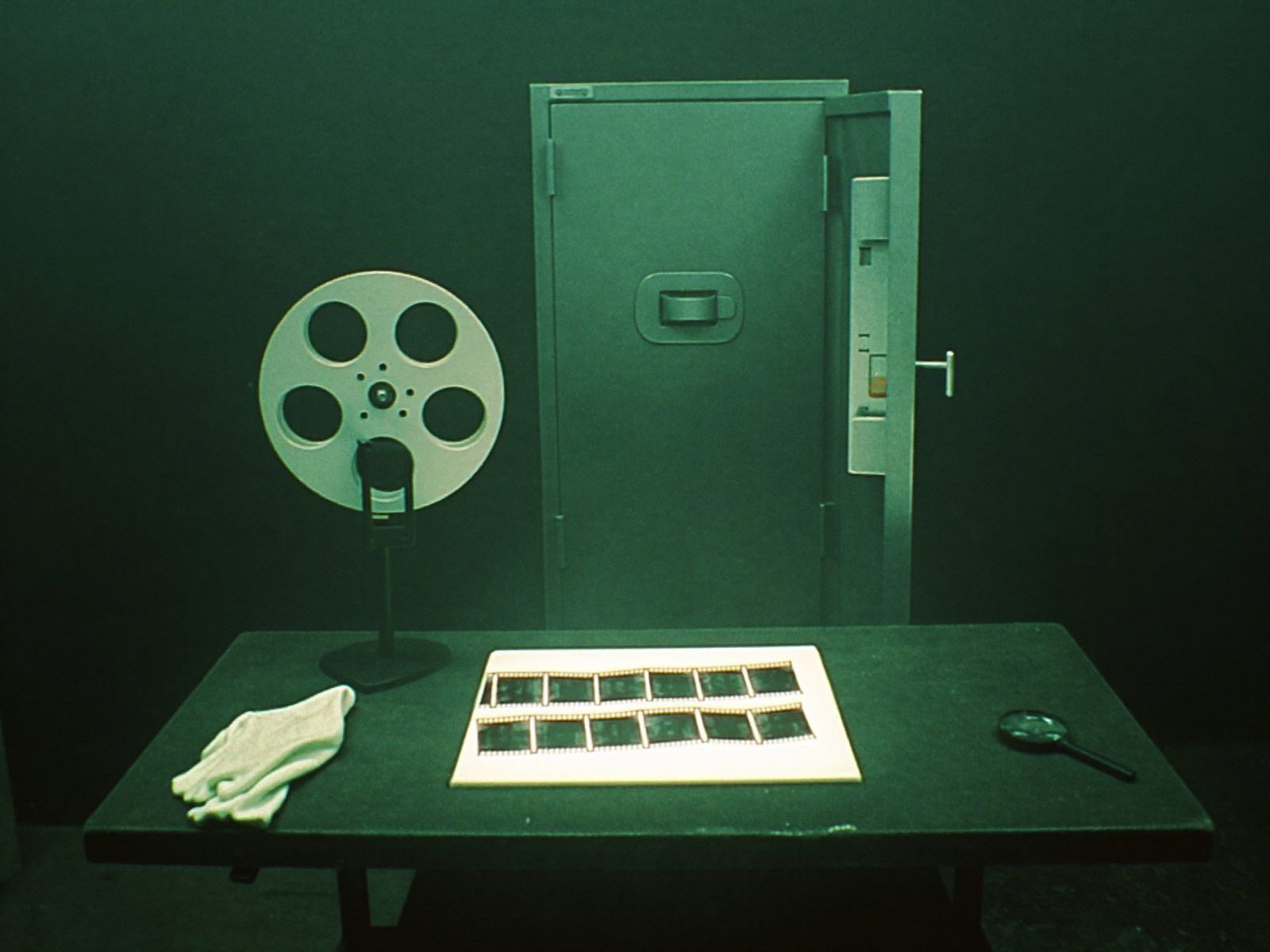
The most-cited fifty-nine seconds in this subject — a hairy figure walking away from a hand-held camera in 1967 — now has a second document beside it. After the man who ran Boeing's film department died — by one account, the man who developed the 1967 footage — his daughter found a reel in a locked safe. A documentary maker had it digitised and found a forty-second clip, produced and developed a year before the famous film was shot, showing a thinner figure walking through comparable woodland: in the film's own word, a rehearsal. The 1967 film-maker's son told the same documentary that he had learned from his mother that the whole sighting was a hoax; by one account she disowned him when he wanted to say so publicly. The case is not closed. A Hollywood special-effects artist, on camera, insists that the detail in the original cannot be faked, and qualified people have been making that argument for decades.
A hole in the provenance is not a specimen. It is still new material, and it came with a date on it.
AI illustration · imagined scene, not an evidence photograph
File
CR-0073
Date
12 March 2026
Place
Bluff Creek, California, and a locked safe in Washington State
Record
A film-maker's son; a film instructor; a special-effects artist
Evidence
A 1966 sixteen-millimetre reel showing a thinner figure on comparable ground
Agency
None
Assessment
C · contested
The full file
On 20 October 1967, by their own account, two men from Yakima, Washington, rode on horseback along Bluff Creek, a tributary of the Klamath River in Six Rivers National Forest in the far north of California, about 25 miles of logging road from the village of Orleans. Roger Patterson, a former rodeo rider who had been collecting plaster casts of large tracks in the region since the early 1960s, carried a rented 16 mm camera. With him was his friend Robert "Bob" Gimlin. Patterson filmed a large, hairy, upright figure crossing a sandbar and walking away into the trees; partway through, it turns its head and shoulders towards the camera. Sources place the site in Humboldt County or in Del Norte County; the spot itself was lost for decades and identified again by local searchers in 2011.
The film and where it is
The footage runs to 954 frames of Kodachrome II, about 59 seconds if the camera ran at 16 frames per second and about 53 seconds at 18. Patterson did not record the setting, so the speed is still argued over, and it matters: at different speeds the same figure walks differently. The camera original is missing. Bill Munns and Jeff Meldrum, writing in 2013, record that it was checked out of storage by someone claiming rights to it, never returned, and is "missing, whereabouts unknown"; every analysis since rests on copies of varying generation. Patterson's brother-in-law Al DeAtley, who toured the film round local auditoriums, was by most accounts the one person who did well from it; Gimlin had to sue for his share, and won in 1976.
What investigators concluded
No government agency examined the film, and scientific opinion has barely moved. Grover Krantz of Washington State University accepted it, arguing in 1999 that the film's grain was too coarse to show fine costume detail and that the gait fitted a very heavy biped. John Napier, formerly of the Smithsonian's primate programme, concluded in 1973 that the evidence pointed to a hoax of some kind. In the Skeptical Inquirer in 1999, David Daegling and Daniel Schmitt tested claims that the figure stood over seven feet and weighed nearly a ton, and found the measurements depended on unknowns about distance, lens and film speed; known measurement error and human locomotion data, they wrote, "suggest a more cautious conclusion." Daegling later showed that volunteers could learn the bent-knee walk, and said in 2004 that it was "definitely not a cheap carnival suit." On the other side, Munns, a Hollywood make-up and effects artist, and Meldrum, an anatomist at Idaho State University, argued in 2013 that the copies were neither edited nor too poor to analyse, and that the subject was an animal. That paper appeared in Meldrum's own journal, so it is the defence restated rather than an independent check.
The leading conventional explanation
The leading explanation is a man in a costume. It has two named claimants. Bob Heironimus, a Yakima acquaintance of both men, came forward in 1999 to say he had worn the suit, and was named in Greg Long's 2004 book The Making of Bigfoot. In 2002 Philip Morris, a North Carolina costume maker, said he had sold Patterson a gorilla suit by mail order in 1967. Its strength is that it needs nothing new: Patterson was already planning a documentary about the creature. Its weaknesses are as plain. Neither claimant has produced a suit, receipt or photograph; Long himself noted that the two men's descriptions of the costume do not match; and Gimlin has denied a hoax for nearly sixty years.
The 2026 re-examination
In March 2026 Marq Evans's documentary Capturing Bigfoot premiered at South by Southwest; it is due for release in the United States on 20 October 2026, the film's anniversary. It is built on a 16 mm reel that Teresa Brooks, an Olympic College film instructor, found in a locked safe after the death of her father, Norm Johnson, who was connected to Patterson and Gimlin through his brother. Accounts of Johnson's job differ: one has him running Boeing's film department and developing the 1967 footage, others say only that he worked in a film-processing laboratory. Brooks approached Evans in 2022 by one account, in June 2024 by another. Markings on the reel date it to 1966. It holds about 40 seconds showing a thinner figure in a fur suit walking through woodland, and, according to one report, Gimlin on horseback, in country that looks more like Washington than California. Evans calls it a trial run. Patterson's son Clint told the film he had learned years earlier from his mother that the sighting was faked, and that he had seen his father burn a suit.
What remains disputed
The 1966 reel shows that somebody close to Patterson filmed a costumed figure a year earlier. It does not show the 1967 subject, and a man in a suit in 1966 is not, by itself, the same suit in 1967. Munns, on camera, still maintains that no costume of the period could produce what the original shows. Meldrum, who died in September 2025, was filmed confronting the new material and conceding that "the simplest explanation is uncomfortable to arrive at." Gimlin, now in his nineties, is the one man from that sandbar still living. The original reel is lost and no suit has ever been produced. The film remains contested, now with a dated object beside it.
Sources
Is that a fastener on Bigfoot in film? — John M. Hubbell, Associated Press, Seattle Times, 1999. The 20 October 1967 date, the Six Rivers location, Krantz's defence of the film.
Bigfoot's Screen Test(archived) — David J. Daegling and Daniel O. Schmitt, Skeptical Inquirer 23(3), 1999. The critique of height, weight and gait claims.
Corrected The full file: Capturing Bigfoot had not yet been released when this was written; the text now says it is due for US release on 20 October 2026, with a source for the date.
Corrected The full file: Only one cited source dates Teresa Brooks's approach to Evans to 2022, and none gives June 2022; the text now gives 2022 by one account and June 2024 by another.
Corrected The full file: The claim that Clint Patterson's mother disowned him appeared in none of the cited sources and has been removed.
Sources The full file: Meldrum's death in September 2025 is now supported by a Boise State Public Radio report; the cited review said only late 2025.
Corrected That the film-maker's widow disowned her son for wanting to call the film a hoax now rests on one account and is marked as such; it was previously stated as fact.
Corrected Bob Gimlin is now said to have long maintained the film was real; the file previously said he was still alive, which could not be confirmed after March 2026.
Sources The source on file is now a Times-Standard report of March 2026 on the documentary, rather than an encyclopedia article.
Added The full file, a long-form write-up with its sources, added.

 INDEPENDENT FIELD ARCHIVE