land / Myakka River, Sarasota County, Florida, United States
The Letter To The Sheriff
In December 2000 a county sheriff's department received two photographs and a typewritten letter from someone who would not give her name. She said that in late September or early October the animal had been taking apples from her back porch, that it smelled appallingly, and, in her own framing, asked whether somebody was missing an orangutan. She put it at six and a half to seven feet tall, kneeling. That is the file's problem. At that height kneeling, the animal is about ten feet standing, and the largest male orangutans are around four and a half feet. She also stood within ten feet of it, noted that something that size could hurt a person, and took a second picture; she said it stood up after the second flash. No sample, no interview, and no follow-up by the sheriff's office. These remain the most reproduced skunk ape photographs in circulation.
This file holds an artefact and a postal address, not a sighting.
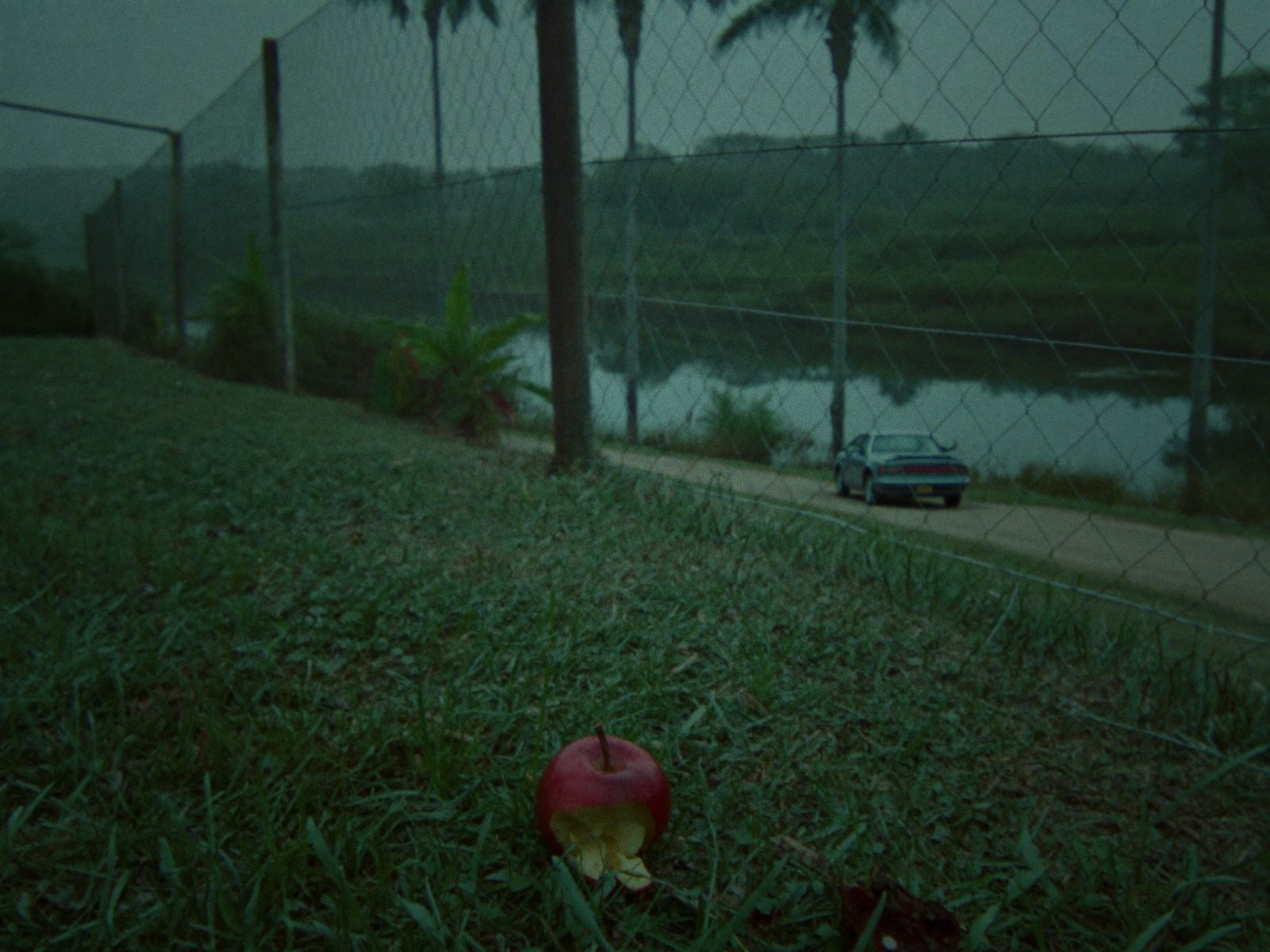
AI illustration · imagined scene, not an evidence photograph
File
CR-0070
Date
December 2000
Place
Myakka River, Sarasota County, Florida, United States
Record
An anonymous letter-writer, who could not be interviewed
Evidence
Two photographs and a typewritten letter
Agency
Sarasota County Sheriff's Department
Assessment
D · reported only, unusable chain of custody
The full file
Around the turn of 2001 the Sarasota County Sheriff's Office in Florida received an envelope containing two colour prints and a typed, unsigned letter. The letter is dated 22 December 2000 and closes "God Bless. I prefer to remain anonymous". Its writer describes herself as a senior citizen with grandchildren. She says that in late September or early October 2000 something took apples off her back porch on two nights, and that on the third night she went into the garden after hearing deep "woomp" noises and photographed it with a flash by the hedge at the back of the property. "My husband says he thinks it is an orangutan," she wrote. "Is someone missing an orangutan?" She says she did not see the animal when she took the first picture because it was too dark. After the second flash it stood up and moved off into the brush, and she judged it "about six and a half to seven feet tall in a kneeling position". She puts herself about ten feet from it when it stood. She mentions a lingering smell and says the family lives near Interstate 75. She asked that there be no "fuss or people with guns traipsing around" behind the house.
The letter, the prints and their trail
The sheriff's office did not treat the mailing as a wildlife case. According to the Tampa Tribune columnist Steve Otto, writing on 12 or 13 February 2001 (Coleman's records give both dates) from material the office had faxed to him, the letter was filed under "Suspicious Incident". He quoted a desk officer's report dated 18 January, which says an unusual anonymous letter addressed to the office's animal services had arrived with two photographs. The prints reached the wider world through David Barkasy, who ran a reptile business in Sarasota and saw them through a friend at the office. He passed scans to the cryptozoologist Loren Coleman, whose website published enlargements and an image of the typed letter in February 2001. The Sarasota Herald-Tribune ran the story on 12 February 2001, and other Florida papers followed. In July 2001 the East County Observer reported Barkasy's finding that the photographs had been printed in December 2000 at an Eckerd photo lab at Fruitville and Tuttle Roads in Sarasota.
In 2001 the original prints were with the sheriff's office. No source consulted for this file records where they are now. The letter writer was never identified, and no hair, track or other physical sample was collected.
What was concluded
The sheriff's office reached no published conclusion. Much of the local press treated the photographs as a joke; one Tampa Tribune caller suggested a Labrador with a fur coat draped over it. Coleman compared the head with a Sumatran orangutan and pointed to the eyeshine, teeth and hair as subjects for analysis. In the Orange Leader of 22 February 2001 he said "the jury is still out" and that the features were "very close" to an orangutan's. By July 2001 he was reported as believing the photographs showed neither a costume nor an escaped zoo animal. Public appeals to the photographer by both men went unanswered.
The fullest sceptical reading is Brian Dunning's for Skeptoid in 2023. He notes three features that do not fit any great ape: a black coat with a grey chin and upper chest, prominent lower fangs, and strong eyeshine, which in mammals comes from a reflective layer behind the retina that apes do not have. He accepts that the processing evidence places the photographs in Sarasota in autumn 2000, and concludes that the pictures cannot show whether the subject is even biological.
The leading explanation: a hoax with a suit or a model
The leading conventional explanation is a deliberate hoax: a person in a costume, or a model, photographed by flash in a garden. The anonymity, the absence of any physical trace and the anatomical oddities Dunning lists all support it. The orangutan the letter itself proposes does not fit: no escape was reported in the area, and the letter's own height estimate makes the animal roughly ten feet tall standing, more than twice the height of the largest male orangutans. The black-bear explanation, offered in general terms for skunk ape reports by the Bradenton Herald's outdoors writer in 2001 and by Joe Nickell in 2013, sits poorly with the face in these particular prints.
The hoax explanation has weaknesses too. Dunning reports that searches for a matching commercial costume have found none, so a suit would have to be custom-made. No one has confessed, and no prop has surfaced. The processing evidence fits the time and place the letter claims. The eyeshine argument is also less decisive than it appears. A flash close to the lens can produce a bright retinal reflection in eyes that lack a reflective layer, as red-eye in human snapshots shows.
What remains open
The subject of the photographs is unidentified. Sources differ on small points: the letter is dated December 2000, Dunning says it was received in 2001, and the desk report is dated 18 January. Dunning transcribes the noise as "whoop", while the letter reads "woomp". The writer's height figure is internally odd: she offers it while noting that the animal was crouched and half-risen, and while admitting it is hard to judge from the photographs. Without the photographer, the garden or the original negatives, none of this can now be tested.
Sources
The anonymous letter, image of the typed original — reproduced by Loren Coleman, 2001 (archived 2002). Date of the encounter, the height estimate, the ten-foot distance, the apples, the request for anonymity.
The Myakka "Skunk Ape" Photographs — Loren Coleman, 2001–2002 (archived). The letter's date of 22 December 2000, Barkasy's role, the scans from the sheriff's originals, and the East County Observer report of 12 July 2001 on the Eckerd lab.
Florida "Skunk Ape" photo news stories — compiled by Loren Coleman, used as an index to the 2001 press. The Sarasota Herald-Tribune (12 and 14 February), the Tampa Tribune (13 and 17 February, including the 18 January desk report and the "Suspicious Incident" filing), the Bradenton Herald (14 February) and the Orange Leader (22 February).
Hunting the Florida Skunk Ape(archived) — Brian Dunning, Skeptoid, 2023. Anatomical objections, the custom-suit point, and processing confirming Sarasota and autumn 2000.
Skunk Ape(archived) — Futility Closet, 2007. The height arithmetic set against the largest male orangutans.
Tracking Florida's Skunk Ape(archived) — Joe Nickell, Skeptical Briefs 23.3, 2013. The black-bear explanation for skunk ape reports in general; it does not discuss these photographs.
Corrected The full file: Dunning's description of the teeth now follows his wording: 'prominent lower fangs' instead of 'thin straight lower canines'. He describes them as both.
Corrected The full file: Coleman's records give Steve Otto's Tampa Tribune column two dates, 12 and 13 February 2001. The text now says so instead of giving 13 February alone.
Corrected The encounter is now dated late September or early October 2000, at her back porch rather than in the yard; December was when the photographs and letter arrived.
Corrected She said the animal stood up after the second flash; the file previously said she stayed long enough to take a second picture. 'No follow-up' now applies only to the sheriff's office, as independent researchers did follow up.
Added The full file, a long-form write-up with its sources, added.

 INDEPENDENT FIELD ARCHIVE