land / Skookum Meadows, Gifford Pinchot National Forest, Washington, United States
The Body In The Wallow
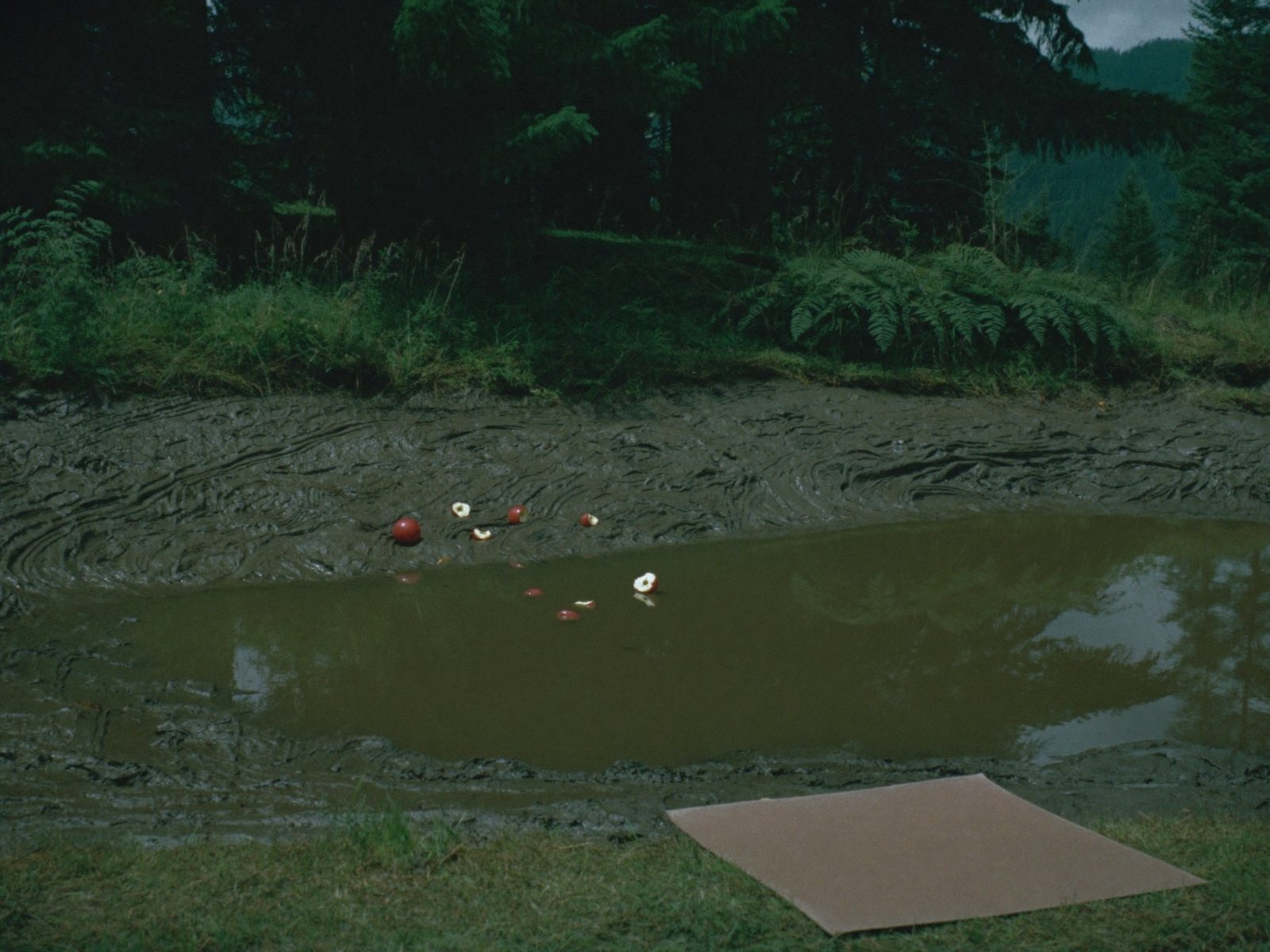
Fruit was left in a muddy wallow overnight and a body impression was found in it the next morning: a cast three and a half feet by five, weighing about four hundred pounds. No camera was left running. Several specialists, Jeff Meldrum among them, read it as the print of a large biped and reported ridge detail in what they took to be the foot area. What the record holds instead is this. Elk, deer, bear and coyote tracks were all over the site, and the hair recovered from the site was mostly elk, with some human hair and one disputed sample. The impression is read most simply as an elk lying at the edge of the wallow and reaching in for the fruit. The expedition's own diary notes its reasoning that the animal did not want to leave tracks — which is the one thing that cannot be true of an animal that has just left its body in the mud.
The finest body evidence in the literature returned the species whose footprints were already there.
AI illustration · imagined scene, not an evidence photograph
File
CR-0069
Date
22 September 2000 → 3 March 2001
Place
Skookum Meadows, Gifford Pinchot National Forest, Washington, United States
Record
An expedition crew, filming for television
Evidence
A three-and-a-half by five foot body impression; hair recovered from the site
Agency
None
Assessment
D · examined, best read as elk
The full file
In September 2000 the Bigfoot Field Researchers Organization (BFRO) spent a week in the Skookum Meadows area of the Gifford Pinchot National Forest in southern Washington, working alongside the crew of Animal X, an Australian television series filming a Bigfoot special. Accounts of the party name Matt Moneymaker, Thom Powell, Rick Noll and LeRoy Fish among others. For six days they played recordings of supposed vocalisations, tried pheromone lures and watched with thermal cameras. On the sixth evening fruit was left beside a muddy patch by a forest road. On the morning of 22 September, the seventh day, the group found an impression in the mud which they read as the print of a large animal that had lain on its side to reach the fruit. No camera had been left running overnight. Sources place the meadow near Mount Adams or near Mount St Helens; both stand in the same forest, and the difference is one of framing rather than fact.
The cast and where it is
The party cast the impression that day, using about 200 pounds of casting material reinforced with tent poles. The finished block measures about three and a half by five feet and weighs roughly 400 pounds. Proponents describe in it a forearm, a hip and thigh, buttocks, a heel and an Achilles tendon. Hairs were collected from the mud during casting and later cleaning. The cast has never been in an institutional collection. In January 2002 Outside reported it was being kept in a relative's garage in a Seattle suburb, in Noll's care. A 2011 skeptics' podcast reported it as jointly owned by Noll, Derek Randles and the estate of LeRoy Fish, and said that BFRO's founder had refused a request from sceptical researchers to examine it. Its present custodian is not documented in any source this file could open.
What examiners concluded
The cast was shown to a succession of specialists, nearly all of them already engaged with the sasquatch question. Jeffrey Meldrum of Idaho State University led the cleaning and analysis; Grover Krantz, John Bindernagel, John Green and Ron Brown were named alongside him. Meldrum told National Geographic in 2003 that "the anatomy doesn't jive with any known animal", and his 2006 book records a "unanimous consensus" that the cast could very well be a sasquatch body imprint. He and the fingerprint examiner Jimmy Chilcutt also described ridge detail in what they took to be the heel. Daris Swindler, a primate anatomist at the University of Washington who called himself a doubter, told Outside the imprints were "certainly not of an elk or bear or anything we know of". Esteban Sarmiento of the American Museum of Natural History went further, attributing the cast to a descendant of Gigantopithecus. Krantz is recorded in more than one way: later summaries list him as a believer, while Outside in 2002 quoted him as undecided between elk and sasquatch. Chilcutt himself, interviewed in 2010, called the ridge detail on this cast inconclusive.
The elk lay
The leading conventional explanation is that an elk made the impression, lying at the edge of the wallow and stretching its neck towards the fruit. On 3 March 2001 Mark Hume, writing in Canada's National Post, pointed to clear elk tracks at the site and argued that the impression matched an elk's legs and hindquarters. The naturalist Anton Wroblewski later compared photographs of the cast with reclining elk and found the shape consistent. The expedition's own record supports the setting: elk, deer, bear and coyote tracks were found around the wallow, and Fish recognised elk hooves in the mud even while he could not account for the forearm and heel. The hair points the same way; most of what was collected was reported as elk. The independent researcher Matt Crowley showed that fine ridge-like texture can form as casting material dries, which weakens the ridge detail as an argument for a primate.
The explanation's strength is that it needs nothing absent from the site. A body print with no footprints is what a large herbivore leaves when it lowers itself to feed and rises again, and the party's own reasoning that their animal had avoided leaving tracks becomes, under this reading, a description of ordinary elk behaviour. Its weakness is that no one has published a formal side-by-side study of the cast against a known elk lay, and the experts who handled the block mostly rejected it. That objection is partly self-inflicted: the specialists who did not already lean towards a sasquatch were never given access.
What remains disputed
The hair is the most unsettled point. Skeptoid's account says Henner Fahrenbach, who examined the samples, reported one hair resembling those in his collection of supposed sasquatch hair. A 2011 skeptics' podcast reports Fahrenbach recalling nothing of compelling value in them, and adds that human hairs were among those recovered. No laboratory report has been published. The anatomical reading rests on the same handful of proponents, the cast has never been independently examined, and the original wallow is long gone. The elk reading remains the simplest account of a site already covered in elk tracks.
Sources
Skookum cast(archived) — Wikipedia, used as an index. Date, dimensions, weight, the Animal X context, the expedition diary's track list, and the citation of Hume in the National Post, 3 March 2001.
The Skookum Cast(archived) — Blake Smith, Skeptoid, 2014. Expedition members, casting material, the named examining team, Sarmiento, Meldrum's 2006 book, Fahrenbach and the hair, Crowley's drying ridges.
Corrected The full file: An earlier unrecorded pass dropped the month from the Outside article's date; the article is dated January 2002, and the text again says January 2002.
Corrected The full file: Crowley showed that ridge-like texture can form as casting material dries, which weakens the ridge detail as evidence for a primate rather than removing it entirely; the text now says 'weakens'.
Corrected The hair recovered was mostly elk, with some human hair and one disputed sample; the file previously said it was reported as elk. Several specialists, Jeff Meldrum among them, backed the biped reading, not two.
Sources The source on file is now Skeptoid's 2014 episode on the cast, replacing a newspaper and book citation linked through an encyclopedia article.
Added The full file, a long-form write-up with its sources, added.

 INDEPENDENT FIELD ARCHIVE