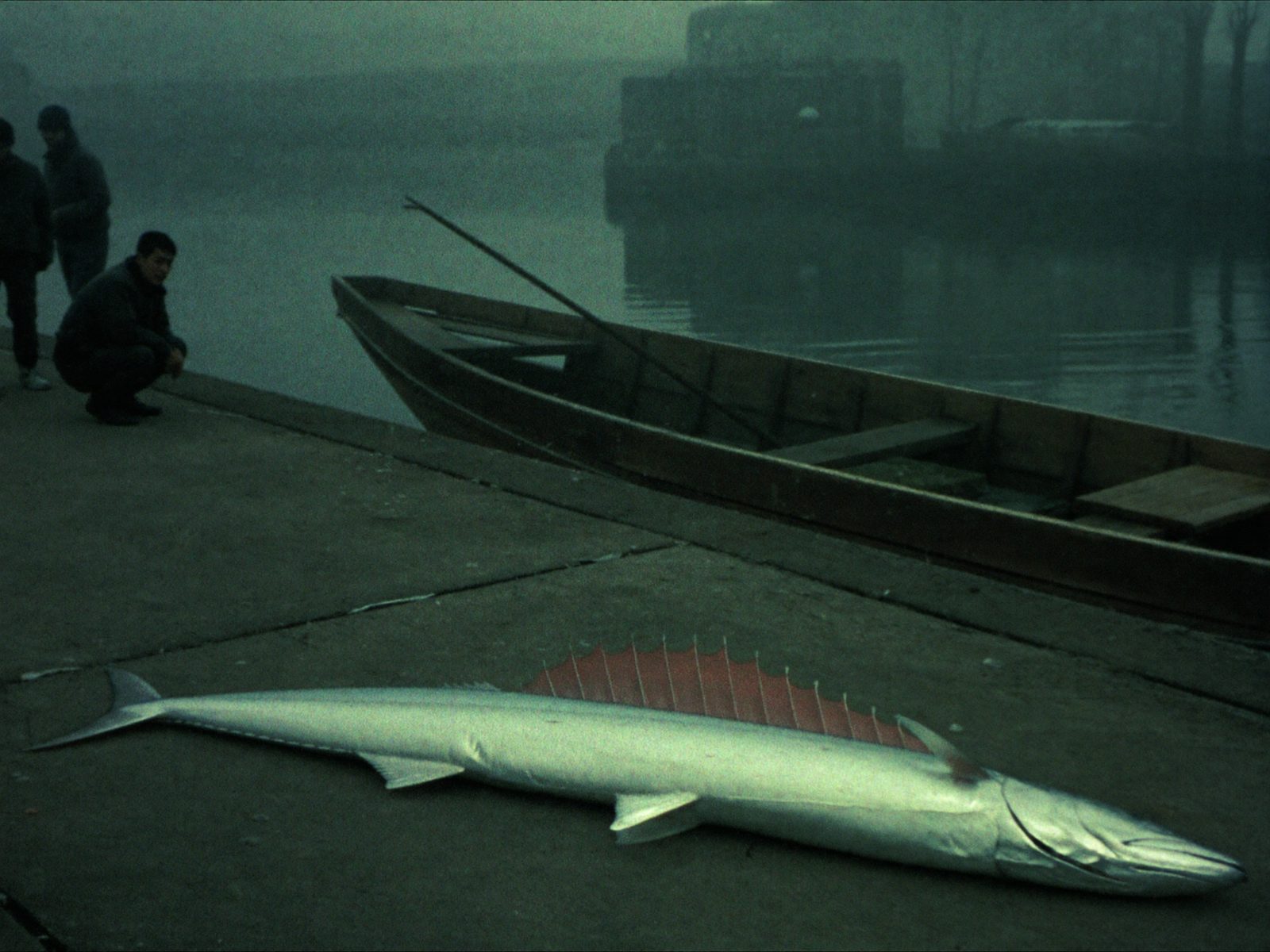
At least a dozen oarfish came ashore on the Japanese coast in late 2009 and 2010. Folk belief — recorded in an eighteenth-century collection of mystery stories — holds that the oarfish, Ryugu no Tsukai, is a messenger of the sea god and warns of earthquakes, and after March 2011 the strandings were read as a premonition of the Tōhoku earthquake. Researchers catalogued 336 deep-sea fish appearances from 1928 to 2011 against 221 earthquakes of magnitude 6.0 or greater. One event was plausibly correlated, and the paper's conclusion is that the association cannot be confirmed.
The fish is real. The warning is a story about a fish.
AI illustration · imagined scene, not an evidence photograph
File
CR-0042
Date
Strandings 2009–2010; claim tested 2019
Place
Japan, mainly the Sea of Japan coast
Record
newspaper records across nine decades
Evidence
336 recorded appearances tested against 221 earthquakes
Agency
Bulletin of the Seismological Society of America
Assessment
A · real animal; the omen fails its test
The full file
In the winter of 2009–2010 an unusual number of oarfish turned up along the coasts of Japan, caught in fixed nets or washed ashore dead. The fish is known in Japanese as ryugu no tsukai, "messenger from the sea god's palace", and an old saying holds that it comes to the beach before a large earthquake. At the time, the strandings were treated as a curiosity. After the magnitude 9.0 Tōhoku earthquake of 11 March 2011 they were reread as a warning that had gone unheeded, and the belief became the subject of a formal statistical test.
What was reported
The fullest contemporaneous account is a Japan Times report from Toyama dated 6 March 2010. It recorded one fish on the beach at Kurobe in December 2009, two more in nets off Takaoka and Nyuzen early in 2010, four washed up on Chirihama beach in Ishikawa Prefecture in January and February, and ten found in fixed nets at Miyazu, Kyoto Prefecture, over the New Year holiday. Further fish were reported from Iwate, Hyogo, Shimane, Yamaguchi and Nagasaki. Most of these places are on the Sea of Japan coast rather than the Pacific. Yoshiaki Kai of Kyoto University's Maizuru Fisheries Research Station told the paper: "I have never heard of so many of them coming up like this."
Later counts vary. CBS Los Angeles in 2013 gave "over a dozen", CNN's Japanese edition in 2019 said more than a dozen within the year before the earthquake, and a 2013 LiveScience article quoted a marine scientist as saying about twenty had stranded "shortly before" it. None of these later figures cites a list, and the Japan Times tally alone already exceeds twenty if the Miyazu catch is counted.
The evidence and where it is held
The evidence is the fish themselves and the newspaper record of them. The animal is not in doubt: the Japanese encyclopedia Nipponica identifies ryugu no tsukai as Regalecus russelii, a ribbon-shaped deep-water fish living at roughly 200 to 1,000 metres and reaching several metres in length, though it notes that some specialists treat Japanese fish as the same species as the giant oarfish, R. glesne. Individual specimens went to local institutions; the Kurobe fish was displayed at Uozu Aquarium in Toyama. The folk belief is usually traced to Shokoku Rijin Dan, a collection of provincial tales by the haikai poet Kikuoka Senryō, dated by the Edo-Tokyo Museum's catalogue to 1743.
What investigators concluded
No investigation was made in 2010. Kiyoshi Wadatsumi, a specialist in ecological seismology, told the Japan Times that deep-sea fish near the sea floor "are more sensitive to the movements of active faults" than surface fish, but added that the fish being found did not seem to be directly connected with earthquakes.
The test came later. Yoshiaki Orihara of Tokai University, prompted by the Tōhoku disaster, worked with Masashi Kamogawa, Yoichi Noda and Toshiyasu Nagao to compile a catalogue of deep-sea fish appearances from a digitised database of local newspapers, covering November 1928 to March 2011. It included oarfish, slender ribbonfish and related species. They compared it with earthquakes of magnitude 6.0 or greater, looking for appearances 10 or 30 days before a quake and within 50 or 100 km of its epicentre. The paper, "Is Japanese Folklore Concerning Deep-Sea Fish Appearance a Real Precursor of Earthquakes?", appeared online in the Bulletin of the Seismological Society of America on 18 June 2019. Of 336 appearances and 221 earthquakes, only one pairing, in July 2007, fell within 30 days and 100 km. No appearance preceded an earthquake of magnitude 7 or more, and no quake of magnitude 6 or more followed within ten days. The authors wrote that "one can hardly confirm the association between the two phenomena." Orihara told the news agency Kyodo, as reported in the Guardian: "It was disappointing to find no correlation."
The sources differ on one figure. The Seismological Society of America's release gives 336 appearances; the Guardian's report of 15 August 2019 gives 363.
The conventional explanation
The leading explanation is ordinary biology. Nipponica describes the oarfish as a weak swimmer, so storms wash it ashore and it is occasionally taken in set nets. A sick, dying or displaced fish drifts upward and inshore, and a run of them reflects conditions at sea. In 2019 the director of Uozu Aquarium suggested the fish were following krill toward the coast. On this reading the 2009–2010 cluster was a real but local event, and its link to Tōhoku was supplied after the fact by people searching for signs.
Its strength is that the one systematic test found no association, and that the 2010 fish came mostly from the far side of Honshu from the Tōhoku rupture. Its weakness is that nobody has shown what drove that particular cluster. A newspaper catalogue also undercounts, and the authors themselves treated the database as incomplete.
What remains disputed
A conference abstract presented in 2018 by Rachel Grant and Pier Francesco Biagi plotted more than 300 oarfish sightings worldwide and found them strongly associated with tectonic plate boundaries. They proposed gases or ionisation from earthquake preparation zones as one possible cause, without testing it. The abstract was not peer-reviewed, and plate boundaries in the western Pacific also coincide with deep water close to shore, which would bring deep-water fish near land whatever the cause. The fish remains poorly known, and why oarfish appear in groups in some years is still unresolved. The earthquake omen, as tested so far, has not held.
Sources
Sea serpents' arrival puzzling, or portentous? — The Japan Times, 6 March 2010 (archived). Places, dates and numbers of the 2009–2010 finds; the Kai and Wadatsumi statements; the Uozu Aquarium specimen.
リュウグウノツカイ (ryugu no tsukai)(archived) — Kotobank, entries from Nipponica (Katayama and Amaoka) and Sekai Daihyakka. Species, depth, size, the species question and stranding biology.
日本沿岸でリュウグウノツカイの発見相次ぐ(archived) — CNN.co.jp, 3 February 2019. "More than a dozen" in the year before 2011; Uozu Aquarium staff on krill and the lack of evidence.
Corrected The full file: Orihara's remark that it was disappointing to find no correlation was said to have been made to the Guardian; the Guardian reports that he said it to the news agency Kyodo, and the text now says so.
Corrected The full file: The text said oarfish are sometimes taken in set nets; Nipponica says this happens rarely, and the text now says occasionally.
Corrected The sightings come mainly from the Sea of Japan coast; the file previously placed them on the Pacific coast.
Added The full file, a long-form write-up with its sources, added.

 INDEPENDENT FIELD ARCHIVE