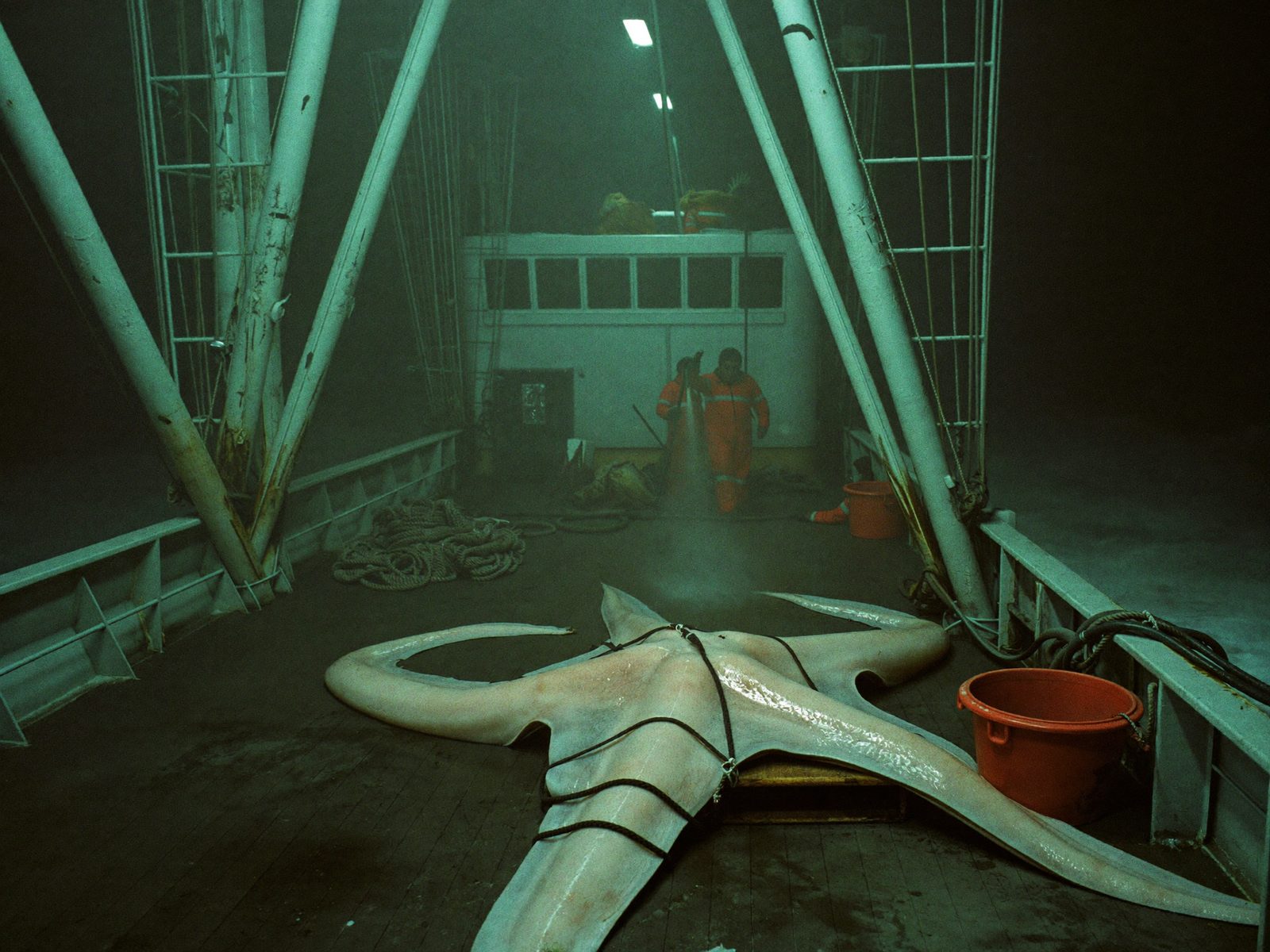
A longliner fishing for toothfish in the Ross Sea hauled its line and found a colossal squid holding on to a hooked fish, still alive. A Ministry of Fisheries observer was aboard, and the crew stopped fishing so it could be landed intact. It reached Te Papa on 13 March 2007 and weighed about 470 kg. When it was defrosted in April 2008 the team found ovaries and thousands of eggs: they had assumed it was male. Its eye measured about 27 cm across, the largest recorded in any animal.
It came to a museum through a fisheries observer programme. Not through a hunt.
AI illustration · imagined scene, not an evidence photograph
File
CR-0039
Date
February 2007
Place
Ross Sea, Antarctica
Record
a fishing crew and a government observer
Evidence
A complete specimen, frozen, then defrosted and dissected in public
Agency
New Zealand Ministry of Fisheries; Museum of New Zealand Te Papa Tongarewa
Assessment
A · verified specimen
The full file
In February 2007 the New Zealand longliner San Aspiring, owned by Sanford Ltd, was fishing for Antarctic toothfish in the Ross Sea when it hauled up a squid holding on to a hooked fish. The animal was a colossal squid, Mesonychoteuthis hamiltoni, a species named in 1925 and encountered since mostly as remains in the stomachs of whales and seabirds. It was alive but, in Te Papa's later account, dying, and could not be released. A Ministry of Fisheries observer was aboard. The crew stopped fishing, and Al Jazeera reported that winching was halted for two hours while the squid was worked into a cargo net and lifted on board.
The catch and the first reports
The capture was announced on 22 February 2007 by the Fisheries Minister, Jim Anderton, who said the squid was "almost dead when it reached the surface" and was likely the first intact adult male of the species ever landed. Early figures were estimates made at sea: about 450 kg and around 10 metres long. Te Papa's own account gives the depth of the toothfish line as 1,500 metres. Footage of the animal alongside the boat was shown on television news and later in a documentary, which makes it one of the few times a living colossal squid had been filmed at all, though at the surface and in distress.
The specimen and where it is held
The squid was frozen in the hold and stored at Sanford's depot in Timaru before being delivered to the Museum of New Zealand Te Papa Tongarewa in Wellington. Te Papa's media release of 14 March 2007 says it arrived "yesterday", which gives 13 March, and that a Deed of Gift between the museum and the Ministry was to be signed on 20 March; a later Te Papa release, of April 2008, says instead that it was gifted in February 2007. Te Papa's current page says only that the Ministry gave it to the museum in 2007.
It spent about a year in a freezer. On 30 April 2008, at the museum's Tory Street facility, it was thawed in a saline tank and examined by Steve O'Shea and Kat Bolstad of Auckland University of Technology, with Tsunemi Kubodera of Japan's National Museum of Nature and Science, while the work was webcast. After formalin fixing it went on public display on 13 December 2008, and it remains on display at Te Papa today. The museum describes it as the most intact adult colossal squid ever caught.
What the examination found
Three of the early claims did not survive the thaw. On 30 April 2008 Te Papa's blog announced that the team had found ovaries "full of several thousands of eggs": the squid was female, not male. Its final total length was 4.2 metres, not 10. And its weight is now given two ways: the 2008 releases say 495 kg, while Te Papa's current page explains that this was weighed frozen with some ice, and that about 470 kg is the more accurate figure.
The eye was measured at 27 cm across, which Te Papa's 2008 release called the largest in the world. It was measured on a specimen that had shrunk. In 2012 Dan-Eric Nilsson, Eric Warrant and colleagues argued in Current Biology that eyes this large make sense mainly for spotting diving sperm whales by the light they disturb; Warrant, who studied the Te Papa eye, described its lens as "the size of an orange". That argument was challenged in 2013 and remains a hypothesis.
The conventional explanation
The animal is a real, described species, and the specimen is in a museum. What needs explaining is the gap between the first reports and the measured animal. The leading explanation is shrinkage combined with estimates made at sea. Te Papa's November 2008 post argued that a year in the freezer dried the tissue out before it was fixed, and tested this on fresh arrow squid, which shrank around 5 per cent in formalin and 20 to 25 per cent in ethanol. On that basis the museum estimated the living animal at well over 6 metres. The strength of the explanation is that it was tested and published by the institution holding the specimen. Its weakness is that the test used a different, much smaller squid, so the 6-metre figure is an inference, not a measurement.
What remains open
Very little about this specimen, and a great deal about the species. No adult colossal squid has been seen alive in its own habitat. The first confirmed footage of a live animal at depth came on 9 March 2025, when the Schmidt Ocean Institute's remotely operated vehicle SuBastian, working from the research vessel Falkor (too) near the South Sandwich Islands, filmed a transparent juvenile about 30 cm long at 600 metres. Bolstad and the glass squid specialist Aaron Evans confirmed the identification from the hooks on the middle of its eight arms. The Institute announced it on 15 April 2025, a century after the species was named. ABC News gives the depth as almost 1,100 feet, which does not match the Institute's 600 metres. How large adults grow, how they hunt and where they breed are still inferred from specimens like the one in Wellington.
Sources
Colossal squid at Te Papa(archived) — Museum of New Zealand Te Papa Tongarewa, current. The capture at 1,500 m, the dying animal, the 495 kg and 470 kg weights, surface footage, display status.
Colossal squid: Shrinkage?(archived) — Te Papa blog, 26 November 2008. The freezer-dehydration explanation, the arrow squid tests, the "well over 6 metres" estimate.
Corrected The full file: The thawing tank is now described as saline, as Te Papa's April 2008 release says; the word 'chilled' was dropped.
Corrected The full file: The 495 kg weight is now attributed to the 2008 releases only. The March 2007 release gave about 450 kg.
Corrected The full file: A claim that a Te Papa caption gives the eye as about 30 cm was removed: no cited Te Papa page contains it.
Corrected The full file: Te Papa's sources do not say where the squid was frozen, only that it was examined at the Tory Street facility. The text now places only the examination there.
Corrected The full file: The 1,500-metre depth is now credited to Te Papa's main colossal squid page, not its collection page, which does not give it.
Added The full file, a long-form write-up with its sources, added.

 INDEPENDENT FIELD ARCHIVE