An ultra-low-frequency sound was loud enough to be heard more than 5,000 km from its source, and the press supplied the rest. What PMEL's own page says is that the sounds recorded in the summer of 1997 are consistent with icequakes generated by large icebergs cracking and fracturing, compared against icequakes logged in the Scotia Sea. For years PMEL's own page said the origin was unknown, though the array had been built to listen for seismicity and ice in the first place.
The sound was real. It was also bigger than any animal call, which is what an iceberg sounds like.
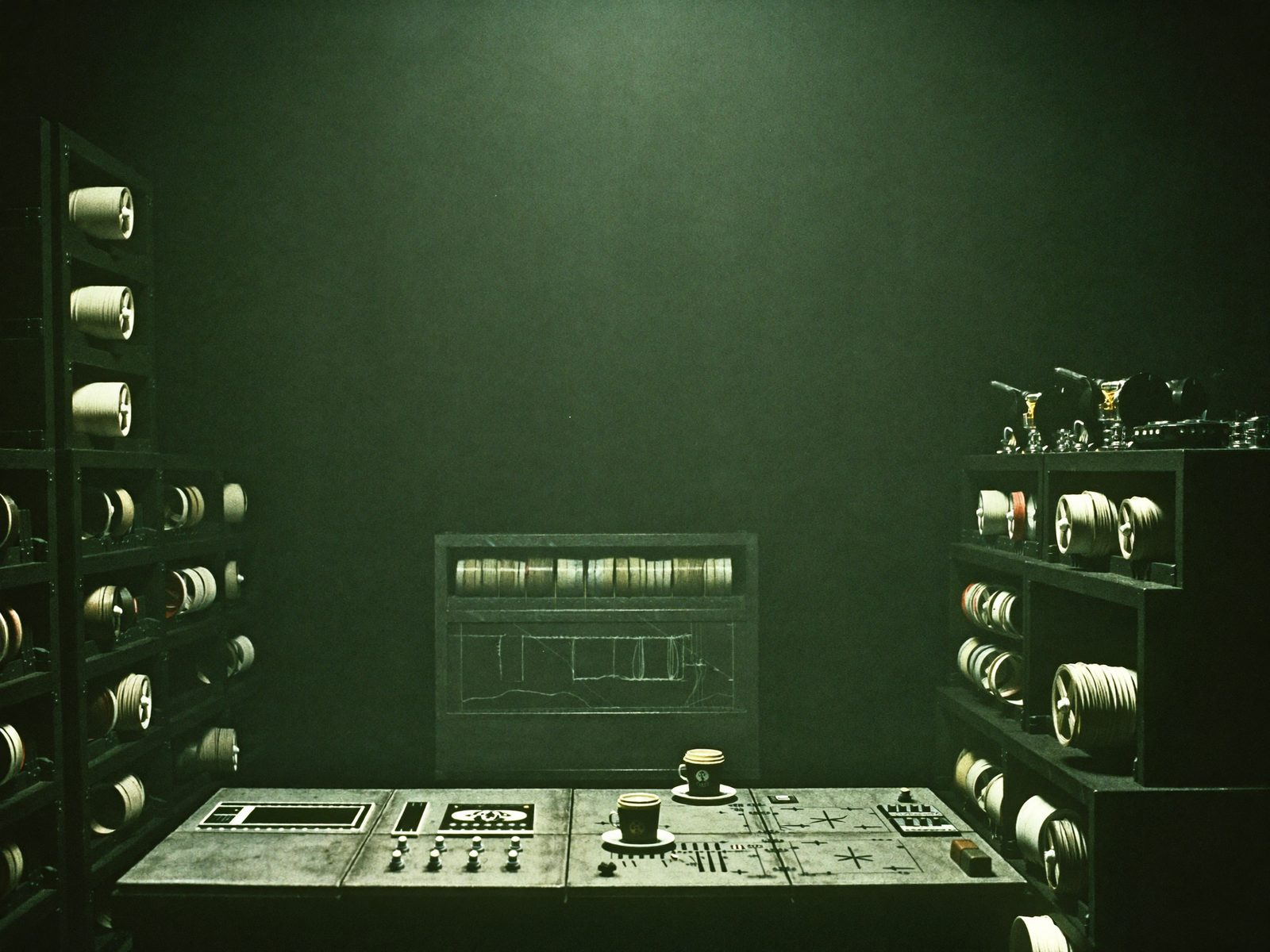
AI illustration · imagined scene, not an evidence photograph
File
CR-0038
Date
Summer 1997
Place
Equatorial Pacific, 50°S 100°W
Record
instrumental — hydrophones thousands of kilometres apart
Evidence
Recordings on the NOAA PMEL autonomous array, compared against known ice events
Agency
NOAA Pacific Marine Environmental Laboratory, with the Navy's SOSUS array
Assessment
D · explained
The full file
In the summer of 1997 a moored network of underwater microphones in the equatorial Pacific picked up the same unusual sound several times over. It was very low in pitch, rose quickly in frequency over about a minute, and was loud enough to register on sensors thousands of kilometres from its source. The scientists who ran the network gave it a nickname, "Bloop", and filed it among the sounds they could not yet identify. Within five years it had been retold as the call of an animal bigger than any whale.
The recording
The array belonged to the Acoustic Monitoring Project at NOAA's Pacific Marine Environmental Laboratory (PMEL) in Newport, Oregon, which used the Navy's SOSUS listening network and its own moored autonomous hydrophones to monitor undersea earthquakes and volcanoes, and to listen to whales. PMEL's sound-library page for Bloop, as it stood in 2005, said the sound was "repeatedly recorded during summer, 1997" on the Equatorial Pacific autonomous array, that it was heard "at a range of over 5,000 km", and that it gave a general location near 50°S 100°W, in the open South Pacific west of the southern tip of South America. That page ended with a plain sentence: "The origin of the sound is unknown."
Sources give the reach in different ways. PMEL speaks of a range of over 5,000 km; New Scientist in 2002 said the sound was detected by sensors up to 4,800 km apart; CNN the same year said 3,000 miles; NOAA's Ocean Service now says more than 3,219 km apart. Accounts also differ on the instruments: PMEL names its own autonomous array, while CNN described Navy "spy" sensors.
The evidence and where it is held
The evidence is acoustic only: the hydrophone recordings, a spectrogram and the triangulated position. PMEL still publishes a short audio clip, sped up sixteen times so that human ears can hear it, with the spectrogram on its current Icequakes (Bloop) page. No sighting, specimen or physical trace has ever been attached to the sound.
What was said at the time
The project's lead, Christopher Fox, was cautious but not consistent. In September 2001 he told CNN he thought it "may be related to ice calving", adding that it "always comes from the south" and that ice off Antarctica was his suspicion. In June 2002 David Wolman's New Scientist feature, "Calls from the deep", reported a different hunch: that Bloop was the sound most likely to come from some sort of animal, because its rapid change in frequency resembled known marine animal calls. Wolman then reasoned that anything heard so far away must be "far louder than any whale noise", and raised the idea of giant squid. Fox's own recorded reply was that no one knew whether squid made noise at all, and a Boston University marine biologist quoted in the same piece doubted squid could produce such a sound. Wolman also noted that the nicknames were not meant to indicate where the sounds came from.
CNN's summary of the article, dated 13 June, two days before the magazine's cover date, went further: "one theory" was a deep sea monster, "possibly a many-tentacled giant squid". That sentence, rather than any finding from PMEL, is the root of the monster story.
The icequake explanation
The leading conventional explanation, and NOAA's own, is that Bloop was an icequake: the sound of a large iceberg cracking and breaking apart. From 2005 to 2010 PMEL ran hydrophones in Bransfield Strait and the Drake Passage, much closer to Antarctica. In 2012 the PMEL seismologist Robert Dziak told Wired that the Bloop signal was "essentially identical" to icequakes recorded there, and that tens of thousands occur every year. PMEL's current page states the 1997 sounds "are consistent with icequakes" and places the likely source between Bransfield Strait and the Ross Sea, or possibly at Cape Adare. The same Scotia Sea instruments recorded iceberg A53a, roughly 55 by 25 km, as it ground across shoals in 2007 and broke up near South Georgia on 2 February 2008; Dziak and colleagues reported those break-up sounds in Oceanography in 2013 as broadband signals loud enough to be heard over thousands of kilometres.
Its strengths are considerable. The source lay to the south, as Fox had noted in 2001; icequakes are among the loudest natural sounds in the Southern Ocean; and Dziak pointed out that the animal-like quality comes from the sixteen-fold speed-up, with the real-time sound closer to thunder. Its weakness is that the identification is by resemblance: no specific iceberg or calving event in the summer of 1997 has been matched to the recording, and PMEL's chosen word is "consistent", not "identified". NOAA's Ocean Service dates the solution to 2005, while Dziak's account places the realisation in the analysis of data gathered from 2005 onwards and published around 2012.
What remains open
Very little of substance. The sound was real and was recorded by working scientists, and ice, Fox's suspicion as early as 2001, has been the only serious candidate for its source since the Antarctic recordings. What remains is a matter of precision rather than mystery: which iceberg, on which day, and exactly how far apart the sensors that heard it were. The animal reading never rested on evidence, only on the distance the sound travelled and on how it was played back.
Sources
Acoustics Monitoring Program: Icequakes (Bloop)(archived) — NOAA Pacific Marine Environmental Laboratory, c. 2012, current. The icequake attribution, the Scotia Sea comparison, A53a, the 5,000 km range and the likely source area.
Acoustics Monitoring Program: "Bloop" — NOAA PMEL, archived 2005. The original description, summer 1997 date, 50°S 100°W position and "origin unknown" wording.
Calls from the deep — David Wolman, New Scientist, 15 June 2002. Fox's animal hunch, the 4,800 km figure, the squid speculation and the naming.
Corrected The full file: The closing section said ice had been the only serious candidate since 2001, although Fox told New Scientist in 2002 that he leaned towards an animal; it now says ice, Fox's suspicion as early as 2001, has been the only serious candidate since the Antarctic recordings.
Corrected The full file: A sentence saying the underlying 1997 data remain with PMEL's acoustics programme could not be confirmed in any source and has been removed.
Corrected The sound was heard more than 5,000 km from its source; the file previously said it was recorded by sensors more than 5,000 km apart.
Corrected For years PMEL's own page said the origin was unknown; the file previously dismissed the 'unexplained' label as a mere filing category.
Added The full file, a long-form write-up with its sources, added.

 INDEPENDENT FIELD ARCHIVE