The full file
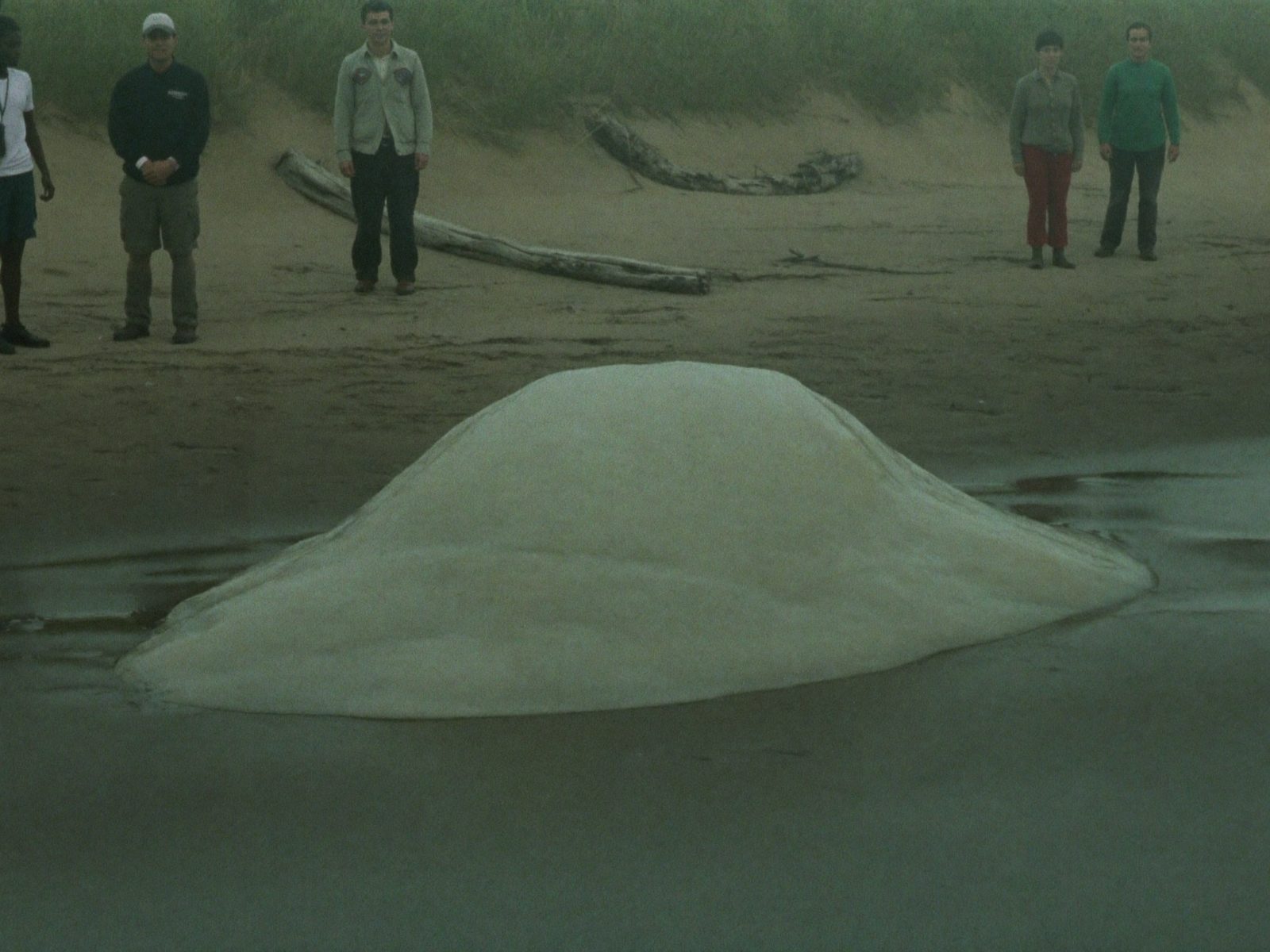
In 1988 a pale, boneless mass of tissue came ashore on Bermuda and stood for sixteen years in the popular literature as the remains of something unknown. It belonged to a family of white, fibrous carcasses with no head and no skeleton, read by the press as giant octopuses or sea monsters since the 1890s. The writer Ivan T. Sanderson gave the type a name, "globster", after a Tasmanian carcass of 1960. Between 1995 and 2004 three laboratory studies examined a run of them.
What came ashore
The oldest case in the series is the St Augustine carcass, found on Anastasia Island, Florida, late in 1896. A local physician, DeWitt Webb, president of the St Augustine Scientific Society, had it photographed and hauled above the tideline. It is usually given as about 21 feet long and some seven tons. The Yale zoologist A. E. Verrill, working from Webb's letters, named it Octopus giganteus in 1897, then withdrew the identification within months.
The Bermuda mass, usually called Bermuda Blob 1, was photographed and sampled by Teddy Tucker, a Bermudian diver and fisherman who often worked with scientists. Bermuda's Bernews places the find in Mangrove Bay, Somerset, in May 1988, and quotes Tucker describing the exterior as "almost like wet wool". The 1995 paper that studied it says instead that it washed into a lagoon "during the summer of 1988", and gives its size as about 2.5 by 1.25 by 0.3 metres. A second Bermuda mass beached in January 1997, according to the 2004 study, which dates the first to 1995, not 1988; a University of South Florida press release likewise lists Bermuda finds in 1995 and 1997, and Bernews captions a photograph of the second as 1995.
On 2 August 2001 residents of St Bernard's, Fortune Bay, on Newfoundland's south coast, found what the scientists who examined it called "an enormous, whitish mass of rotting flesh", about 5.6 metres long, with a fringe that looked like hair. In July 2003 a much larger mass was found on Pinuno Beach at Los Muermos in southern Chile; the press release gave it as 41 feet long and 13 tons. A Nantucket mass of November 1996 completes the set.
The evidence and where it is held
The evidence is tissue. Sizeable pieces of the St Augustine carcass were preserved in formalin by Webb and went to the Smithsonian Institution; the 2004 paper says a sample reached the researchers through the ichthyologist Eugenie Clark in 1995 and that the first Bermuda sample came from Clark as well, though the 1995 paper credits Joseph Gennaro of the University of Florida and Teddy Tucker. The second Bermuda sample came from Wolfgang Sterrer of the Bermuda Biological Laboratory. Fisheries and Oceans Canada cut the Newfoundland samples, the Chilean tissue was sent by Elsa Cabrera of the Centro de Conservación Cetacea in Santiago, and the Nantucket sample came through the island's shellfish warden. The DNA sequences are in GenBank; the papers do not say where the physical samples are held now.
What the laboratories found
In 1995 Sidney Pierce and colleagues at the University of Maryland examined the St Augustine and Bermuda samples by electron microscopy and amino-acid analysis. Both were "masses of virtually pure collagen", arranged as vertebrate skin rather than octopus mantle. The Florida sample came from a large warm-blooded animal; the Bermuda sample, unexpectedly, from a cold-blooded one, a large fish or shark. They concluded that "there is no evidence to support the existence of Octopus giganteus".
In 2002 Steven Carr's group at Memorial University of Newfoundland extracted DNA from the Fortune Bay carcass. Its mitochondrial NADH2 sequence matched a sperm whale's at 1,040 of 1,044 positions, differences of the size expected between individual whales. They read the mass as decomposing muscle that had come away from the skeleton.
In 2004 Pierce, now at the University of South Florida, published the Chilean results under the subtitle "Nothing but Whales". Its fibres matched whale blubber, and its DNA was identical to sperm whale. Nantucket's DNA matched a fin whale. The team set the older samples alongside these and concluded that all of them, Bermuda included, were the decomposed remains of great whales. In the paper's words, "we have not found any evidence that any of the blobs are the remains of gigantic octopods, or sea monsters of unknown species."
The whale explanation
The leading explanation is that a globster is what is left of a large whale after long decay: a tough sheet of blubber collagen that outlasts muscle and bone, often still wrapped in skin, with loose flaps that read as arms or tentacles. Its strengths are a matching fibre structure under the microscope, a collagen amino-acid profile in every sample, and DNA matches in three cases.
Its weakness is that the DNA covers only Newfoundland, Chile and Nantucket. The 2004 team tried to extract DNA from the others and failed, so the whale reading for St Augustine and Bermuda rests on microscopy and amino-acid chemistry, not genetics.
What remains disputed
The main loose end is Bermuda. The same laboratory, with three authors in common, called the 1988 sample cold-blooded in 1995 and grouped it with the whales in 2004, without new DNA evidence. Some later summaries also misstate the evidence: the South Florida press release said the Chilean DNA matched Nantucket's, though the paper places them in different species, and some popular accounts say the 2004 DNA work confirmed the St Augustine carcass, which the paper does not claim. None of this reopens the octopus.
Sources
- On the Giant Octopus (Octopus giganteus) and the Bermuda Blob: Homage to A. E. Verrill — S. K. Pierce, G. N. Smith, T. K. Maugel and E. Clark, Biological Bulletin 188, 1995 (DOI 10.2307/1542087). Bermuda 1988 size, date and finder, Webb, Verrill, the collagen results and the cold-blooded finding.
- How To Tell a Sea Monster: Molecular Discrimination of Large Marine Animals of the North Atlantic (archived) — S. M. Carr and others, Biological Bulletin 202, 2002 (DOI 10.2307/1543217). The Fortune Bay carcass, its date and size, and the 99.6% sperm whale match.
- "How to tell a Sea Monster" (archived) — Memorial University of Newfoundland, 2001. Carr's contemporary account of the DFO material and result.
- Microscopic, Biochemical, and Molecular Characteristics of the Chilean Blob ... Nothing but Whales — S. K. Pierce and others, Biological Bulletin 206, 2004 (DOI 10.2307/1543636). The Chilean and Nantucket results, the sample sources, Bermuda 1997 and the failed DNA extractions.
- Identification of the Chilean sea monster (archived) — Society for Integrative and Comparative Biology, 2004. Conference abstract confirming the July 2003 date and sperm whale result.
- Scientists Solve Chilean 'Blob' Mystery (archived) — University of South Florida via ScienceDaily, 22 January 2004. Chilean size and weight, Cabrera's role, and the 1995 Bermuda date.
- Remembering the "Bermuda Blobs" (archived) — Bernews, 2010. Mangrove Bay, May 1988, and Tucker's own description.
- It was no sea monster! The Bermuda blob was blubber — The Royal Gazette, Bermuda, 30 July 2004. Bermuda's own report of the 2004 finding and the earlier fish-or-shark result.
- The Myth of the St. Augustine Monster (archived) — Bess Lovejoy, JSTOR Daily, 2018. The 1896 find, dimensions and Verrill's retraction.

 INDEPENDENT FIELD ARCHIVE