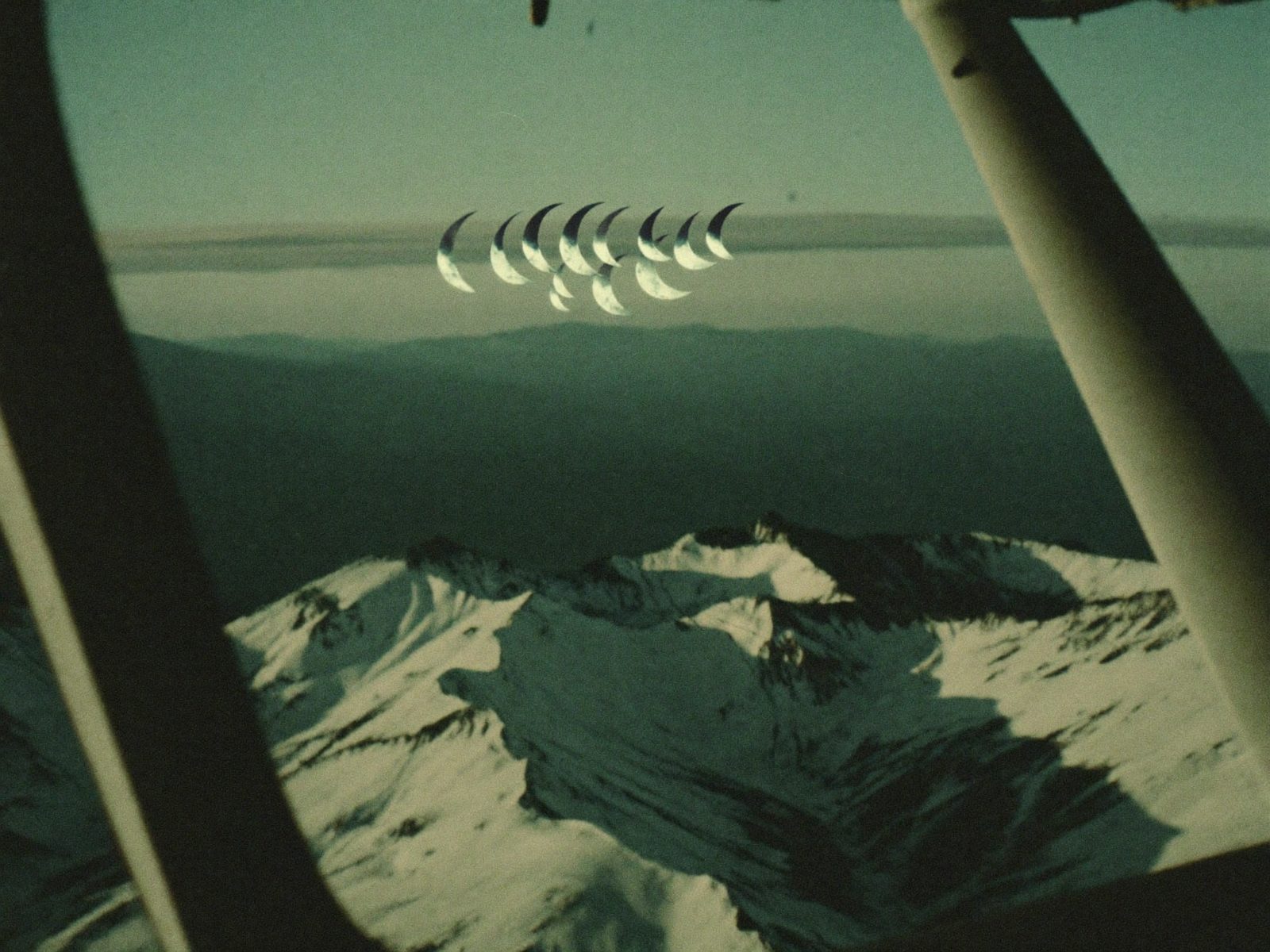
A private pilot reported nine flat, bright objects — his signed statement for the Army Air Forces calls them completely round, though later accounts made them crescents — crossing in formation near Mount Rainier at an estimated 1,700 miles an hour. He said their motion was like a saucer skipped across water, and the press kept the noun and dropped the movement. Army Air Forces investigators recorded the report and found no physical evidence and no matching aircraft.
The report that named the subject: one pilot's estimate, recorded within days, never traced to anything on the ground.
Kenneth Arnold, a private pilot flying alone over Mount Rainier
Evidence
A signed statement and sketch for the Army Air Forces, press interviews, and no instrumented record
Agency
US Army Air Forces, Project Sign era
Assessment
C · single witness, signed statement and Air Force file
The full file
On the afternoon of Tuesday 24 June 1947, Kenneth Arnold, a Boise businessman who sold fire-control equipment and flew his own light aircraft, was crossing the Cascade Range in Washington State when he saw nine bright objects pass between Mount Rainier and Mount Adams. His account, given to reporters in Pendleton, Oregon, the next day, went out on the Associated Press wire and opened the American flying-saucer era. The Air Force's own papers on it still disagree with one another.
What Arnold reported
Arnold had left Chehalis for Yakima, and turned aside to search the south-west flank of Rainier for a Marine Corps transport that had gone missing. The Air Force summary of his account has him at about 9,200 feet near the town of Mineral, in smooth air, when a bright flash struck the plane. To the left and north of Rainier he saw a chain of nine objects flying south at roughly his own height, which he first took for jets but could find no tails on. In his written statement to the Army Air Forces he said they flew "like many times I have observed geese", in a diagonal line, swerving in and out of the high peaks.
He put their distance at 20 to 25 miles and timed them with the sweep hand of his clock as they crossed from Rainier to Adams: one minute and forty-two seconds. The Air Force worked this out at 1,656.71 miles an hour, a figure usually rounded to 1,700. Flying level they were "just a black thin line"; when they flipped in the sun they looked round. The official summary records that he likened them to saucers skipping on water, a phrase the newspapers shortened to "flying saucers".
The evidence and where it is
There is no photograph, film or physical trace, only Arnold's statements and sketches, newspaper stories and the Air Force file. The file, Incident 17 in the Air Force's numbering, survives in the Project Blue Book records at the US National Archives, read on microfilm publication T-1206, roll 1. A copy from that microfilm is held in the Richard F. Haines papers at the American Heritage Center, University of Wyoming. It contains Arnold's signed nine-page statement, a teletype from Wright Field of 10 July 1947 thanking him for it, an intelligence officer's interview notes, a data sheet, press clippings and two later analyses.
His radio interview on KWRC in Pendleton on 26 June 1947 survives as a transcript. In it he compared the objects to "a pie-plate that was cut in half" and did not use the word saucer at all.
What investigators concluded
The file does not settle on one answer. An intelligence agent's interview notes record that he believed Arnold had really seen the "flying discs", adding that if Arnold had invented the story he belonged in "Buck Rogers fiction". J. Allen Hynek, the astronomer who reviewed the case for Project Sign, wrote that it was "impossible to explain this incident away as sheer nonsense" if Arnold was honest, but that his figures could not all be right. At 20 to 25 miles, objects showing such detail must have been about 2,000 feet long; at a plausible size they must have been within about six miles, moving at about 400 miles an hour. He concluded they were probably moving at "subsonic" speeds and might be known aircraft. The Air Materiel Command's own opinion was blunter: the report "cannot bear even superficial examination". Even so, the case summary and the Project 10073 record card give the formal conclusion as a mirage.
Edward Ruppelt, who later ran Project Blue Book, set out the two camps that formed at Wright Field, one sure he had seen jets and the other that he could not have. Writing in 1956, he called it "just another UFO report marked 'Unknown'", which does not match the card in the file.
The leading conventional explanation
The official explanation is a mirage. The summary bases it on Arnold's own remark that the air was smooth and crystal clear, which it takes as a sign of stable air and temperature inversions that bend light. It would account for bright flashes near snow-covered ridges without any craft. Against it, Arnold had already rejected the idea in his statement: he had watched through an open side window as well as through the glass, and called a mirage "absolutely false". Hynek's alternative, ordinary aircraft at a shorter range, explains the speed but not the missing tails or the flipping motion Arnold described. Later writers have proposed meteors, blowing snow, water drops on the windscreen and a flock of white pelicans. None is supported by any document in the file.
What remains open
Even basic figures vary within the file. Arnold's statement gives the sighting as two and a half to three minutes, and later accounts as about two. The speed is 1,656.71 miles an hour in the summary but "approximately 150 MPH" in the interview notes, almost certainly a typing error. The course is north to south in the narrative and "West" on the record card. Hynek's analysis corrects an earlier figure of 1,200 miles an hour to about 1,700, and later accounts give 1,400. Arnold's own sketch shows a rounded shape, not the crescent of later retellings. The objects were never identified. The mirage verdict stands on the card, while the analyses filed with it point elsewhere.
Sources
Project 10073 Record, Witness Kenneth Arnold, June 24, 1947(archived) — US Air Force, Project Blue Book file (NARA microfilm T-1206, roll 1), copy in Richard F. Haines papers, American Heritage Center, 1947–49. Arnold's statement and sketch, interview notes, Hynek's analysis, the AMC opinion and the "mirage" conclusion.
USAF and the UFOs(archived) — John T. Correll, Air Force Magazine, 2011. The 1,700 mph estimate, the saucer phrase and the mirage as the consensus reading.
Was This the First Reported UFO?(archived) — Mike Bezemek, American Heritage, 2026. The search for the Marine transport, the AP dispatch and the later pelican suggestion.
Corrected The full file: The Wright Field teletype thanking Arnold is dated 10 July 1947 in the file copy, not 18 July; the text now says 10 July.
Corrected The full file: No cited source names Arnold's aircraft as a CallAir; the make has been removed.
Corrected The full file: The 1,200 miles an hour figure is not from later accounts: Hynek's analysis in the Air Force file corrects an earlier figure of 1,200 to about 1,700. The text now says so, and keeps HistoryLink's 1,400.
Corrected His signed 1947 statement for the Army Air Forces calls the objects completely round; the crescents come from later accounts. The file previously said he drew them as crescents for the Army Air Forces.
Corrected The evidence now includes his signed statement and sketch and the Air Force file, and the C rating no longer rests on the press record alone.
Corrected The counter-reading now records that the record card says mirage and that Ruppelt says the case was marked unknown; the file previously offered a misjudged speed, birds or a meteor.
Sources The source on file is now Kenneth Arnold's Project Blue Book file rather than an encyclopedia article.
Added The full file, a long-form write-up with its sources, added.

 INDEPENDENT FIELD ARCHIVE