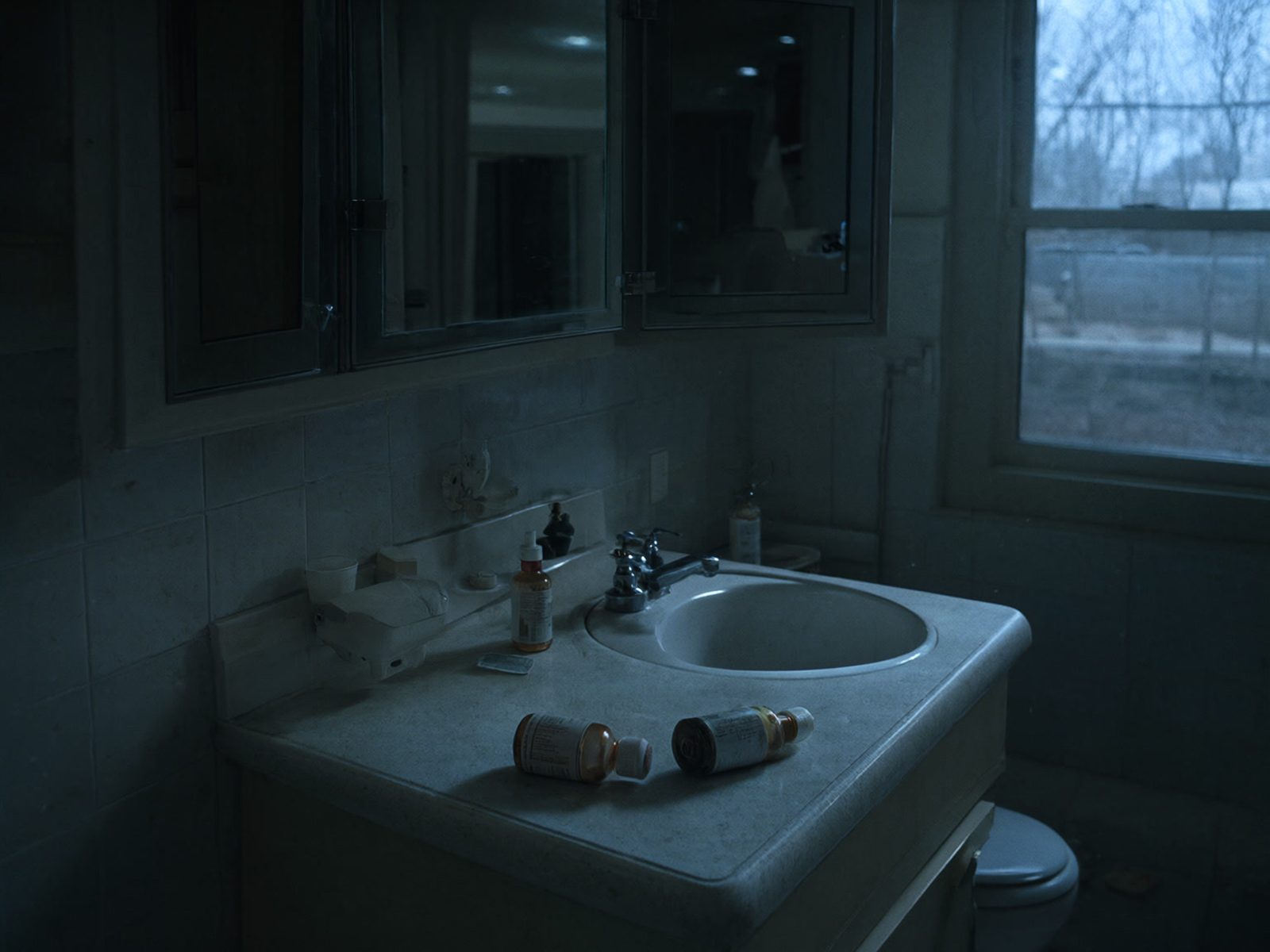
Over five weeks in 1958 a Long Island family reported screw-capped bottles losing their caps with a pop and spilling, and figurines, a globe and furniture falling or flying, 67 incidents in all. A detective was assigned to the house full-time, and the utility, engineers and the police laboratory looked for a physical cause and found none. Two Duke University investigators spent more than a week in the house and published a full account that June.
The leading explanation is trickery by the 12-year-old son, around whom the events clustered. Pratt and Roll weighed it and did not accept it: they found no evidence of fraud and argued that some events could not be explained that way, though they called their own report inconclusive. Bottles the police secretly dusted with fluorescent powder never spilled again. By the Psi Encyclopedia's account, the magician Milbourne Christopher (1970) and Joe Nickell (2012) later argued that a boy's tricks could account for all of it.
AI illustration · not an evidence photograph
File
BR-0009
Date
3 February – 10 March 1958
Place
Seaford, Long Island, New York
AssessmentB · documented by a police record and investigators during the events
The record on file
Witnesses
The Herrmann family, two parents and children of 13 and 12; Patrolman J. Hughes; Detective Joseph Tozzi of the Nassau County Police; a relative and two reporters who were in the house; J. G. Pratt and W. G. Roll of the Duke University Parapsychology Laboratory
Evidence
The Nassau County police record, begun 11 February; a list of 67 incidents; tests by the Long Island Lighting Company, the police laboratory, an R.C.A. radio test truck, the town building department and visiting engineers, all of which found nothing
Record made at the time
The Nassau County Police record, started on 11 February 1958, eight days after the first incident, and kept by Det. Joseph Tozzi, who was assigned full-time and took statements within minutes or hours of each event; quoted at length in Pratt and Roll's "The Seaford Disturbances", Journal of Parapsychology, June 1958, alongside their own notes of the five incidents that happened while they were in the house.
Agency
Nassau County Police; Duke University Parapsychology Laboratory (J. G. Pratt, W. G. Roll)
On the afternoon of Monday, 3 February 1958, in a house in Seaford, on the south shore of Long Island, ornaments were found broken in a boy's bedroom and a small bottle of holy water was found on its side, uncapped and spilled. Over the next five weeks the household of James and Lucille Herrmann, and their children Lucille, 13, and James, 12, reported more spilled bottles, along with figurines, a globe, a bookcase and other furniture falling or moving. By the time it stopped, on 10 March, the case had been in the national press, a detective had spent most of a month on it, and two investigators from Duke University had written it up at length.
What was reported
The holy-water bottle stood on Mrs Herrmann's dresser; other bottles followed around the house, among them bleach, starch, medicines, shampoo and ink. The family lodged a complaint with the Nassau County Police on 9 February. From 11 February Detective Joseph Tozzi was assigned to the house full-time. Witnesses outside the family came to include a cousin, Marie Murtha; a Newsday reporter, David Kahn, who stayed in the house; John Gold of the London Evening News; a physicist, Robert Zider; and police officers, among them Sergeant B. McConnell, who was in the cellar with Kahn and Dr J. G. Pratt on the evening of 25 February when a lamp overturned in the bedroom above. The final incident was a thump and a bleach bottle found uncapped in the cellar at 8.14 p.m. on 10 March.
The story travelled fast. An Associated Press report carried by the Washington Evening Star on 27 February noted that no bottles had opened while a Duke University psychologist was in the house the day before, and that Pratt was trying to learn whether the boy could be influencing events. LIFE ran the story in its issue of 17 March 1958.
The record and where it is held
The record that puts this case on the Investigated shelf is the police dossier kept by Tozzi. In the investigators' words it "was started on February 11, eight days after the disturbances began". Its present location is not stated in any source examined here; by the Psi Encyclopedia's account the sceptic Joe Nickell later worked from a 60-page police file. Its substance survives because J. G. Pratt and W. G. Roll of the Duke Parapsychology Laboratory quoted it at length in "The Seaford Disturbances", Journal of Parapsychology 22 (June 1958), pages 79 to 124, a scan of which is held by the Internet Archive. Their paper lists 67 incidents and gives their own notes on the five that happened while one or both of them were in the house. Contemporary clippings, including a New York Times report by Milton Bracker and LIFE's photograph of the fallen cellar bookcase, are held in the Garrett Collection at the University of Maryland, Baltimore County.
What investigators concluded
According to Pratt and Roll, the Long Island Lighting Company put an oscillograph in the cellar on 13 February and later checked wiring and fuse panels; an R.C.A. test truck found no unusual radio signals on 26 February; the Town of Hempstead building department found the house sound; the Seaford Fire Department found no change in a nearby well; the police laboratory found no foreign matter in five bottles; a chimney cap made no difference; flight schedules from Mitchel Field did not match the events. On 19 February the police dusted five previously affected bottles with fluorescent powder, told no one outside the department, and Tozzi carried a lamp that would show the powder on anyone's hands. In the paper's words, "none of these bottles ever spilled again."
Pratt, who stayed four and a half days and left on 1 March, returned with Roll without publicity on 7 March for more than a week. They concluded that "the fraud hypothesis is not supported by the evidence", identified 17 incidents at which a third person could account for both children's positions, and judged "recurrent spontaneous psychokinesis" centred on the boy a hypothesis worth considering, while calling their report exploratory and the evidence inconclusive. In a note at the end they record that the parents declined a lie-detector test and that Mr Herrmann later withdrew consent to further testing, which led them to postpone their psychological analyses.
The conventional explanation
The leading explanation is trickery by the 12-year-old boy. Pratt and Roll themselves conceded that the children's involvement could not be ruled out in many of the incidents. The events clustered around him; the bottles dusted with powder were never touched again; and an observer's attention is easy to draw away in a busy house. By the Psi Encyclopedia's account, the magician Milbourne Christopher, whose offer of help the family refused, reproduced similar effects by misdirection in Seers, Psychics and ESP (1970), and Nickell (2012) argued that each movement was within a boy's reach. Its weakness is that no one caught him, he did not confess, and it requires some of the outside witnesses, the reporters and police among them, to have misjudged where he was.
What remains disputed
The disagreement rests on those 17 incidents and on how reliable the witnesses' placement of the children was; nothing in the published record settles it. The case is filed here as contested, with no explanation on record and with ordinary trickery the explanation the evidence most easily allows.
Sources
The Seaford Disturbances, Journal of Parapsychology 22(2) — J. G. Pratt and W. G. Roll, Parapsychology Laboratory, Duke University, June 1958 (Internet Archive scan). The dossier, dates, 67 incidents, tests, fluorescent powder, the five witnessed events, conclusions and the polygraph note.
Seaford Poltergeist(archived) — Psi Encyclopedia, Society for Psychical Research. Index to the family, the witnesses, and the Christopher and Nickell critiques.
Chronicling America search: Seaford, 1958 — Library of Congress; Associated Press report in the Washington Evening Star, 27 February 1958, p. 2. Pratt's presence on 26 February and the press focus on the boy.
LIFE, 17 March 1958(archived) — Time Inc., 1958 (Google Books). The magazine's account of the case, dating the first incident to 3 February.
Corrected The full file: A quotation from the Associated Press report of 27 February 1958 could not be confirmed and was turned into paraphrase: no bottles opened while a Duke University psychologist was in the house the day before.
Corrected The full file: Pratt and Roll say Detective Tozzi carried a lamp that would show the fluorescent powder on anyone's hands, not that the family's hands were later checked under a lamp; the text now says so.
Corrected The full file: Pratt and Roll wrote that the children's involvement could not be ruled out in a number of incidents, not that many incidents could have been staged by a child alone; the text now follows their wording.
Added The full file, a long-form write-up with its sources, added.
Also filed under Poltergeists
The Rosenheim poltergeistThe Law Office in Rosenheim · October 1967 – January 1968 · telephone faults from the summer
The Enfield poltergeistThe House in Green Street · 31 August 1977 – 1978 or 1979 (sources differ)

 INDEPENDENT FIELD ARCHIVE