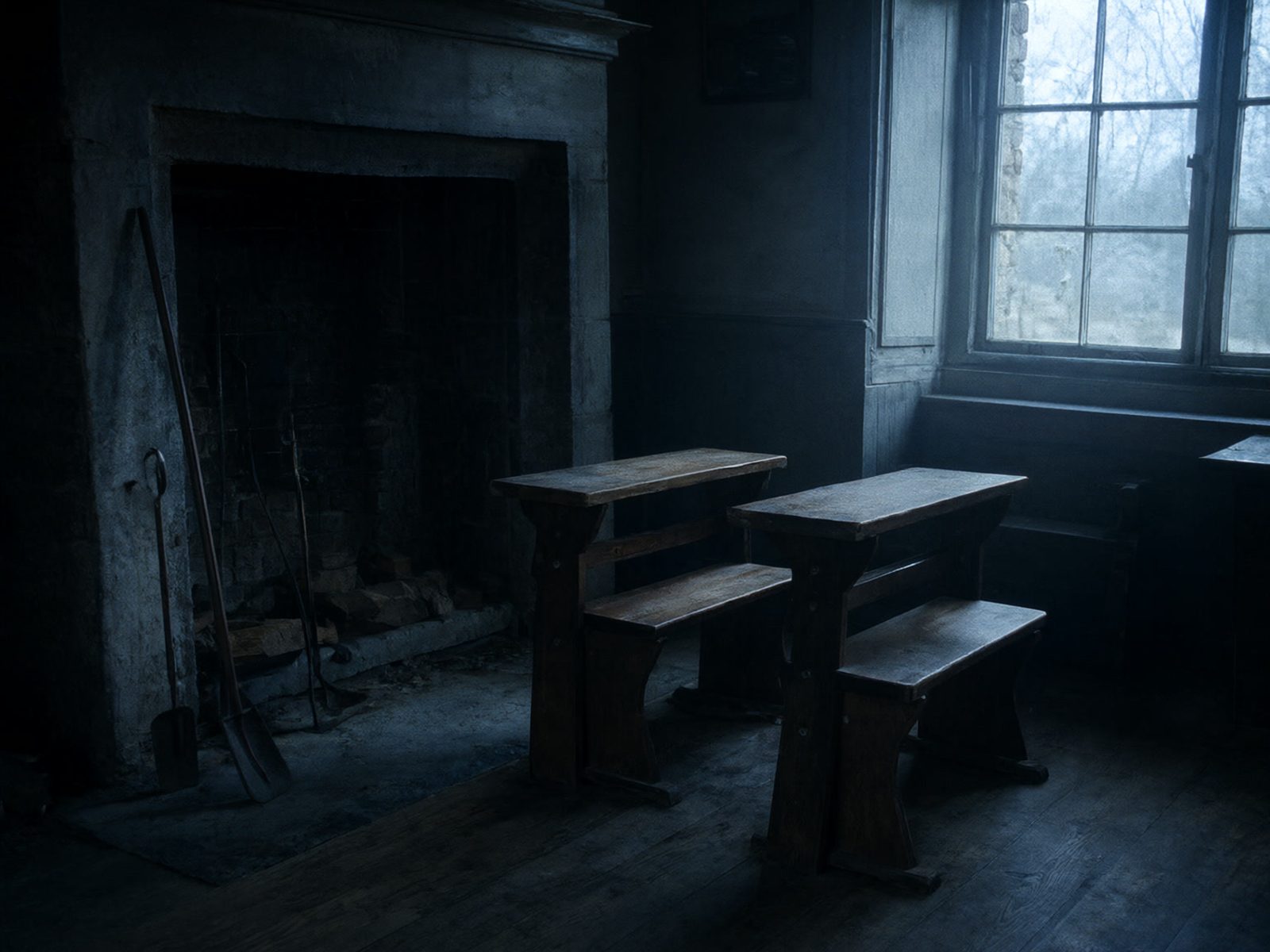
Poltergeists / Cideville, near Yerville, Normandy, France
The Presbytery at Cideville
A shepherd, Thorel, sued the curé of Cideville for defamation and assault after the curé blamed him for knocking, flying objects and moving furniture around two boys he was teaching. The case was heard before the Juge de Paix of Yerville from 7 January 1851. Witnesses described raps that beat out tunes on request and fire tongs, a desk and a table moving with no one near them, while a gendarme who watched for an hour and a half saw nothing, and a second had the same experience.
The obvious explanation is that the boys did it. One witness heard M. Fontaine, the plaintiff's advocate, call out that he had caught the younger boy moving a table; the boy denied it, and the judge disallowed the plaintiff's questions about Fontaine. The court never tested the explanation: it found that the cause "remains unknown" and dismissed the suit because Thorel had himself spread the report that he was responsible.
AI illustration · not an evidence photograph
File
BR-0008
Date
26 November 1850 – February 1851 · judgment 4 February 1851
Place
Cideville, near Yerville, Normandy, France
AssessmentB · documented by sworn testimony and a court judgment
The record on file
Witnesses
Two boys boarding with the curé, aged twelve and fourteen; more than twenty deponents on oath, among them two gendarmes, a neighbouring curé, local gentry and farmers
Evidence
Sworn depositions and the judgment of the Juge de Paix of Yerville, from an authenticated copy of the court record summarised by Andrew Lang in 1903–04
Record made at the time
The depositions and the judgment of 4 February 1851 in Thorel's suit against the curé Tinel before the Juge de Paix of Yerville. An authenticated copy, transcribed with the leave of the then Juge de Paix, reached the Society for Psychical Research through the Marquis d'Eguilles and was summarised by Andrew Lang in its Proceedings, vol. 18 (1903–04).
In the winter of 1850–51 the presbytery at Cideville, a village near Yerville in the Pays de Caux, Normandy, was the scene of knocking, moving furniture and thrown objects that centred on two boys boarding with the curé, M. Tinel, who was preparing them for the priesthood. It is remembered because a shepherd blamed for it went to law, and more than twenty people gave evidence on oath.
What was reported
According to the pupils' own depositions, the knocking began at about five in the afternoon of Tuesday 26 November 1850, as light hammer-blows on the wainscot of the upstairs room where the boys worked. They were Gustave Lemonnier, aged twelve, and Clément Bunel, fourteen. Within a week they were beating out the song Maître Corbeau on request. Witnesses later described tongs leaving the hearth, desks overturning, a candlestick striking a maid, and raps that counted the letters of visitors' names; the younger boy spoke of a black hand that slapped him and a figure in a smock that followed him.
Lemonnier identified that figure as Félix Thorel, a shepherd from neighbouring Anzouville-l'Esneval known for boasting of occult powers. Tinel told Thorel to kneel and ask the boy's pardon, which he did, and on a later occasion struck him with a cane. Thorel lost his place and sued the curé before the Juge de Paix of Yerville for defamation and assault. The summons was served on 3 January 1851 and the case opened on 7 January; witnesses were heard from 28 January.
The record, and where it survives
The record that puts this case on the Investigated shelf is the court's own: the summons, the sworn depositions, read back to each witness, and the judgment. Two independent transcriptions of it were printed. The Marquis de Mirville, himself a witness, copied the documents within weeks and printed them as an appendix to his Des esprits et de leurs manifestations fluidiques (Paris, 1852–53). Half a century later the Society for Psychical Research obtained an authenticated copy, transcribed with the permission of the then Juge de Paix through the Marquis d'Eguilles, and Andrew Lang summarised it in the Society's Proceedings for 1903–04. Robert Dale Owen's English account of 1860 translates from de Mirville. Where the original papers are held today has not been confirmed; no catalogue entry was found in the Seine-Maritime departmental archives, the usual home of such records.
What the court heard and decided
The testimony divided sharply. Two gendarmes, Masson and Bourrienne, watched at length and saw nothing. Others described tests they believed ruled out the boys. Robert de Saint-Victor stood a boy in each window and said he then heard mallet-like blows in the room. The curé of Saussay, Leroux, said he had crouched under the table to be sure the children could do nothing. Adolphe Cheval, a farmer of forty and by Owen's account the mayor, lay in bed with the boys, his hands on theirs, and saw the coverlet fly off. De Mirville said the raps gave the correct number of letters in his names, his daughters' names and his commune.
The evidence the other way is thinner. A witness, Andrieu, heard a M. Fontaine call from a window that he had caught the younger boy cheating with a table; the boy denied it at once. De Mirville's footnotes identify this Fontaine as Thorel's own advocate. Thorel then asked for nine questions, partly about Fontaine, to be put to a witness, and the judge refused them as "contrary to the dignity of justice".
The judgment found that whatever the cause of the extraordinary events, the clearest result of all the evidence was that it "remains unknown". Thorel had himself spread the report that he was responsible and had twice shown contrition, so the curé had not defamed him; the beating was ruled self-defence. Thorel lost and paid the costs, about £6 by Lang's reckoning. The date is disputed: Lang gives 15 February 1851, but de Mirville's printed judgment is headed 4 February, and Owen follows him. De Mirville gives 15 February as the day the archbishop had the boys removed, after which, he says, the noises stopped.
The conventional explanation
The leading explanation is that the boys produced the effects, and it fits much of the record. The disturbances began when the boys were alone, followed them, and by de Mirville's account ended the day they left. The trained observers, the gendarmes, saw nothing. Some favourable witnesses conceded the point in passing: Leroux allowed that "perhaps the child had had time" for one incident, and de Mirville that a boy was in front of a desk he was told was moving. The rap tests were run by questioners who knew the answers, so they were not blind, and many deponents were the curé's friends who already thought the cause diabolical.
It fits less well the controls several witnesses described and the heavy blows some said shook the wainscot, though those controls rest on recollection weeks later and none was tested. Lang wrote that he "cannot form a conjecture" as to how the things were done.
What remains open
The court did not decide whether the boys were responsible; it was not asked to, and it declined questions about the one man who claimed to have caught them. That Fontaine was Thorel's lawyer cuts both ways: he had reason to want a trick found, and he was the only witness to say he had seen one. The judgment date and the whereabouts of the original papers remain unsettled.
Des esprits et de leurs manifestations fluidiques — J. E. de Mirville, Paris, 1852. Printed summons, depositions and judgment (headed 4 février 1851); identifies Fontaine as Thorel's advocate; dates the boys' removal to 15 February.
Footfalls on the Boundary of Another World — Robert Dale Owen, 1860, pp. 272–284. English translation from de Mirville; Thorel's commune, Cheval as mayor, the 4 February judgment date.
Cideville Poltergeist(archived) — Psi Encyclopedia, Society for Psychical Research. Reprint of Lang's article, used to check names and dates.
Corrected The full file: De Mirville's printed papers show the summons was served on 3 January 1851 and the case opened before the Juge de Paix on 7 January; the text previously said the summons was dated 7 January and now gives both dates.
Corrected The Yerville judgment is dated 4 February 1851; the file previously gave 15 February.
Corrected M. Fontaine, who called out that he had caught the younger boy moving a table, is now identified as the plaintiff's advocate; the file previously left him unidentified.
Added The full file, a long-form write-up with its sources, added.
Also filed under Poltergeists
The Cock Lane ghostThe Knocking in Cock Lane · 1759–62 · committee sat 1 February 1762

 INDEPENDENT FIELD ARCHIVE