Poltergeists / Green Street, Enfield, north London
The House in Green Street
From August 1977 a family in an Enfield council house reported knocking, furniture moving and objects thrown, centred on two sisters, and later a gruff voice that seemed to come from the younger, Janet, who was 11. The BBC reporter Rosalind Morris visited the family many times and recorded the knocking and the voice for a radio documentary broadcast in December 1978. By the Psi Encyclopedia's account, a police constable called to the house described in her statement a chair sliding across the floor that she could not account for.
The leading explanation is that the girls play-acted, and it is partly confirmed. By the Psi Encyclopedia's account Janet later put the faked incidents at "2 per cent", and Wikipedia cites two books saying a video camera caught her trying to bend spoons and an iron bar. By the same source's summary, the SPR's own committee found good evidence for paranormal phenomena described by credible informants while reserving judgement on much else, so the explanation was neither fully accepted nor rejected.
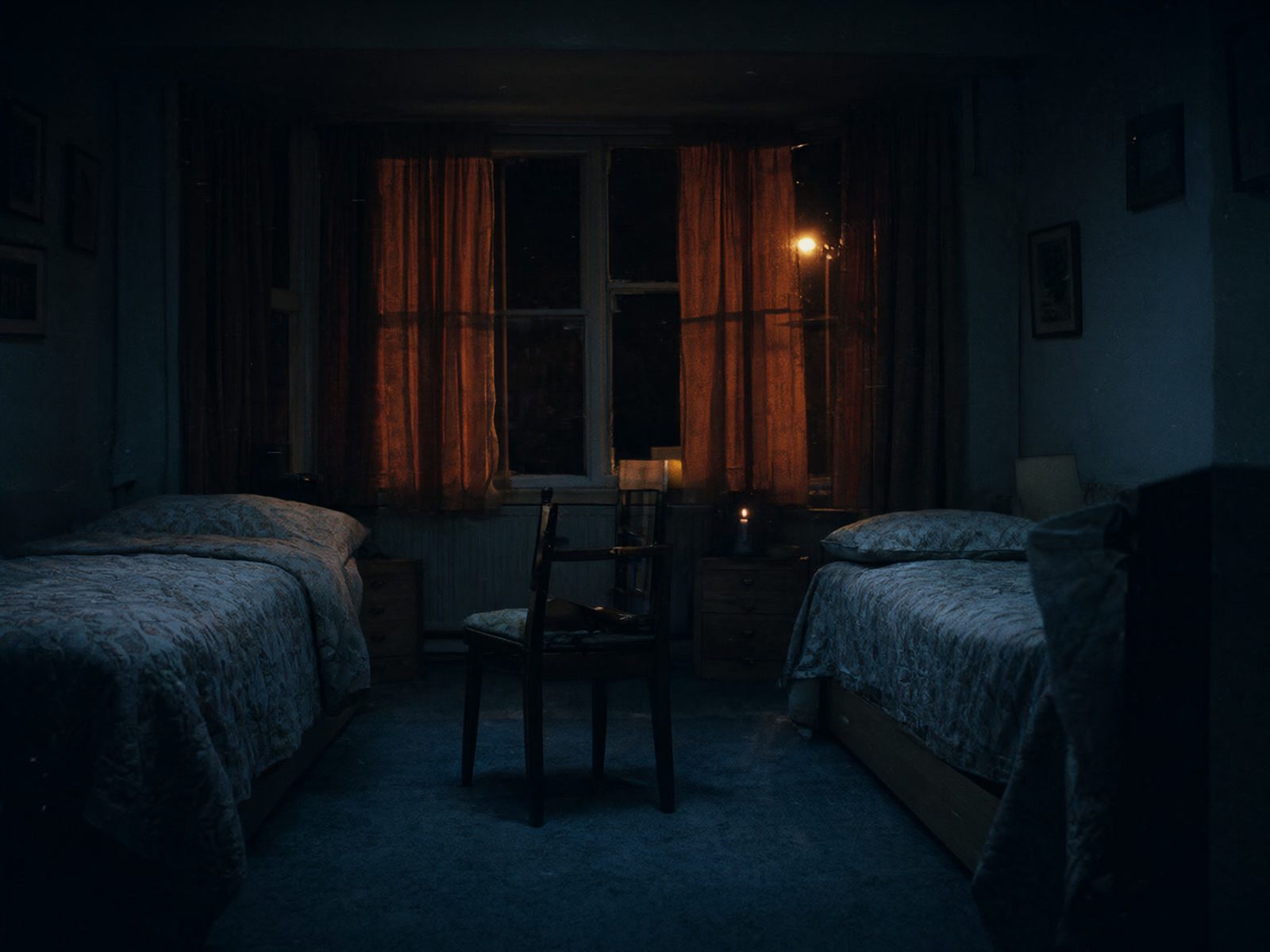
AI illustration · not an evidence photograph
File
BR-0011
Date
31 August 1977 – 1978 or 1979 (sources differ)
Place
Green Street, Enfield, north London
AssessmentB · documented during the events, partial faking admitted
The record on file
Witnesses
The Hodgson family, centred on two sisters aged 11 and 13; their neighbours; a police constable; Daily Mirror reporters and a photographer; the SPR investigators Maurice Grosse and Guy Lyon Playfair; the physicist John Hasted; a BBC radio reporter. The BBC puts the eyewitnesses at over 30
Evidence
A BBC Radio 4 documentary recorded during the events, with recordings of the knocking and the voice; by the Psi Encyclopedia's account, a police constable's statement, Daily Mirror coverage from September 1977, the SPR investigators' tapes and an SPR committee report of 1978
Record made at the time
Rosalind Morris's BBC Radio 4 documentary The Enfield Poltergeist, made from interviews with the family, neighbours and investigators during the events and first broadcast on 26 December 1978, with her recordings of the knocking and the voice. By the Psi Encyclopedia's account, the SPR investigators' tapes and a police constable's statement, reproduced in the SPR committee's 1978 report, also survive.
Agency
Society for Psychical Research (Maurice Grosse, Guy Lyon Playfair)
Late on the night of 31 August 1977, by the Society for Psychical Research's account, a family in a council house at 284 Green Street, Enfield, in north London, heard shuffling and knocking in a bedroom and saw a chest of drawers move across the floor. The disturbances came to centre on Peggy Hodgson's two daughters, Janet, then 11 in most accounts (12 in one), and Margaret, whose age is given as 13 or 14 depending on the source. Other accounts put the first night a day earlier, on 30 August. The neighbours, the Nottinghams, came round, found no source for the knocks, and called the police.
What was reported
Two officers arrived at about one in the morning. One of them, WPC Carolyn Heeps (the name is also spelt Caroline), later gave the investigators a signed statement. In it she describes four distinct taps on a wall, then more from another wall, and then, with the lights off, a chair beside the sofa that she saw "wobbling slightly from side to side" before it slid three or four feet towards the kitchen wall. She wrote that she "could find nothing to explain how it had moved". Her statement places the call at about 1 am on Thursday 1 September.
Over the following days the family and neighbours reported marbles and pieces of Lego flying about the house. On 4 September Peggy Nottingham telephoned the Daily Mirror; its reporter Douglas Bence and photographer Graham Morris visited, and Morris was struck on the forehead by a piece of Lego. Maurice Grosse of the Society for Psychical Research visited on 5 September. The writer Guy Lyon Playfair joined him on 12 September. Over more than a year they made about 180 visits and 25 all-night vigils. Later in the case a gruff male voice, which called itself "Bill", seemed to come from Janet. The BBC counts more than 30 eyewitnesses over some 18 months. By Janet's later account, events quietened in the autumn of 1978, though they did not stop entirely.
The record and where it is held
The police constable's statement and an account by the Mirror reporter George Fallows are reproduced in the 1978 report of an SPR committee (Mary Rose Barrington, Hugh Pincott, Peter Hallson and John Stiles), which is held in the Society's archive at Cambridge University Library. The same archive holds Grosse and Playfair's collection of correspondence, cuttings and articles. Their cassette tapes, more than 180 hours of them, and Grosse's video diaries are in the Society's audio-visual archive, held separately in Norfolk. The BBC reporter Rosalind Morris, who arrived with Playfair, made a Radio 4 documentary first broadcast on 26 December 1978; the BBC restored it in 2018.
What investigators concluded
Grosse and Playfair held that much of what they saw was genuine. They conceded that the girls had sometimes tried to trick them, but said such attempts were few and quickly caught. The physicist John Hasted of Birkbeck College reported sudden weight increases while Janet lay on a weighing couch, and a laryngograph test of the voice with the phonetician Adrian Fourcin suggested sound produced by the false vocal folds. Fallows, for the Mirror, wrote that his team had ruled out total trickery, though "we have been able to simulate most of the phenomena". The SPR committee, by the Society's own summary, found good evidence for some phenomena from credible witnesses, reserved judgement on incidents nobody had clearly seen, and was wary of the voice. Anita Gregory, who visited with John Beloff in December 1977, argued in the Society's journal in 1980 that the girls enjoyed play-acting and that the case had been overrated.
The leading explanation: play-acting
The leading conventional explanation is that the girls produced the effects themselves, and it is partly admitted. In 1980 Janet told ITV News that they had faked things "once or twice" to see whether the investigators would catch them. In a 2011 newspaper interview, asked how much had been faked, she said: "I'd say 2 per cent." Both sisters have otherwise maintained that the events were real. Playfair's own book records the poltergeist acting mainly when unobserved, and the voice speaking only when the girls were alone with the door closed. The ventriloquist Ray Alan and the magician Milbourne Christopher, who both visited, concluded that the girls were responsible; by Playfair's account, Christopher once saw Janet slip out of her room to check that she was not being watched. Melvin Harris read the Mirror's sequence of "levitation" photographs as "gymnastics" rather than levitation. Writing for the Skeptical Inquirer in 2012, Joe Nickell put the faked share closer to all of it.
The explanation is strong because it needs nothing new: most of the effects happened out of sight, under no controls, in a house full of people expecting them. Its weakness is that it accounts for the record rather than for every entry in it. Heeps's chair, the movements Fallows and Grosse said they watched, and Hasted's readings have not been shown, case by case, to be tricks.
What remains disputed
A claim that a video camera caught Janet bending spoons and trying to bend an iron bar appears in later reference books, attributed to Gregory; the footage and a first-hand report of it were not found for this write-up. The share of the events that was faked, and whether any of it was not, remains a matter of judgement.
Sources
Enfield Poltergeist(archived) — Psi Encyclopedia, Society for Psychical Research. Heeps's and Fallows's statements as reproduced in the 1978 committee report, the committee's findings, Hasted, Gregory, visit counts and tape hours.
Enfield Poltergeist(archived) — Joe Nickell, Skeptical Inquirer 36(4), 2012. The sceptical case from Playfair's own book: Ray Alan, Christopher, Harris, Gregory, and the 30 August start date.
Corrected The full file: The text now says WPC Heeps's statement places the call at about 1 am on Thursday 1 September, where an older wording said the statement was dated 1 September. The new wording matches the statement as the SPR reproduces it.
Corrected The full file: The text now drops the claim that the 1978 SPR committee report was never published. No cited source supports that claim.
Corrected The full file: The text gave Janet's age as 11 and Margaret's as 12, 13 or 14. No source gives 12 for Margaret, and the SPR's own article gives Janet as both 11 and 12. The text now says Janet was 11 in most accounts (12 in one) and Margaret 13 or 14.
Corrected Janet's estimate of faked incidents is now quoted as '2 per cent', and the SPR committee's finding is given as the Psi Encyclopedia's summary rather than as the committee's own quoted words.
Added The full file, a long-form write-up with its sources, added.

 INDEPENDENT FIELD ARCHIVE