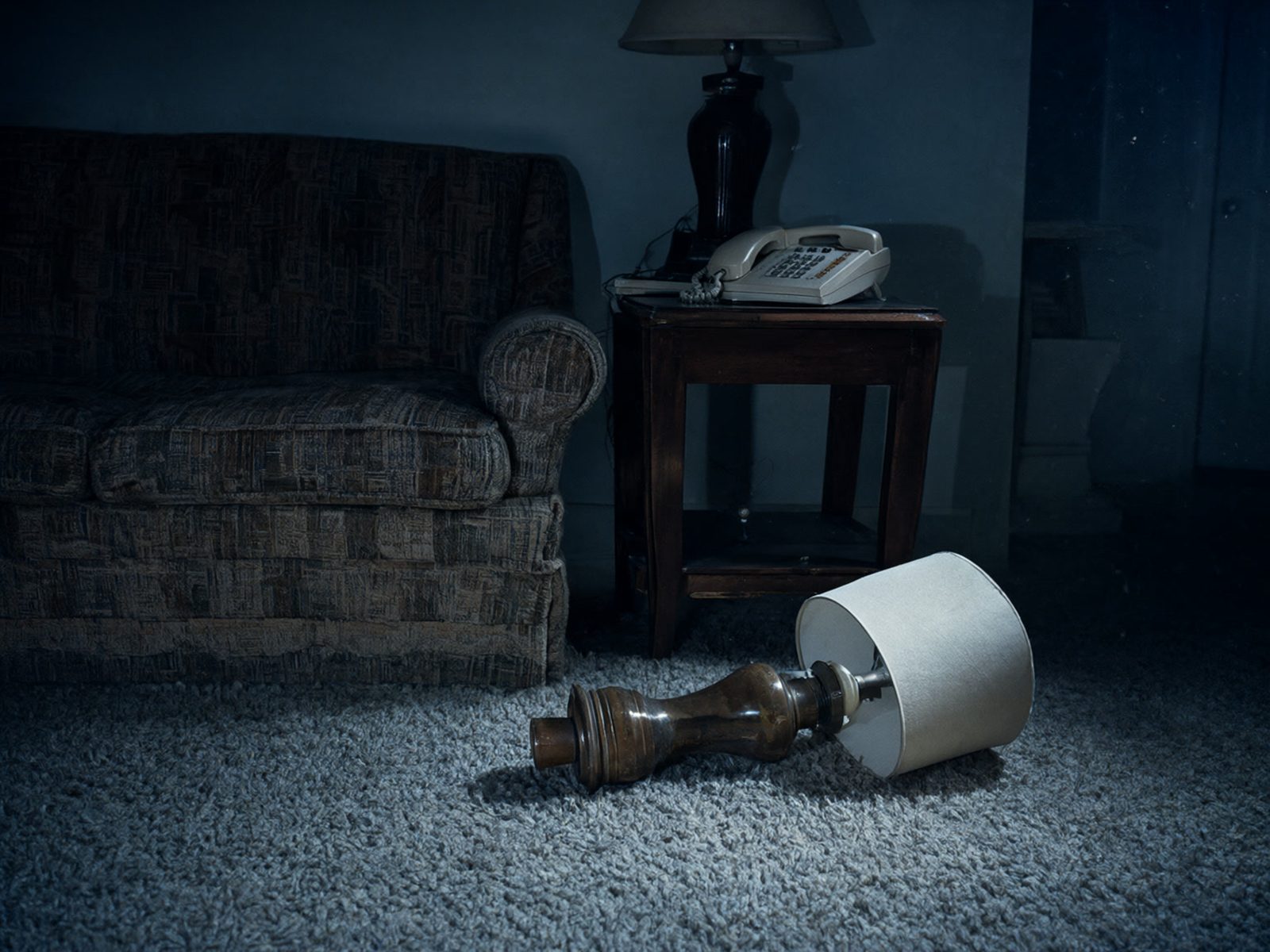
In March 1984 a Columbus couple who had fostered some 250 children reported phones, lamps and furniture flying and falling around their 14-year-old adopted daughter. The Columbus Dispatch published a photograph of a telephone apparently in mid-air in front of her, and it went round the world. On 8 March a television camera left running after a long press visit recorded her checking that no one was watching, pulling a table lamp over and acting terrified, twice.
The leading explanation is an unhappy teenager's tricks, and for the filmed lamp it is accepted: shown the broadcast, she said she was "only fooling", by James Randi's account. Randi, who examined the photographer's whole roll, found seven "flying" telephones and that the photographer had not been looking at her when he took them. William Roll held that some movements he watched on 14 March could not have been hers; by the Psi Encyclopedia's account, a formal test on 29 March scored at chance and further testing in July 1985 was negative.
AI illustration · not an evidence photograph
File
BR-0012
Date
From 1 March 1984 · the lamp filmed 8 March
Place
North Side, Columbus, Ohio
AssessmentD · a specific mundane cause, caught on tape for the key incident
The record on file
Witnesses
The Resch family and their 14-year-old adopted daughter, Tina; Columbus Dispatch reporter Mike Harden and photographer Fred Shannon; television crews; the parapsychologist William Roll and psychologist Kelly Powers
Evidence
Fred Shannon's 36-frame film for the Columbus Dispatch, shot on 5 March 1984; a WTVN-TV camera tape of 8 March; James Randi's report for CSICOP, who examined the whole film roll
Record made at the time
Fred Shannon's photographs for the Columbus Dispatch, taken on 5 March 1984 and published the next day; the WTVN-TV tape of 8 March 1984, of which only the broadcast portion survives by Randi's account; and Randi's report of his inquiry in Columbus from 13 March, published in the Skeptical Inquirer in spring 1985.
Agency
CSICOP (James Randi, with astronomers Steve Shore and Nick Sanduleak); Psychical Research Foundation (William Roll)
On 1 March 1984 the household of John and Joan Resch, on the North Side of Columbus, Ohio, began reporting disturbances centred on their 14-year-old adopted daughter, Tina. The Resches had fostered some 250 children over the years. Over the following days lights, taps and appliances were said to switch themselves on, and telephones, lamps, pictures and furniture to fly or fall, often towards her.
What was reported, and by whom
The family called Mike Harden, a Columbus Dispatch reporter who knew them. On 5 March he returned with the photographer Fred Shannon, and on 6 March the Dispatch ran his story with Shannon's pictures. One frame, a telephone handset apparently in flight in front of a cowering Tina, was distributed by the Associated Press and printed around the world. Reporters and camera crews then filled the house; by Randi's and United Press International's accounts, forty or more people were at times packed into a single room. The family held a long press conference on 8 March.
At the end of that day a camera belonging to WTVN-TV, the Columbus ABC station, was left running while its crew packed up. UPI reported the next morning that the tape showed Tina's hand pulling a lamp off a table. The station's Drew Hadwal said it did not account for other things he had seen there.
The record and where it is now
Three records were made at the time by people other than Tina: Shannon's 36-exposure roll, the WTVN tape, and the work of two sets of investigators. William Roll of the Psychical Research Foundation, with his assistant Kelly Powers, arrived on 11 March and stayed with the family. A team from the Committee for the Scientific Investigation of Claims of the Paranormal (CSICOP) arrived on 13 March: the magician James Randi and the astronomers Steve Shore and Nick Sanduleak of Case Western Reserve University.
Mrs Resch admitted the astronomers but refused the "magician", so Randi worked from the Dispatch contact sheet. His report, "The Columbus Poltergeist Case: Part I", appeared in the Skeptical Inquirer in spring 1985 and is the most accessible primary record, now online through the Center for Inquiry. The Dispatch refused to let him publish the frames and, by UPI's account, locked the negatives away, so his article carries artist's sketches instead. Where they are now is not on record. Of the WTVN tape, Randi says only the broadcast portion was given to him; the station told him the rest had been erased in error. Roll's account appeared in 2004 as Unleashed, written with Valerie Storey.
What the investigators concluded
Randi found seven "flying" telephones on the roll. By Randi's account, Shannon had learned to look away and press the shutter at a movement in the corner of his eye. In Shannon's words, "I decided I would outfox the force." Randi read frame 24, where the cord already lies across Tina's chair, as the set-up for the published frame 25. A sharp tug, he argued, would throw the handset into place. In other frames she holds the phones, holds a picture frame whose glass is already broken, or grips the arms of the recliner whose footrest has just "popped out". He concluded that the evidence for the phenomena was "anecdotal and thin, at best".
Shown the broadcast, Tina said she had been "only fooling" and wanted the cameraman to leave, by Randi's account.
Roll reached the opposite view. By his book's account, as summarised in the Society for Psychical Research's Psi Encyclopedia, he recorded fifteen object movements and five unexplained sounds in 52 minutes on 14 March. He was certain she had not caused six that moved while he watched her. He called the case recurrent spontaneous psychokinesis. A formal test by Richard Broughton at the Institute for Parapsychology on 29 March scored at chance, and further psychokinesis testing in July 1985 was negative.
The leading conventional explanation
The leading explanation is deliberate trickery by an unhappy adolescent, aided by a crowded, excited house and observers who were often looking elsewhere. Its strength is the lamp tape, which shows the method plainly and was admitted, together with Shannon's own description of how he took his pictures. Randi also pointed to motive: Tina wanted to trace her birth parents against the Resches' wishes.
Its weakness is that Randi never entered the house, interviewed Tina or traced the girl seen in several frames. He conceded that his team "was not able to conduct a proper investigation". Fakery in one incident does not prove fakery in every one.
What remains disputed
Roll and Randi contradict each other on plain fact. Randi, retelling Roll's press-conference account, says Tina had spent some 30 minutes alone upstairs before a rush of events in which a tape recorder flew from a dresser behind Roll. Roll answered that Randi misrepresented his reports, that he had been with her during that time, and that he had never claimed to see that recorder move. Randi says the couch seen "jumping out" at her was a rollaway that she could hook with her foot; Roll says it stood on fixed legs. Whether anything in the house happened without a hand behind it rests on Roll's unreplicated observations against the negative tests.
Tina Resch, later Christina Boyer, is living. After her three-year-old daughter died in Georgia in 1992 she entered an Alford plea, accepting a sentence without admitting guilt, and she remains in prison. Roll and Storey's book argues that she was innocent; her case has been the subject of a later documentary series.
Sources
The Columbus Poltergeist Case: Part I(archived) — James Randi, Skeptical Inquirer 9, 1985. The CSICOP inquiry, Shannon's roll frame by frame, the WTVN tape and its erased remainder, the critique of Roll.
Tina Resch (Columbus Poltergeist)(archived) — Psi Encyclopedia, Society for Psychical Research. Dates, Roll's 14 March observations, the 1984–85 tests, Roll's rebuttal of Randi, her later imprisonment.
'Force' may be human hand(archived) — Jodi Gossage, United Press International, 9 March 1984. Contemporaneous report of the lamp tape, Hadwal's comments and the first Dispatch report.
Corrected The full file: The quotation of Mrs Resch's refusal now matches Randi's wording: she admitted the astronomers but not the "magician".
Corrected The full file: The dispute over Roll's 14 March observations now follows the sources: Randi, retelling Roll's press-conference account, says Tina spent some 30 minutes alone upstairs before events in which a tape recorder flew from a dresser behind Roll, and Roll replied that he had been with her and never claimed to see the recorder move.
Corrected The full file: The text said photographer Fred Shannon told Randi how he took his pictures, but Randi never met Shannon; it is now given as Randi's account.
Corrected The full file: Randi's description of the couch is now quoted accurately, as "jumping out" rather than "jumped out".
Added The full file, a long-form write-up with its sources, added.
Also filed under Poltergeists
The Enfield poltergeistThe House in Green Street · 31 August 1977 – 1978 or 1979 (sources differ)
The Rosenheim poltergeistThe Law Office in Rosenheim · October 1967 – January 1968 · telephone faults from the summer

 INDEPENDENT FIELD ARCHIVE