From the autumn of 1967 a Rosenheim law office reported fluorescent tubes turning in their sockets, bulbs exploding, fuses tripping, lamps swinging and the telephone exchange logging calls to the speaking clock that the staff said nobody had dialled. The municipal utility monitored the supply from mid-November, ran a separate cable to the office and, by Bender's later account, brought in a generator, and the disturbances went on. Hans Bender linked them to a 19-year-old office employee, and they stopped at the office once she left.
The first explanation, a fault in the electricity supply, was rejected: two physicists from the Institute for Plasma Physics at Garching found the recorder swings were not voltage changes and concluded that the effects could not be described by known physics and looked "mechanically" produced. Fraud, the remaining explanation, was never settled. In 1970 Die Zeit reported that the authors of a sceptical book had found a nylon thread tied to a lamp that had repeatedly swung, another on the wire stand of a wall plate, and a rubber truncheon behind a shelf; Adam took them to court. By Wikipedia's account, Piet Hein Hoebens (1986) wrote that a policeman caught the employee cheating and that no full report was ever published.
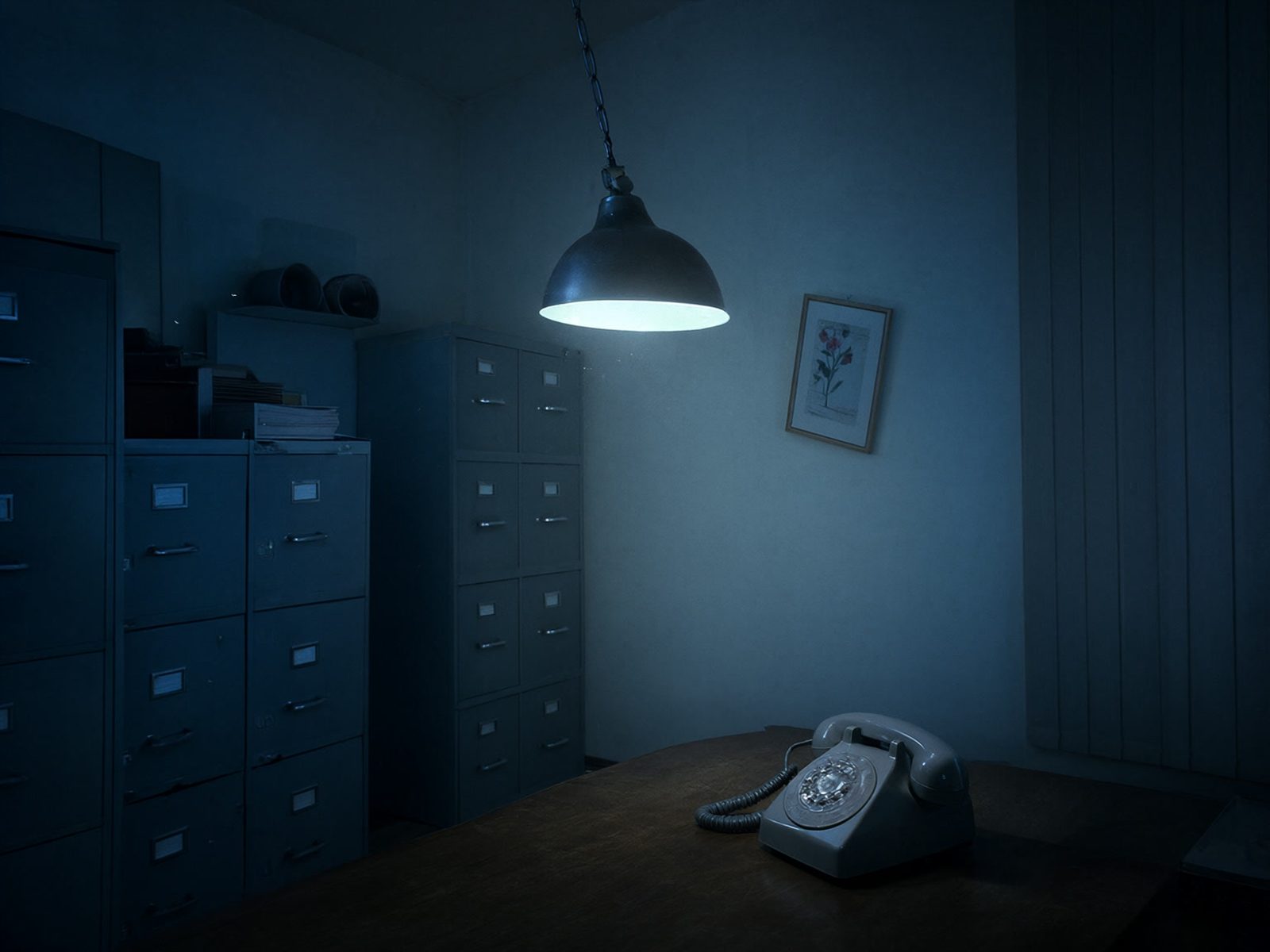
AI illustration · not an evidence photograph
File
BR-0010
Date
October 1967 – January 1968 · telephone faults from the summer
Place
Rosenheim, Bavaria, West Germany
AssessmentA · instrumented by the utility, two physicists and the telephone exchange; fraud alleged
The record on file
Witnesses
Staff of the lawyer Sigmund Adam; engineers of the Rosenheim municipal utility; telephone technicians; the physicists F. Karger and G. Zicha; Hans Bender's team from Freiburg; the criminal police, investigating Adam's complaint against persons unknown
Evidence
Traces from the utility's sealed voltage and current recorders; the physicists' storage-oscilloscope measurements of 6–8 December 1967; the telephone exchange's automatic log of calls to the speaking clock, on some days 40 to 50 in a row; video of swinging lamps
Record made at the time
The Rosenheim utility's inspection report by P. Brunner, dated 21 December 1967, with its recorder strips; Karger and Zicha's oscilloscope measurements in the office on 6–8 December 1967; and the telephone exchange's automatic call records. Bender quotes the utility report, and the physicists published their own report, both in the Zeitschrift für Parapsychologie in 1968.
Agency
Rosenheim municipal utility; F. Karger and G. Zicha (Institute for Plasma Physics, Garching); Hans Bender (Freiburg); Rosenheim criminal police
At the end of November 1967 the German press reported that something was wrong in the law office of Sigmund Adam in Rosenheim, Upper Bavaria. Fluorescent tubes on a 2.5-metre ceiling kept going out, and electricians found them turned about 90 degrees in their holders. Staff reported loud bangs, circuit breakers tripping on their own and developing fluid spilling from the photocopier. The telephones had been misbehaving since the summer: all four extensions rang at once, calls were cut off, and the bills climbed. Both national television channels covered the story before the month was out.
What was reported
The municipal utility's inspection office, under P. Brunner, began monitoring on 16 November 1967 (15 November in the physicists' report) with voltage and current recorders, and asked the staff to log anything unusual. The recorders showed full-scale deflections, some at the moment of an incident. The tubes were replaced with ordinary bulbs, which then burst; on 21 November one exploded in the anteroom while the strip recorded three full deflections. The office was then connected by its own cable directly to the transformer station, ruling out the street cable, house connection and riser, and the disturbances went on. From 30 November the hanging lamps swung, watched by the utility's inspectors. At Adam's insistence an emergency generator was arranged. Bender's 1968 report says only that one was planned; his 1974 account says it was installed and the deflections continued.
Bender and two assistants from the Freiburg institute arrived on 1 December. He reported that the deflections and incidents occurred only in office hours, and most strongly when the 19-year-old employee he calls Annemarie Sch. was present. Pictures then began to turn on the wall. Brunner's inspection report, as Bender quotes it, describes a picture rotating about 320 degrees about a metre from him, and a second inspector confirmed it. By Bender's account, a filing cabinet weighing 3½ Zentner (about 175 kg, the figure he also gives in his 1974 English account) moved about 30 cm from the wall. Annemarie Sch. was sent on leave, came back for 5 to 17 January 1968, and then took a post at another office, after which the disturbances at Adam's office stopped.
The record and where it is held
This case is on the Investigated shelf because records were made at the time by people other than the office staff. The utility's inspection report by Brunner, dated 21 December 1967, with its recorder strips, is quoted by Bender. The Post Office's automatic call logs, kept after the Siemens system was removed and replaced by a single set with a counter, showed the speaking clock, 0119, dialled four or five times a minute and on some days 40 to 50 times in a row; Bender's 1974 chapter says six times a minute. On 19 October 1967 a witness stayed in the office from 17.35 to 17.55, signed a statement that nobody used the telephone, and the log recorded about 20 calls to 0119 in that time. The physicists F. Karger and G. Zicha, of the Institute for Plasma Physics at Garching, made oscilloscope measurements in the office on 6 to 8 December. Adam had filed a complaint against persons unknown, and Bender had the criminal police files. His team recorded lamps swinging and bangs on an Ampex video recorder, and Adam's son later used it to record a picture turning about 320 degrees.
Bender's and Karger and Zicha's reports appeared in the Zeitschrift für Parapsychologie 11 (1968), digitised by Freiburg University Library. The location of the original strips, logs and police files has not been established for this write-up; the Freiburg institute (IGPP) holds Bender's photographs of the case.
What investigators concluded
The physicists excluded voltage changes, capacitor discharges, static charge, magnetic fields, infrasound and ultrasound, vibration, loose contacts and manual operation of the recorder. At their suggestion the utility fed the recorder from a 1.5-volt cell instead of the mains, and the deflections still came. They concluded that a description with existing physics appeared "nicht möglich", that the effects, the telephone ones included, seemed produced mechanically rather than electrodynamically, and that they looked like intelligently guided forces that tended to avoid investigation. Bender called the case spontaneous psychokinesis centred on Annemarie Sch.
The leading conventional explanation
The electrical-fault explanation failed against the physicists' tests. The leading explanation since is fraud. According to Wikipedia's summary of Die Zeit (10 April 1970), the authors of a 1969 book, Falsche Geister, echte Schwindler?, reported nylon threads attached to lamps and a wall plate, and Adam went to court. By the same account, the journalist Piet Hein Hoebens wrote in 1986 that a policeman caught the employee cheating, a fact Bender did not report, and the physicist John Taylor judged in 1980 that the recorder trace looked mechanically made by hand. Fraud explains the threads, the timing in office hours and the link to one person. Its weakness is the record: the deflections came while the recorders were sealed, and the telephone log ran while a witness watched an untouched handset.
What remains disputed
No full report of the case was ever published, as Hoebens noted. The court outcome is not on file. A later book by the criminologist Herbert Schäfer (1994), as cited by Wikipedia, says a manipulation by the employee was detected at least once, which the physicists' own 1968 report does not mention. The telephone log remains the hardest item for either side.
Sources
Der Rosenheimer Spuk – ein Fall spontaner Psychokinese(archived) — Hans Bender, Zeitschrift für Parapsychologie 11, 1968 (Freiburg University Library). The utility's monitoring, Brunner's report, dates, the speaking-clock log, the witnesses and the end of the case.
Spukphänomene(archived) — Gerhard Mayer and Eberhard Bauer, Anomalistik-Handbuch, ch. 15. The Max Planck plasma physicists, audio and video records, the case's status and its critics.
Corrected The full file: Bender's 1968 report gives the filing cabinet as 3½ Zentner (about 175 kg), the same as his 1974 account, not 3.4 Zentner; the supposed discrepancy has been removed.
Corrected The full file: Bender's team recorded swinging lamps and bangs on its Ampex video recorder; the picture turning about 320 degrees was recorded later by Adam's son, and the text now says so.
Corrected The full file: The account of Herbert Schäfer's 1994 book no longer says the physicists themselves detected a manipulation, since the cited summary does not say who detected it.
Corrected The full file: The start of the utility's monitoring is given as 16 November by Bender and 15 November by the physicists; the text now gives both dates.
Corrected The generator brought in at the office is now attributed to Hans Bender's later account, the utility's 1968 report saying only that one was planned; the file previously stated it as fact.
Added The full file, a long-form write-up with its sources, added.

 INDEPENDENT FIELD ARCHIVE