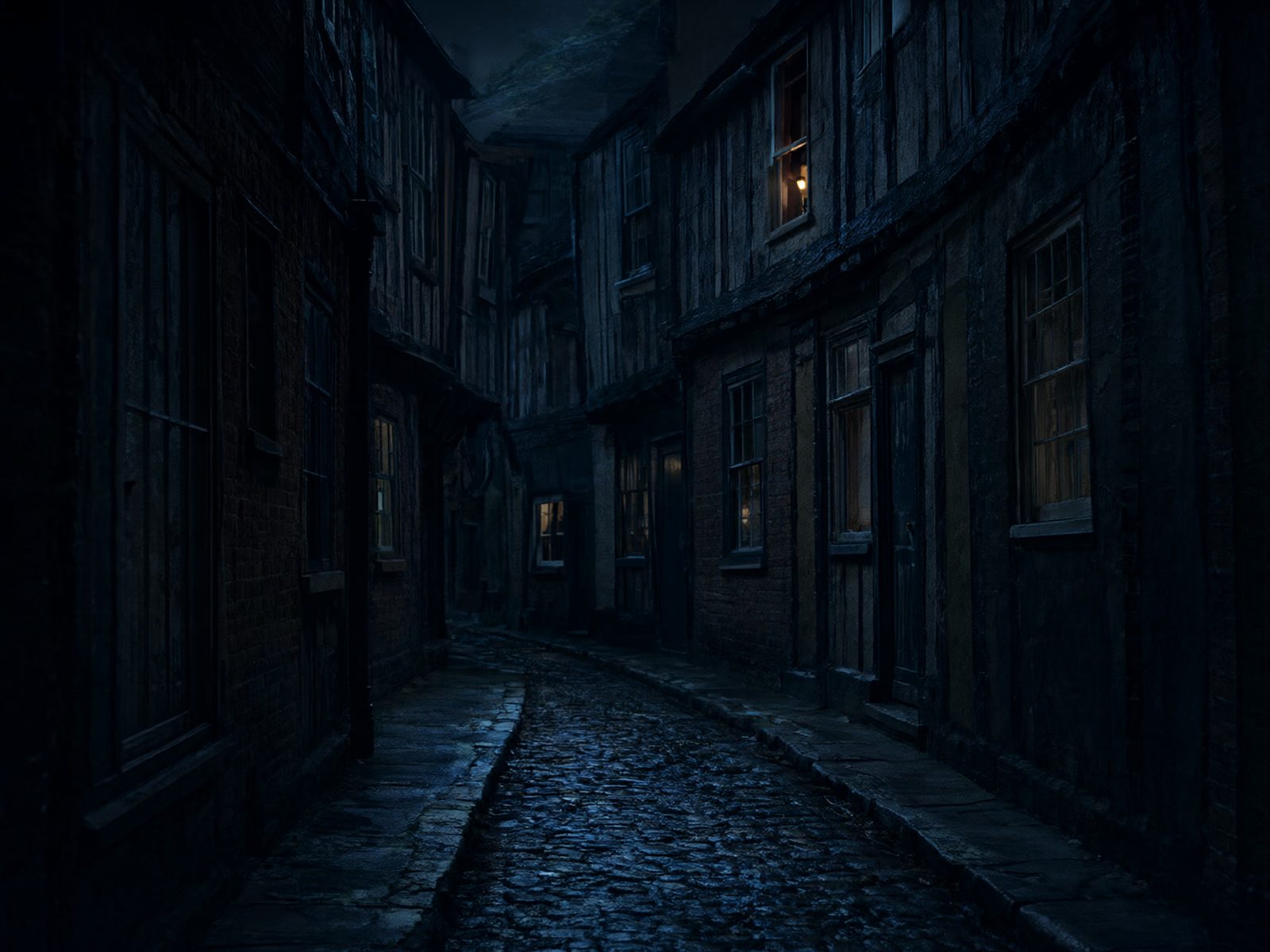
Knocks around a parish clerk's young daughter were taken for the ghost of a dead woman, accusing William Kent, the man she had lived with, of her murder. A committee of clergy and gentlemen sat with the girl on 1 February 1762. Once her hands were kept in view, nothing knocked at all.
The committee's finding: the child "has some art of making or counterfeiting particular noise", with "no agency of any higher cause".
AI illustration · not an evidence photograph
File
BR-0001
Date
1759–62 · committee sat 1 February 1762
Place
Cock Lane, Smithfield, London
AssessmentD · a specific mundane cause, established by investigation and court
The record on file
Witnesses
An investigating committee of clergy and gentlemen, Samuel Johnson among them by Boswell's account, sitting with Elizabeth Parsons, the girl the knocks came from
Evidence
The committee's published account; the conspiracy conviction of her father and others that followed in 1762 is recorded by Dr Johnson's House
Record made at the time
"An Account of the Detection of the Imposture in Cock-Lane", the committee's report, published in The Gentleman's Magazine in February 1762, the month it sat.
Agency
An investigating committee, then the court at Guildhall
In January 1762 the London papers filled with reports of a ghost in Cock Lane, a short street near Smithfield. The noises, knocks and scratches, came from the bed of Elizabeth Parsons, the young daughter of Richard Parsons, clerk of St Sepulchre-without-Newgate. Within weeks a committee of clergy and gentlemen had sat with her, and by the following year her father and four others had been convicted of a conspiracy against the man the knocks accused.
What was reported
The story begins with William Kent, a widower from Norfolk, and Fanny, the sister of his late wife. Barred by canon law from marrying, they lived together as man and wife, and took lodgings in Parsons's house. According to Andrew Lang's reading of the Annual Register, Fanny first heard scratching and rapping while Kent was away at a wedding and Elizabeth was sharing her bed. Kent lent Parsons money, the loan was not repaid, and the couple moved to Bartlet's Court, Clerkenwell, where Fanny died on 2 February 1760. Her physician and apothecary gave the cause as smallpox, and her coffin was laid in the vault of St John's, Clerkenwell. Kent sued Parsons for the debt.
The noises returned in 1761–62 and now centred on Elizabeth, said to be about eleven; Dr Johnson's House gives her age as twelve. Questions were put on the code of one knock for yes and two for no, a method Lang credits to Mary Frazer, who attended the child, and Dr Johnson's House to Parsons and an associate. The answers declared that Fanny had been poisoned with arsenic by Kent.
The record and where it is held
What places the case on this shelf is "An Account of the Detection of the Imposture in Cock-Lane", printed in The Gentleman's Magazine for February 1762, page 81, the month the committee sat. On the night of 1 February a company of gentlemen met at the house of the Rev. Mr Aldrich of Clerkenwell. Several ladies put the girl to bed; the men sat for more than an hour and heard nothing. When ladies near the bed reported knocks and scratches, the girl said she felt the spirit "like a mouse upon her back", and she was made to hold her hands out of bed. From then on nothing happened. At one o'clock the gentleman to whom the spirit had promised a knock on the coffin went down into the St John's vault; there was silence. The magazine credits the account only to "a gentleman of veracity and learning". Boswell's Life of Johnson (1791), on the word of John Douglas, later Bishop of Salisbury, says Johnson wrote it in the committee's presence.
That issue, and those reporting the trial, are scanned on the Internet Archive; the printed volumes are in research libraries. No physical evidence from the case is known to survive.
What investigators concluded
The committee's verdict was that the child "has some art of making or counterfeiting particular noise, and that there is no agency of any higher cause". The magazine added that the imposture had since been detected more clearly. Lang, drawing on contemporary reports, describes what followed: the girl was tested in other houses, and after two silent nights, told that she and her father would go to Newgate if nothing was heard, she hid a small board about six inches by four in her clothes. The maids saw her do it, and the scratches that followed were judged imitations.
On Saturday 10 July 1762, at the court of King's Bench in Guildhall, Parsons, his wife, Mary Frazer, a clergyman and a tradesman were tried before Lord Mansfield and a special jury for conspiring to injure Kent. Secondary accounts name the clergyman as John Moore and the tradesman as Richard James. All were convicted. On 12 February 1763 Parsons was sentenced to the pillory three times in one month and two years' imprisonment, his wife to a year, and Frazer to six months' hard labour in Bridewell. The clergyman and the tradesman, having compromised with Kent, were reprimanded and dismissed; the magazine put the damages and costs at £580 and upwards, while Wikipedia, citing Douglas Grant's 1965 history, gives £588. On 16 March 1763 Parsons stood in the pillory at the end of Cock Lane, and the crowd gave him money instead of pelting him.
The conventional explanation
The accepted explanation is fraud: the child made the noises, coached by her father, whose motive was usually taken to be his quarrel with Kent over the debt. Its strengths are considerable. The noises stopped when her hands were in view, she was seen hiding a board, and a jury convicted the household. Its weakness, pressed by Lang in 1894, is that the investigators never showed how the earlier sounds were made: the scratches she produced with the board did not resemble them, and the first noises came while Parsons was still on good terms with his lodgers, before any quarrel.
What remains disputed
Lang thought a sitting of little more than an hour inadequate and declined to call the cause found, setting the case beside other knocking households; Colin Wilson later read it as an ordinary poltergeist. Neither changes the record: the one controlled test found nothing. Elizabeth's age, the exact damages, and who first proposed the knocking code differ between sources.
Cock Lane and Common-Sense(archived) — Andrew Lang, 1894 (Project Gutenberg). The narrative from the Annual Register, the board, and the case that the cause was never shown.

 INDEPENDENT FIELD ARCHIVE