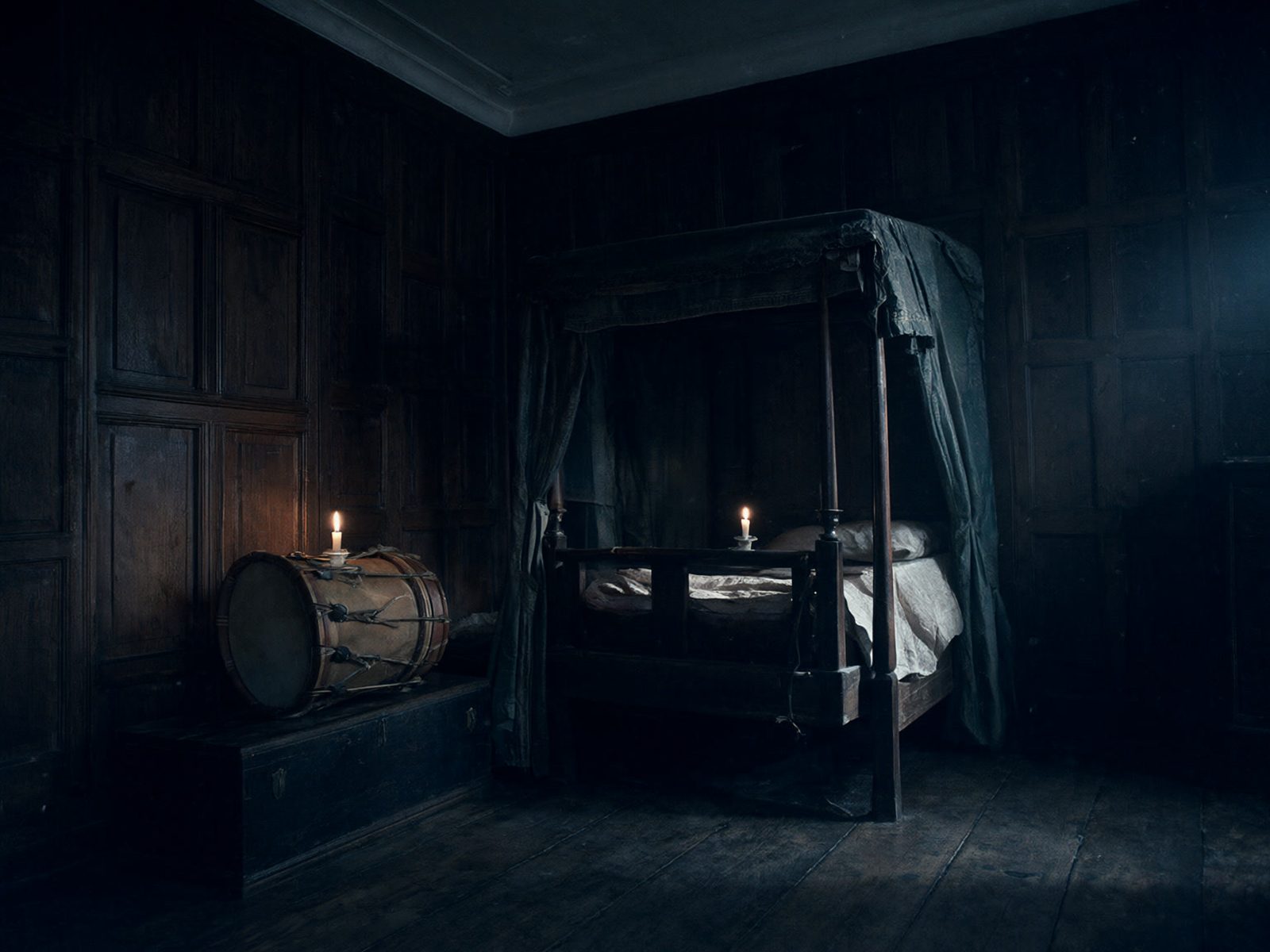
In March 1662 John Mompesson, an excise officer, had a drummer named William Drury arrested over a forged pass and his drum confiscated; in April the drum was sent to Mompesson's house. For more than a year the household reported drumming and knocking, scratching, objects thrown about the room and beds lifted, and visitors came to hear it for themselves. Drury was tried for witchcraft over it at Salisbury in August 1663: the grand jury found the bill and the trial jury acquitted him.
The leading explanation is fraud by someone in the house. The Earl of Chesterfield, sent with Falmouth on the King's behalf, wrote that they "could neither see nor heare any thing that was extraordinary", and that the King later told him Mompesson had confessed the cheat. Mompesson denied any confession in a letter of 8 November 1672. Hunter thinks the confession plausible but notes that it rests on Chesterfield's retrospective account and on rumour. It was never tested, and never settled.
AI illustration · not an evidence photograph
File
BR-0007
Date
April 1662 – at least November 1663
Place
North Tidworth, Wiltshire, England
AssessmentB · documented by visitors at the time, no physical evidence
The record on file
Witnesses
John Mompesson's household and servants; many visitors, among them the clergyman Joseph Glanvill, who stayed at the house in January 1663; the Earls of Chesterfield and Falmouth, sent down on the King's behalf
Evidence
An unsigned visitor's account in the State Papers, a letter from Glanvill written the day after his visit, and depositions printed in two newspapers in April 1663, all published or described by the historian Michael Hunter; Mompesson's own letters to the Oxford professor William Creed
Record made at the time
An unsigned account by a visitor who witnessed the disturbances, filed in the State Papers under 1667 but dated by Michael Hunter to January 1663 (he suggests Glanvill as its author); Glanvill's letter to Richard Baxter of 21 January, dated by Hunter to 1663, saying he had come "yesterday" from the house; and depositions taken before the Wiltshire justice Isaac Burgess and printed in Mercurius Publicus and The Kingdoms Intelligencer in April 1663. The newspapers are cited from Hunter and were not opened.
Agency
Visiting clergy, chiefly Joseph Glanvill; a royal party; the Wiltshire assizes
In March 1662 John Mompesson, a landowner, militia officer and holder of the Wiltshire excise, intervened at Ludgershall when a travelling drummer asked the constable for money on a forged pass. The man was William Drury of Uffcott, near Swindon, a tailor who had served in the parliamentary army. Mompesson had him arrested and his drum taken; Drury was later freed, and in April the drum was sent to Mompesson's house at North Tidworth, then usually spelled Tedworth. For more than a year the household reported knocking, drumming, scratching, panting, smells, lights, objects thrown about and beds lifted, increasingly centred on the children's beds.
What was reported, and by whom
Mompesson described the events in letters to William Creed, Regius Professor of Divinity at Oxford, between December 1662 and January 1663. Those are the experiencer's record. The case is on this shelf because others wrote at the time too. The clergyman Joseph Glanvill stayed at the house in January 1663. That night he heard "as loud a scratching, as one with long Nails could make upon a Bolster" behind the heads of two small girls, then a panting that shook the bed. He and a companion searched the bed, bolster and wall and found nothing. By his own account the louder drumming had stopped before he arrived.
What evidence exists, and where it is held
The record is entirely written; there is no physical evidence. The oldest independent document is an unsigned account by a visitor who saw the disturbance in the children's bed. It is in the State Papers at The National Archives (SP 29/230, no. 177), filed under 1667. The historian Michael Hunter dates it to January 1663 and suggests Glanvill wrote it. Glanvill's letter to Richard Baxter of 21 January, saying he came "yesterday" from the house, is in the Baxter letters at Dr Williams's Library, London. Mompesson's letters survive in copies at Corpus Christi College, Oxford (MS 318). Depositions taken before the Wiltshire justice Isaac Burgess were printed in Mercurius Publicus and The Kingdoms Intelligencer in April 1663, and are the only source for the drummer's name. They are cited here from Hunter and were not consulted directly. Glanvill's printed narrative appeared in 1668 and was revised in Saducismus Triumphatus (1681). It follows Mompesson's letters closely but places the events a year early, in 1661–62; Hunter corrects the dates.
What was concluded at the time
At the Gloucester assizes on 31 March 1663 Drury was convicted of stealing two pigs and sentenced to transportation. He escaped from the barge and returned to Wiltshire, and Mompesson indicted him at Salisbury under the 1604 witchcraft statute. A servant, Thomas Avis, deposed that Drury had said Mompesson "shall never have his quiet again, till I have my Drum". On 3 August 1663, by Mompesson's account, the grand jury found the bill "but the Petty Jury acquitted him, but not without some difficulty". No official record of the trial survives. Drury was again sentenced to transportation over his escape.
Opinion at court was divided. Pepys recorded on 15 June 1663 that Lord Sandwich doubted the story because there was one tune the drummer "tried to play and could not". The Earls of Chesterfield and Falmouth were sent down on the King's behalf. Chesterfield later wrote that they "could neither see nor heare any thing that was extraordinary".
The leading explanation: fraud within the house
Most critics, then and since, have thought someone in the household made the noises. Chesterfield wrote that about a year after the visit the King told him "hee had discovered the Cheat", and that Mompesson had confessed. By 1670 the story was current at court and the Inns of Court. In a letter of 8 November 1672, which Glanvill printed, Mompesson said he would "to my Dying-day" deny any cheat. John Webster in 1677 dismissed the affair as "abominable cheats and impostures". John Aubrey records that Sir Christopher Wren heard a drumming "as one may drum with one's hand upon the wainscot". Wren noticed that it happened only when a certain maidservant was in the next room, behind a thin partition. Another visitor found that the knocks answered spoken requests but not whispered ones.
The fraud explanation fits several facts. The royal party heard nothing, and Wren pointed to a particular person. The noises also kept sociable hours, seldom after midnight or before six. But it has weaknesses. The confession rests on Chesterfield's second-hand account and on rumour. Mompesson denied it in writing, and no motive was established. Glanvill argued that Mompesson had nothing to gain, since the affair had damaged his name, his estate and his household. Glanvill also searched the bed himself and described the search in detail. Hunter finds the confession "highly plausible" but acknowledges how little supports it.
What remains unsettled
No one was caught in the act, and no confession survives in Mompesson's hand. His letters show his reading of events changing as advisers offered explanations, and Glanvill's printed version smooths that over. The sceptics' case survives mostly as anecdote. When the disturbances ended is also unclear. In November 1663 Glanvill reported that the house had been quiet for nine weeks while Drury was away, and that the trouble had come back after he escaped. After that the record stops. The witchcraft charge failed, the fraud charge was never tested, and the case remains open.
Saducismus Triumphatus (1700 edition) — Joseph Glanvill, ed. Henry More, Internet Archive scan. Glanvill's narrative of his visit, his replies to sceptics, and the misdating to 1661.
Saducismus Triumphatus (1705 edition) — Joseph Glanvill, Internet Archive scan. Mompesson's letters of 8 November 1672 (the denial) and 8 August 1674 (the assizes and Avis's deposition).
Drummer of Tedworth(archived) — Psi Encyclopedia, Society for Psychical Research. Used as an index and to cross-check dates and Glanvill page references.
Corrected The full file: Glanvill did not rebut claims that the noises were a ploy to lower a rent or profit from visitors; he argued that Mompesson had nothing to gain because the affair had damaged his name, his estate and his household. The text now says that.
Added The full file, a long-form write-up with its sources, added.
Also filed under Poltergeists
The Cock Lane ghostThe Knocking in Cock Lane · 1759–62 · committee sat 1 February 1762
The Cideville poltergeistThe Presbytery at Cideville · 26 November 1850 – February 1851 · judgment 4 February 1851

 INDEPENDENT FIELD ARCHIVE