Psychic research / Princeton University, New Jersey · replication also at Freiburg and Giessen, Germany
The Machines at Princeton
From 1979 Princeton Engineering Anomalies Research, run by Robert Jahn and Brenda Dunne and funded mainly by private donors, tested whether volunteers could shift the output of electronic random event generators by intention. When Princeton and research groups at Freiburg and Giessen jointly repeated the experiments, the deviations went in the intended direction at all three laboratories, but "failed by an order of magnitude" to match the earlier results or to reach "any persuasive level of statistical significance". Jahn and Dunne closed the laboratory themselves in 2007, as Jahn was about to retire.
The leading conventional explanation, for random-number-generator studies generally, is small-study and publication bias. A meta-analysis of 380 such studies, two of whose authors had taken part in the consortium replication, found "a significant but very small overall effect", strongly and inversely related to sample size, which "could in principle be a result of publication bias". The consortium did not treat its result as null: it reported "interior structural anomalies" in parts of the data.
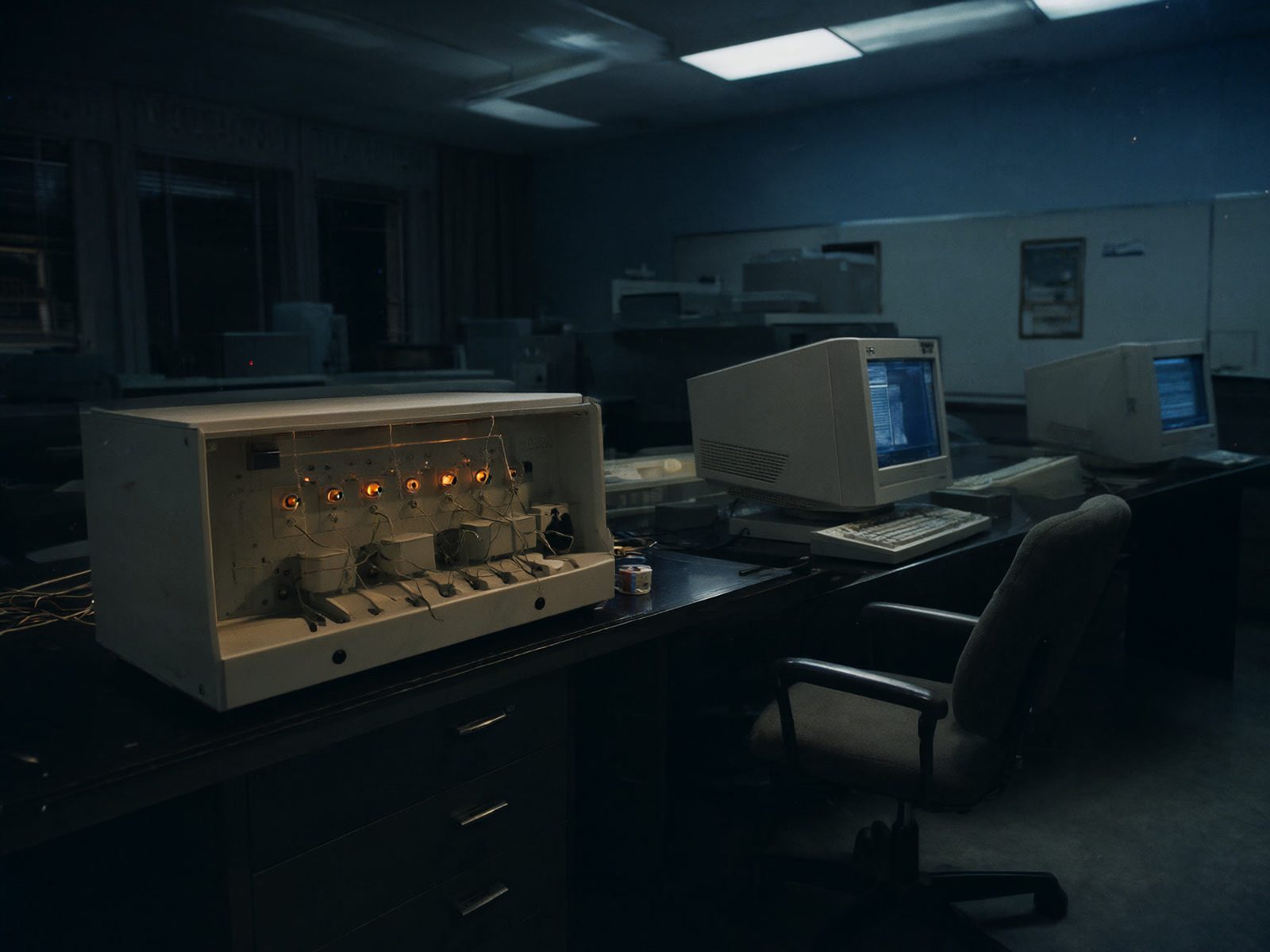
AI illustration · not an evidence photograph
File
BR-0021
Date
1979 – February 2007
Place
Princeton University, New Jersey · replication also at Freiburg and Giessen, Germany
AssessmentB · documented: the laboratory's own multi-site replication, published with its negative primary result
The record on file
Witnesses
Robert Jahn and Brenda Dunne, who ran the laboratory; volunteer operators, 227 of them in the consortium replication
Evidence
The consortium's report of its replication (2000); a meta-analysis of 380 random-number-generator studies, independent of PEAR (Bösch, Steinkamp and Boller, Psychological Bulletin, 2006); press accounts of the closure (Philip Ball, Nature news, 13 February 2007; The Daily Princetonian)
Record made at the time
The Mind/Machine Interaction Consortium's report of its PortREG replication (2000), by Princeton and its partners at Freiburg and Giessen; its abstract states the primary result. Also a meta-analysis by Bösch, Steinkamp and Boller, Psychological Bulletin 132(4), 2006.
Agency
Princeton Engineering Anomalies Research, with the Mind/Machine Interaction Consortium (Freiburg, Giessen, Princeton)
In 1979 Robert G. Jahn, then dean of Princeton's School of Engineering and Applied Science, founded a small laboratory to test whether human intention could alter the behaviour of physical devices. Princeton Engineering Anomalies Research, known as PEAR, ran for twenty-eight years in the engineering building, managed by Brenda Dunne and paid for almost entirely by private donors, among them James McDonnell of McDonnell Douglas. Unusually for the field, its last major experiment was a strict replication, run with outside partners, whose primary result its own founders published as a failure.
What was reported
PEAR's main instrument was the random event generator: an electronic noise source sampled into strings of binary bits, summed into "trials" of 200 bits, with a chance mean of 100. Volunteer "operators", unpaid and anonymous, sat by the machine and tried in turn to push its output higher, push it lower, or leave it alone, the three intentions recorded in advance. Jahn set out the programme for an engineering audience in "The persistent paradox of psychic phenomena: an engineering perspective", in the Proceedings of the IEEE in 1982.
Over the following years the laboratory reported a small but persistent shift in the intended direction. Its benchmark database, as summarised in 2000, came from 91 operators over twelve years: 522 series and nearly two and a half million trials, with a separation between high and low intentions of about 0.02 on the 100-point scale and a Z-score of 3.81. That is a few parts in ten thousand, made statistically significant only by the size of the database.
The record and where it is held
The case is on this shelf because of a record its subjects did not write: the multi-laboratory replication. In 1996 PEAR formed the Mind/Machine Interaction Consortium with the Freiburg Anomalous Mind/Machine Interactions group at the Institut für Grenzgebiete der Psychologie und Psychohygiene, Freiburg, and the Giessen Anomalies Research Project at Justus-Liebig-Universität Giessen. Each laboratory collected 250 sessions of 3,000 trials on identical PortREG noise sources, with 227 operators in all, under an agreed primary criterion: the high-minus-low separation. The twelve authors, from all three groups, published the result in the Journal of Scientific Exploration 14(4), pp. 499–555, in 2000. A copy is hosted by the International Consciousness Research Laboratories, the organisation that succeeded PEAR.
What investigators concluded
The consortium's abstract is plain. The separations went the intended way at all three sites, but "failed by an order of magnitude" to match the earlier experiments, or to reach "any persuasive level of statistical significance". In the paper's tables the pooled separation is about 0.003, with a Z-score of 0.60; Princeton's own share is about 0.002, Z of 0.17. The authors called this "an empirical paradox". They reported instead "interior structural anomalies", such as depressed trial-level standard deviations and irregular series-position patterns, which they judged well beyond chance, though none was the agreed test. They suggested that the simpler equipment, computer-screen feedback, or a changed operator pool might explain the drop.
Stanley Jeffers, a physicist at York University in Toronto who had run experiments of this kind with others in the field, wrote in the Skeptical Inquirer in 2006 that "even the PEAR group was unable to reproduce a credible effect". He also argued that PEAR's baseline data, the condition in which operators tried to do nothing, fell outside the laboratory's own significance limits, which would suggest the device was not behaving randomly.
Jahn and Dunne closed the laboratory in February 2007. Nature's news report of 13 February quoted their statement that they had "accomplished what we originally set out to do 28 years ago". The Daily Princetonian reported that the equipment had been dismantled, much of it bought by other researchers, and that donor deaths had left the laboratory unable to renew it; Jahn spoke of "a law of diminishing returns". The Daily Pennsylvanian, reporting on 19 February, said instead that the laboratory would close at the end of the year.
The leading conventional explanation
For random-generator studies in general, the leading explanation is small-study and publication bias. In 2006 H. Bösch, F. Steinkamp and E. Boller combined 380 such studies in Psychological Bulletin and found "a significant but very small overall effect size", with effect sizes "strongly and inversely related to sample size". A simulation showed that this pattern "could in principle be a result of publication bias". Bösch and Boller had been Freiburg members of the consortium, so the meta-analysis was independent of PEAR but not of the replication. For PEAR itself, the plainest reading is that an effect this small, found mainly in one laboratory's database, shrank towards zero when the same laboratory and two others tested it under an agreed criterion.
The explanation has limits. Publication bias across many studies does not by itself explain the shift in PEAR's own benchmark database. Jeffers's baseline argument points to a fault in the device or the analysis but does not identify one.
What remains disputed
Proponents did not accept the bias reading. Dean Radin, Roger Nelson, York Dobyns and Joop Houtkooper replied in the same journal that Bösch and colleagues had wrongly assumed effect size to be independent of sample size, and called selective reporting "an implausible explanation". Whether the benchmark shift reflects an undetected technical or statistical artefact, and whether the structural anomalies in the replication mean anything beyond the many comparisons made, have not been settled in print.
Corrected The full file: Stanley Jeffers was described as having collaborated with the PEAR group; his Skeptical Inquirer article says only that he had run such experiments with others in the field, and the text now says that.
Corrected The full file: The text said PEAR reports that it published its benchmark data in full; no cited source says so, and the sentence now says only that publication bias across many studies does not by itself explain the shift in PEAR's own database.
Corrected The 2006 meta-analysis by Bösch, Steinkamp and Boller is now described as independent of PEAR but not of the consortium replication, two of its authors having taken part in it; the file previously called it independent outright.
Added The full file, a long-form write-up with its sources, added.
Also filed under Psychic research
Pat Price and URDF-3The Crane at URDF-3 · 9–11 and 15 July 1974 · analysed 4 December 1975

 INDEPENDENT FIELD ARCHIVE