Psychic research / Institute for Parapsychology, Foundation for Research on the Nature of Man, Durham, North Carolina
The Second Recorder
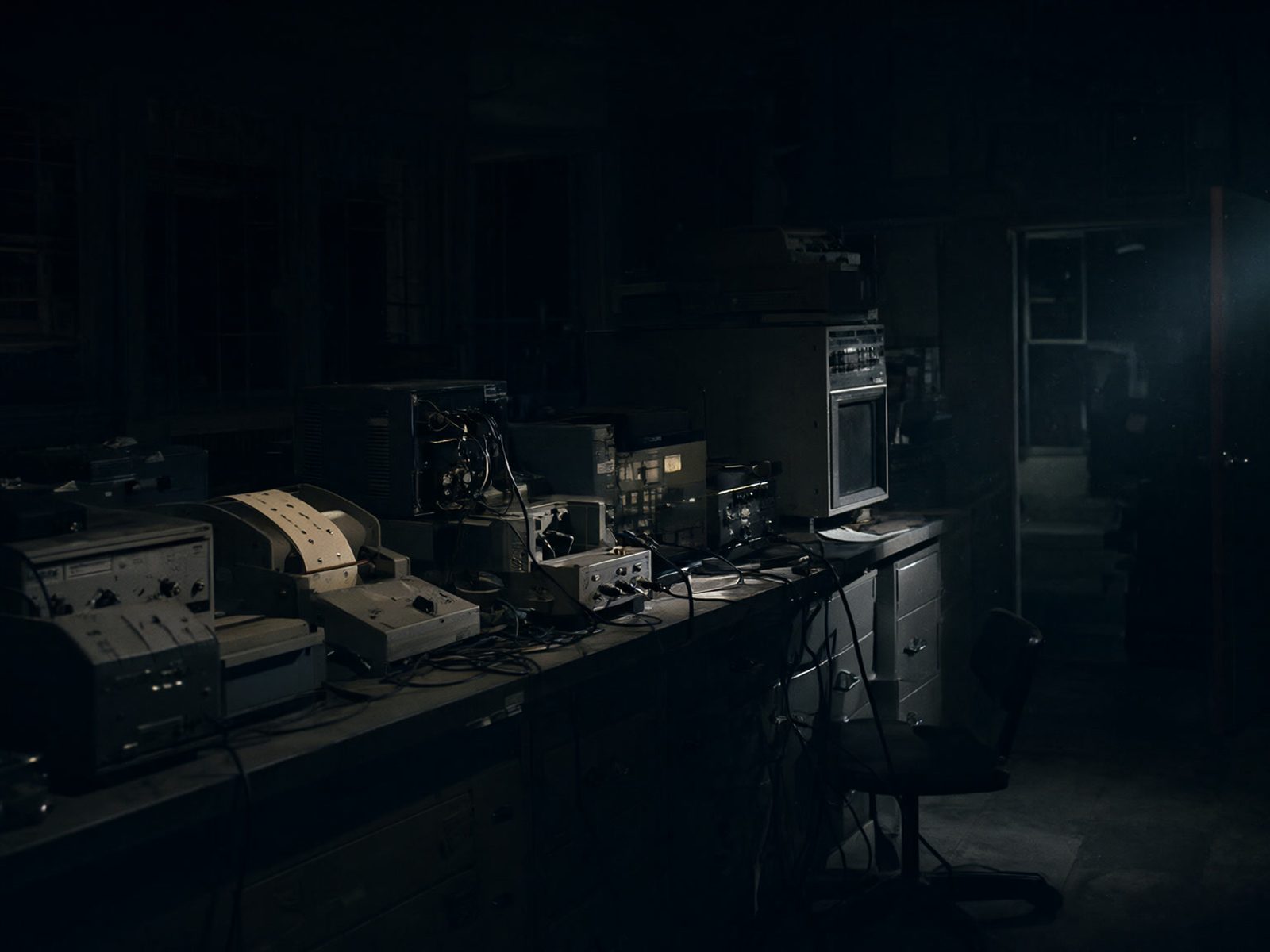
In 1974 three researchers at the Institute for Parapsychology grew suspicious of how often its director, W. J. Levy, had his hands in the equipment during automated psychokinesis experiments with rats. They secretly set up a chart recorder in the basement on the random generator's output, and on 11 June one of them watched from the porch as Levy reached into the wiring, then saw through a window that the plug for the channel recording misses had been pulled. Against the chart, the official paper-punch record showed that during long strings of hits "the misses were simply not recorded".
The explanation on file is deliberate falsification of the official record, caught by a parallel recording and an eyewitness. By the Psi Encyclopedia's account, Levy resigned when confronted and Rhine reported the investigation in 1974 and again in 1975. The chronology is the researchers' own and is hosted on Kennedy's site, not in an archive.
AI illustration · not an evidence photograph
File
BR-0019
Date
10 May – 11 June 1974
Place
Institute for Parapsychology, Foundation for Research on the Nature of Man, Durham, North Carolina
AssessmentD · a specific mundane cause, established by a parallel record and an eyewitness
The record on file
Witnesses
Three of the institute's researchers, J. E. Kennedy, J. W. Davis and J. Levin, watching its director, W. J. Levy
Evidence
The three researchers' dated chronology, written in 1974; an Esterline Angus chart recorder run in the basement in parallel with the official paper-punch record
Record made at the time
A chronology written in 1974 by J. E. Kennedy, J. W. Davis and J. Levin "to summarize what had happened", with notes Kennedy added in March 2005. The copy is on Kennedy's own site, not in an archive.
Agency
Institute for Parapsychology, Foundation for Research on the Nature of Man
In the spring of 1974 the Institute for Parapsychology in Durham, North Carolina, was run day to day by Walter J. Levy Jr., a young medical graduate whom J. B. Rhine had hired full-time in 1973 and soon made its director. Time gave his age as 26 that August. Levy specialised in automated experiments on animal psi: gerbils, chick embryos and rats, each wired to a random generator so that a psychic effect would show up as a score above chance with no human judgement involved. Between 10 May and 11 June 1974 three junior researchers at the institute, Jerry Levin, James Davis and James Kennedy, came to suspect that the scores were being made by Levy rather than by the animals, and set out to test it.
What was reported
The three researchers' own account is precise. On Friday 10 May Levin found Levy at the indicator panel during a gerbil precognition study, holding wires from the random generator in a position where he could control the target and follow the run. Unable to see a clear act of manipulation, Levin taped the wires and told the others. On Saturday 8 June Kennedy ran a rat experiment, on the effect of valium on psychokinetic scoring, in which the rat's wires had been left disconnected without Levy's knowledge. He saw Levy with his hand in the equipment several times, and more than once found a long string of hits on the paper-tape punch, the official record, just after Levy had left the room.
On the night of 9 June the three set up an Esterline Angus chart recorder in the basement to record the random generator's output independently. On 11 June, during an evening rat experiment, Davis heard the mechanical counter sound on every four-second trial while the paper punch did not register on every trial. Comparing the two records, he found that when a long string of hits occurred on the punch tape, "the misses were simply not recorded". He then watched from the porch as Levy put his hand among the wires to the punch, and saw through the window that the plug for the channel recording misses had been pulled.
The record and where it is held
The case is on this shelf because a record made at the time by people other than the experimenter survives. It is the dated chronology the three wrote in 1974 to summarise what had happened, with notes Kennedy added in March 2005. The copy available is on Kennedy's own website, not in an archive. The chart recording and the punch tapes themselves have not been published, and no public archive is known to hold them. Rhine's own reports appeared in the Journal of Parapsychology.
What investigators concluded
Rhine confronted Levy, who admitted falsifying the recent rat work and resigned. Time reported the resignation on 26 August 1974 and said Rhine had told other parapsychologists not to rely on Levy's data until they were checked. Levy maintained, according to Kennedy's 1975 summary and Time, that his earlier work was genuine and that he had only begun to falsify when the effect was lost. Rhine reported the case in the Journal of Parapsychology in 1974, in a paper titled "A new case of experimenter unreliability", and followed it with "A second report on a case of experimenter fraud" in 1975. The psychologist Chris Roe, summarising the second report, writes that Rhine concluded no study fully excluded dishonesty and wrote the whole body of work off.
The institute's checks did not support Levy's defence. Kennedy's 1975 summary records that the laboratory notebook for the rat work, last seen with Levy, was missing, and that rats tested after his departure showed no consistent self-stimulation and no consistent psychic effect. Staff then found that published practice gave bar-pressing rates far above the 200 to 400 an hour Levy had recorded, and that roughly handled rats would exceed his criterion of 250 an hour with no stimulation at all. Kennedy concluded that Levy had probably never had a rat that truly self-stimulated. Kennedy now writes that the investigation found evidence of fraud in all of Levy's research.
The conventional explanation
The leading explanation is the established finding: the director falsified the official record by disconnecting the channel that logged misses, and the effect disappeared when an independent recorder ran in parallel. It is well supported. Two kinds of record agree, one mechanical and one observed, and Levy admitted the falsification. Its limit is scope: the sting caught one experiment, and the verdict on the rest rests on the institute's later checks.
What remains disputed
Nothing about the June experiment is in serious dispute. What is argued over is detail and meaning. Accounts of the method differ: Roe describes the colleagues as wiring the computer to produce a second record, while the chronology describes a separate chart recorder in the basement, and Kennedy has criticised several published versions, including Roe's, as inaccurate. Citations for Rhine's 1975 report also differ, giving volume 38 or volume 39 of the journal. The wider argument is how typical the case is. Roe treats it as one of only two well-established frauds in experimental parapsychology, comparable to cases in mainstream biology; Kennedy treats it as evidence that misconduct is a standing risk in the field. Much of the detailed record comes from Kennedy himself, which should be borne in mind.
Sources
Chronology of Events in Exposing W. J. Levy(archived) — J. E. Kennedy, J. W. Davis and J. Levin, 1974, with notes by Kennedy, 2005 (author-hosted). Dates from 10 May to 11 June, the chart recorder, the porch and window observations.
Summary of Rat Implantation Work(archived) — J. E. Kennedy, 1975 (author-hosted). Levy's admission and defence, the lost notebook, failed retests and the bar-pressing criterion.
Science: The Psychic Scandal(archived) — Time, 26 August 1974. Contemporaneous press: Levy's age, hiring, 54 per cent scores, resignation and Rhine's warning to colleagues.
The Problem of Fraud in Parapsychology(archived) — Chris A. Roe, Mindfield 8(1), Parapsychological Association, 2016. Citations for Rhine 1974 and 1975, Rhine's write-off of the work, and the comparison with mainstream fraud.
Fraud articles(archived) — J. E. Kennedy (author-hosted). Index to the 1974–75 documents and his criticism of published accounts by Rogo, Roe and Palmer.
Corrected The full file: The text said Levy used 200 to 400 bar presses an hour as his criterion; Kennedy's 1975 summary gives 200 to 400 as the rates Levy recorded and 250 an hour as his criterion, and the text now gives both figures correctly.
Corrected The full file: Rats retested after Levy left were said to show no psychic effect; Kennedy's summary records one session with significant below-chance scoring and no consistent effect after that, and the text now says no consistent effect.
Corrected Rhine first reported the Levy investigation in 1974, and again in 1975; the file previously gave 1975 alone.
Added The full file, a long-form write-up with its sources, added.
Also filed under Psychic research
Pat Price and URDF-3The Crane at URDF-3 · 9–11 and 15 July 1974 · analysed 4 December 1975
The ganzfeld experimentsThe Ganzfeld Dispute · Experiments from about 1974 · debated in Psychological Bulletin 1994–2013
The Star Gate remote-viewing programmeThe Evaluation of Remote Viewing · CIA programme 1972–77, DIA from about 1985 · evaluation dated 29 September 1995

 INDEPENDENT FIELD ARCHIVE