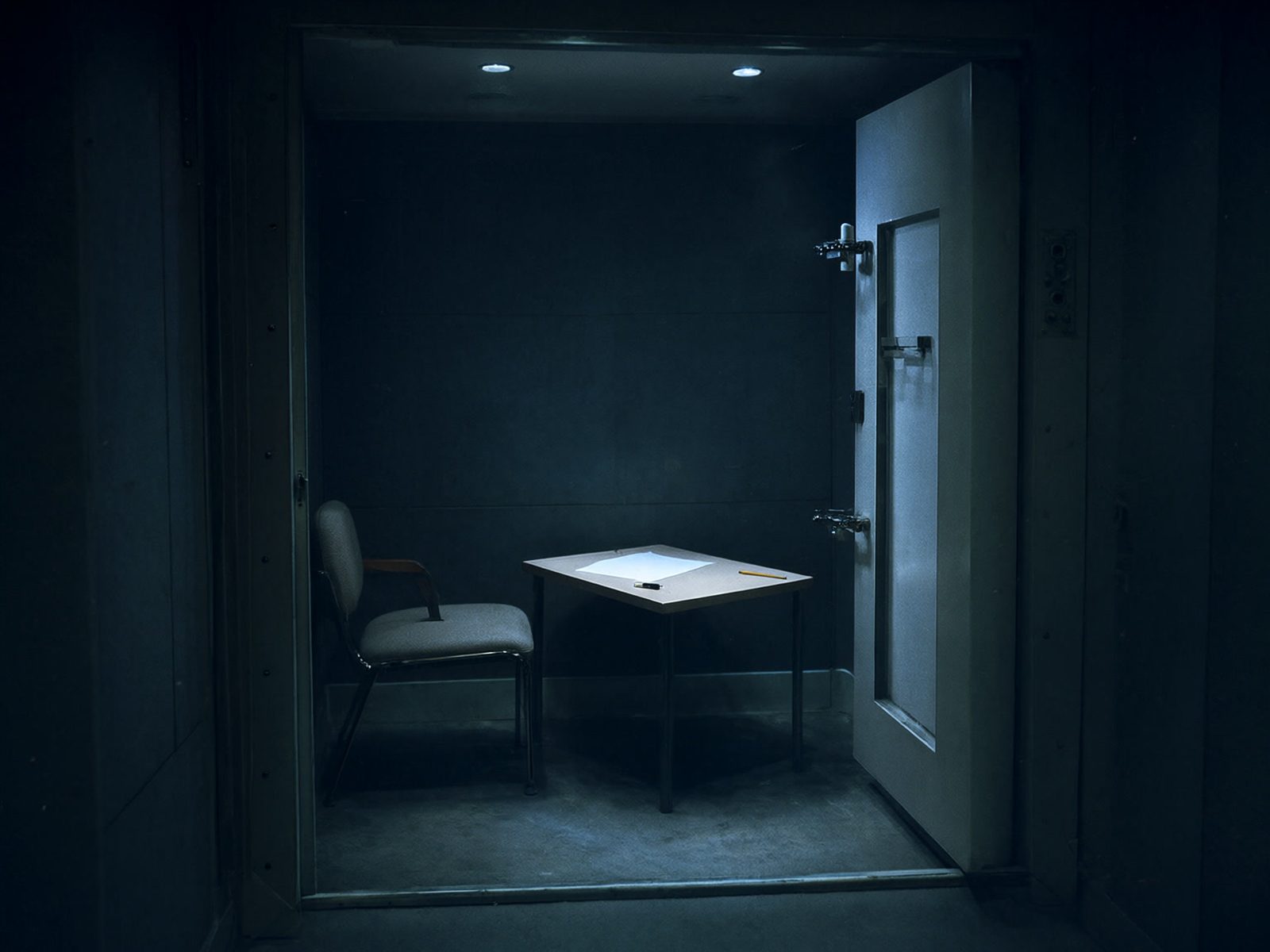
Psychic research / Stanford Research Institute, Menlo Park, California
The Shielded Room at SRI
In August 1973 two SRI physicists, Russell Targ and Harold Puthoff, had Uri Geller reproduce drawings while he was locked in a double-walled shielded room, and in October 1974 Nature published their paper on information transmission under sensory shielding. Nature printed it beside a leading article reporting that its referees agreed the paper was "weak in design and presentation", and that it contained no evidence for Geller's claimed metal-bending. In 1978 David Marks and Richard Kammann reported in Nature that duplicate remote-viewing experiments "do not verify their conclusions".
The conventional explanations were on file from the start. A CIA memo records ARPA's "serious doubt" that Geller's feats went beyond "the range of activities of a skillful magician", and concern about the researchers' "experimental bias in favor of successful outcomes". For the remote viewing, AIR's 1995 review recorded critics' finding that matches could be made "just from cues contained in the transcripts", with "no way to determine the extent" of the effect. Neither explanation was confirmed or excluded.
AI illustration · not an evidence photograph
File
BR-0015
Date
January 1973 – October 1974 · replication reported August 1978
Place
Stanford Research Institute, Menlo Park, California
AssessmentB · documented: a peer-reviewed paper with its referees' criticisms published alongside it
The record on file
Witnesses
The physicists Russell Targ and Harold Puthoff, testing Uri Geller and remote-viewing subjects; ARPA scientists who visited SRI to watch; Nature's three referees
Evidence
SRI's write-up of the Geller sessions of 4–11 August 1973; a CIA memorandum of 24 January 1973 on SRI's briefing; Nature's 18 October 1974 issue carrying the paper and a leading article on its refereeing; Marks and Kammann's reply in Nature, August 1978
Record made at the time
SRI's write-up, Experiments – Uri Geller at SRI, August 4–11, 1973 (CIA-RDP96-00787R000700110003-2); a CIA memorandum dated 24 January 1973 on SRI's briefing the day before (CIA-RDP96-00787R000400070029-2); and Nature's leading article of 18 October 1974 on the refereeing of Targ and Puthoff's paper (CIA-RDP96-00787R000700050002-0).
Agency
Stanford Research Institute; Nature's referees; CIA and ARPA observers
In the early 1970s Russell Targ and Harold Puthoff, physicists at Stanford Research Institute in Menlo Park, California, began testing people who claimed extrasensory abilities, the best known being Uri Geller, an Israeli performer known for apparently bending cutlery. Their results reached Nature on 18 October 1974, in a paper titled "Information transmission under conditions of sensory shielding", printed with an unusually frank leading article on its refereeing.
What was reported
The earliest dated record is a CIA memorandum of 24 January 1973. It reports that on 23 January Targ and Puthoff showed a film of their work with Geller, described there as "an Israeli magician with claimed capabilities in ESP". The film showed him reproducing sealed drawings, calling the face of a shaken die, picking out which of twelve containers held metal or water, and bending spoons. According to the memo, Edgar Mitchell's foundation had supported the work.
The formal series ran in August 1973. SRI's own write-up, Experiments – Uri Geller at SRI, August 4–11, 1973, describes Geller shut in "an opaque, acoustically and electrically shielded room", the double-walled shielded room used for EEG research, with inner and outer doors on refrigerator-type locks. Outside, experimenters chose a target, at first by opening a dictionary at random and taking the first word that could be drawn, and drew it. Geller then tried to draw it from inside the room. The write-up concludes, underlined, that Geller "has demonstrated his paranormal perceptual ability in a convincing and unambiguous manner."
The Nature paper reported thirteen drawing experiments; the write-up speaks of eight days of sessions, while the paper says seven, and its table runs from 4 to 10 August. In ten of the thirteen Geller gave a response, and two SRI scientists not involved in the work matched the drawings to the targets blind, both without error. The authors gave the odds against chance as about three in ten million. In a die test Geller answered eight times out of ten, correctly each time. The paper also reported remote viewing by Pat Price, a former police commissioner, who described Bay Area sites while a team visited them. On metal-bending the authors were explicit: they had not been able to obtain data "sufficient to support the paranormal hypothesis."
What evidence exists
SRI's 30-page session write-up and the CIA's January 1973 memo, released in 2003 and 2000, are held in the CIA's online Reading Room among the papers of the government's later remote-viewing programmes. The Nature issue of 18 October 1974 is in Nature's archive and is also filed there, as is New Scientist's issue of 17 October 1974, given over largely to Joseph Hanlon's investigation, "Uri Geller and Science". The drawings themselves survive only as the figures reproduced in the paper.
What investigators concluded
Doubt was recorded before the work was published. The CIA memo notes that ARPA scientists who had visited SRI had "serious doubt" that Geller's feats went beyond what "a skillful magician can perform", and concern that the experimenters' "experimental bias in favor of successful outcomes" was weakening their controls. The memo's author added that he had seen no unorthodox behaviour by Puthoff or Targ at the briefing.
Nature's leading article, "Investigating the paranormal", reported that of its three referees one opposed publication, one was neutral and one was "guardedly in favour". All agreed the paper was "weak in design and presentation", its account of how the experiments were run "disconcertingly vague", the dictionary method of choosing targets naive, and the safeguards against fraud also vague. The journal published anyway, so that others could judge the work, and stressed that the paper contained no evidence for Geller's claimed metal-bending. New Scientist, in the same week, reported that Geller had agreed to be tested by a panel that included a professional magician and later withdrew.
The remote-viewing series drew the most sustained criticism. In August 1978 David Marks and Richard Kammann, psychologists at the University of Otago, reported in Nature that they had run duplicate experiments and that "our results do not verify their conclusions." Tart, Puthoff and Targ replied in Nature in 1980; Marks answered in 1981 under the title "Sensory cues invalidate remote viewing experiments".
The conventional explanation
For the Geller sessions, the leading explanation is conjuring under loose controls: a practised performer, loosely randomised targets, and safeguards the referees could not reconstruct from the paper. Its strength is that ARPA's observers, the referees and New Scientist raised it independently. Its weakness is that no one has shown how a particular result was obtained; the explanation rests on what the controls failed to exclude, not on a demonstrated method.
For the remote viewing, the explanation is cueing in the transcripts. Jessica Utts's 1995 review for the American Institutes for Research, broadly favourable to the field, still recorded that critics showed matches could be made "just from cues contained in the transcripts", for instance when a viewer mentioned a previous day's target, and that there was "no way to determine the extent" of the effect.
What remains disputed
Neither explanation was confirmed or ruled out for these sessions, and the original material cannot now be re-run. What is settled is narrower: the paper was published over its referees' reservations, its strongest claims were not reproduced by an independent laboratory, and later SRI work, by Utts's account, was designed to remove the weaknesses identified here. Geller's own abilities remain a matter of his claim and his critics' rebuttals, not of any finding in this record.
Corrected The full file: Nature's referees called the account of how the experiments were carried out 'disconcertingly vague'; the text had applied that phrase to the safeguards against fraud, which the editorial describes separately as vague. Both are now given correctly.
Corrected The full file: SRI's write-up describes a double-walled shielded room, not a steel room; the text now says shielded.
Added The full file, a long-form write-up with its sources, added.
Also filed under Psychic research
The ganzfeld experimentsThe Ganzfeld Dispute · Experiments from about 1974 · debated in Psychological Bulletin 1994–2013
The Star Gate remote-viewing programmeThe Evaluation of Remote Viewing · CIA programme 1972–77, DIA from about 1985 · evaluation dated 29 September 1995

 INDEPENDENT FIELD ARCHIVE