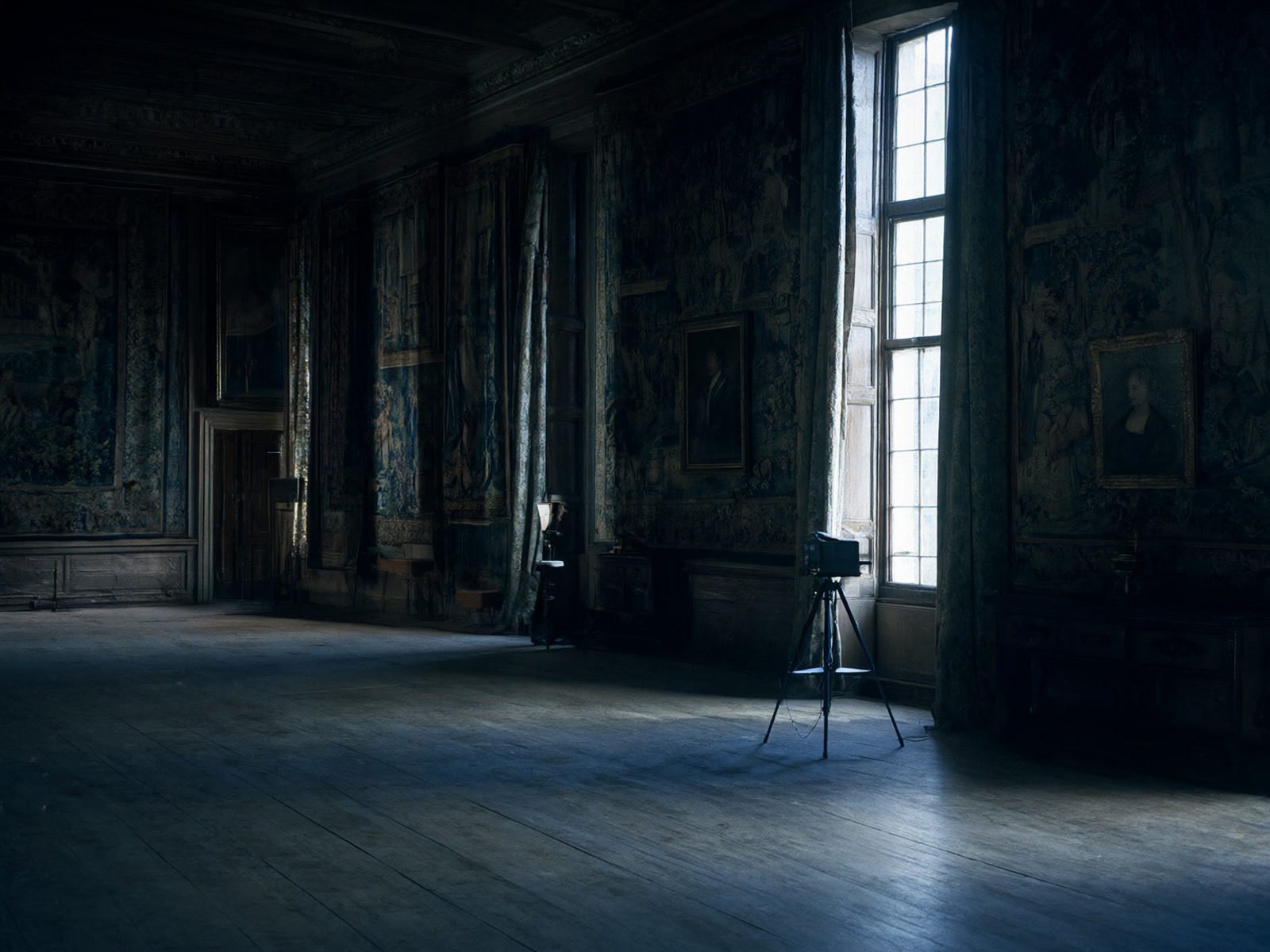
Hauntings and apparitions / Hampton Court Palace, Surrey, England
Cold Spots at the Palace
In early 2000 Hampton Court Palace invited the psychologist Richard Wiseman to find out why staff and visitors reported ghostly experiences there. Over nine days hundreds of visitors walked the Haunted Gallery, associated since at least 1918 with a woman in white, or the Georgian Rooms, and marked where they felt anything unusual: 431 experiences, about two-thirds of them sudden changes in temperature. Reports clustered in particular spots, and believers in ghosts reported more than disbelievers.
The leading conventional explanation is belief, suggestion and ordinary features of the surroundings. The study partly supported it: believers reported more, and the spots where experiences clustered showed a partial link with local magnetic fields, and telling half the groups that activity had recently increased made no significant difference overall, though its interaction with belief was significant, which the authors thought might be chance. The authors held that until further work the cause was likely to remain "something of a mystery".
AI illustration · not an evidence photograph
File
BR-0006
Date
27 May – 4 June 2000
Place
Hampton Court Palace, Surrey, England
AssessmentB · recorded at the time by a controlled study
The record on file
Witnesses
678 members of the public who walked the Haunted Gallery or the Georgian Rooms in eighteen sessions; the 462 who completed both questionnaires were analysed
Evidence
Questionnaires, the places where participants marked unusual experiences, and magnetic-field readings, of which the analysis used daytime readings from six areas in each location; a follow-up study in Edinburgh's South Bridge Vaults, published with this one in 2003, added lighting levels
Record made at the time
The investigators' questionnaires and magnetic-field mapping, made at the palace between 27 May and 4 June 2000 by psychologists from the Universities of Hertfordshire and Edinburgh at the palace's invitation, and published as "An investigation into the alleged haunting of Hampton Court Palace" in the Journal of Parapsychology (2002); a companion study of Edinburgh's South Bridge Vaults appeared in the British Journal of Psychology (2003).
Agency
University of Hertfordshire and University of Edinburgh (Richard Wiseman, Caroline Watt and colleagues)
In early 2000 the administrators of Hampton Court Palace invited the psychologist Richard Wiseman, of the University of Hertfordshire, to find out why so many staff and visitors reported "ghostly" experiences in the building. The palace had long had that reputation. Its best-known story concerns Catherine Howard, the fifth wife of Henry VIII, who is said to have run along a corridor now called the Haunted Gallery to plead with the king before being dragged back by guards. The investigators' own paper notes that by the early twentieth century the Gallery was linked with sightings of a "woman in white" and with screams, citing a book of 1918, and that more recent visitors had described a sense of presence, dizziness and sudden changes in temperature, in that room and elsewhere in the palace.
The study at the palace
The fieldwork ran from 27 May to 4 June 2000. The team was Wiseman, Emma Greening and Ciaran O'Keeffe from Hertfordshire, and Caroline Watt and Paul Stevens from the University of Edinburgh. Visitors volunteered for one of eighteen sessions of up to forty people. They first filled in a questionnaire on their belief in ghosts, their past unusual experiences and whether they knew where earlier witnesses had reported anything. They were then taken in groups to one of two reputedly haunted areas, the Haunted Gallery or the Georgian Rooms, walked quietly through it, and marked on an accurate floorplan any place where something unusual happened, with a short description.
Wiseman also tested suggestion. In half the sessions he said in passing that one area had recently seen more reports and the other fewer; in the other half the claim was reversed. Magnetic fields were measured after each floorplan had been divided into 24 equal areas.
What the record holds
Of 678 people who took part, 462 completed both questionnaires and were analysed. They reported 431 unusual experiences, 189 in the Haunted Gallery and 242 in the Georgian Rooms. About two-thirds were sudden changes in temperature; the rest included dizziness, headaches and a sense of presence. Only 6 per cent of experiences were rated "definitely" a ghost, and 12.8 per cent "probably".
The record made at the time is the investigators' own: the questionnaires, the marked floorplans and the magnetic readings, gathered by university researchers at the palace's invitation. It survives as the published analysis, "An investigation into the alleged haunting of Hampton Court Palace", in the Journal of Parapsychology 66(4) in 2002, whose author copy is held in the University of Hertfordshire Research Archive. No public archive of the raw questionnaires was found. A combined report of the palace study and a second study in Edinburgh's South Bridge Vaults appeared in the British Journal of Psychology 94(2) in May 2003. The palace paper says an attempt to obtain "visual evidence" would be reported separately; no such paper was found in this research.
What the investigators concluded
Believers in ghosts reported significantly more experiences than disbelievers and were more likely to attribute them to a ghost. The suggestion made no significant overall difference to expectations, to the number of experiences or to how they were interpreted, though there was a significant interaction: believing groups told of a recent increase reported more. The authors allowed that this might be chance, and that the suggestion was subtle.
Reports were far from evenly spread: some areas drew many more than others in both locations. On magnetism the result was mixed. Daytime readings covered only six areas of each location; the evening readings of all 48 areas did not match them and were set aside. Experiences correlated overall with the variance of the local field, not its mean strength, which was ordinary throughout, and the authors cautioned that a magnetic reading might simply go with some other feature of a spot. The 2003 paper adds that the clustering was not explained by participants' prior knowledge of where ghosts were said to walk, and that experiences in the Edinburgh vaults correlated with lighting levels.
The conventional explanation
The leading conventional explanation is belief and expectation acting on ordinary features of a place: draughts and temperature, light, size and shape, the look of a corner or doorway. The study supports it in part. Belief predicted how much people reported, and the 2003 paper concludes that hauntings could be "at least in part" a response to "normal" factors. Where it fits less well is the clustering itself. Suggestion alone did not account for it, the magnetic link was modest and rested on twelve areas, and participants reported more in the reputed places even when they did not know the reputations. Wiseman said later, in a 2009 interview about the Edinburgh study, that this had surprised him and showed that "location matters".
What remains open
Which features of the hot spots drive the reports has not been settled. The palace paper ends by saying the explanation of the activity, there and elsewhere, "is likely to remain something of a mystery" until further work. The full 2003 paper is behind a subscription, so the Edinburgh study's dates and numbers were not checked here. Press reports from April 2001 place Wiseman's team at Edinburgh Castle during the city's science festival, and a later newspaper retelling describes 240 volunteers in the castle vaults, while the published paper names the South Bridge Vaults. How the two accounts relate is unresolved.
An investigation into alleged 'hauntings'(archived) — University of Edinburgh Research Explorer; Wiseman et al., British Journal of Psychology 94(2), 195–211, 2003. The combined study's abstract, DOI and findings on prior knowledge, magnetic variance and lighting.
Spectre vector(archived) — Times Higher Education, 12 April 2001. Contemporaneous note of Wiseman's nine-member team monitoring Edinburgh Castle during the science festival.
Corrected The full file: Wiseman's 2009 remark that 'location matters' was about the 2001 Edinburgh Vaults study, not Hampton Court; the text now says so.
Corrected The analysis used daytime magnetic readings from six areas in each location, the evening readings being discarded; the file previously described magnetic mapping of 24 areas.
Corrected Telling half the groups that activity had increased made no significant difference overall, but its interaction with belief was significant, which the authors thought might be chance. The file previously reported no effect at all.
Added The full file, a long-form write-up with its sources, added.
Also filed under Hauntings and apparitions
Borley RectoryThe Rectory at Borley · 1900 – 1939 · investigated from June 1929

 INDEPENDENT FIELD ARCHIVE