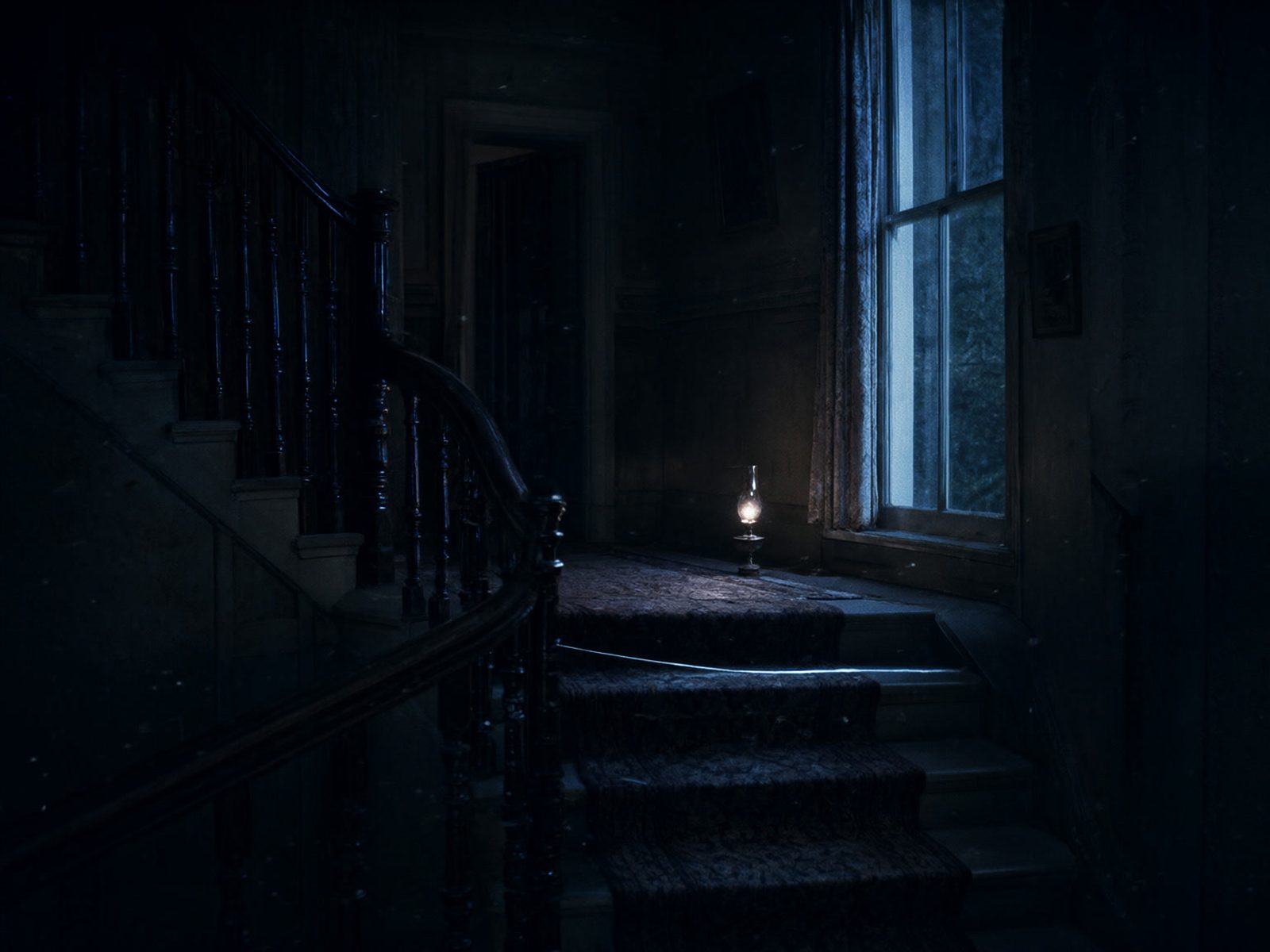
For about seven years a tall woman in black was reported on the stairs and in the drawing room of a rented house in Cheltenham, by the family, their servants and visitors. She vanished when anyone tried to corner her. Strings fixed across the stairs with marine glue were reportedly found undisturbed after she had passed.
The usual explanation for a household haunting is expectation and suggestion passing from one witness to the next. Myers did not accept it: the family had heard nothing odd about the house when they took it, and servants who had not been told about the figure described the same one.
AI illustration · not an evidence photograph
File
BR-0002
Date
1882 – about 1889
Place
Cheltenham, England
AssessmentB · documented by an investigator during the events
The record on file
Witnesses
The family renting the house, chiefly a daughter of nineteen at the first sighting; servants and visitors, some of whom had not been told about the figure
Evidence
Statements collected during the haunting by F. W. H. Myers of the Society for Psychical Research, extracts from letters written at the time, and strings glued across the stairs
Record made at the time
J. W. Graham's account, written out from memory from Captain Morton's telling and revised by the family, which reached Myers in December 1884; and Myers' notes from interviews he began in May 1886. Myers' notes were printed, and Graham's account described, in the SPR's Proceedings in 1892, which withheld the family's name and the town; the house was later identified as in Cheltenham.
In April 1882 Captain F. W. Despard moved his family into a rented house on Pittville Circus Road, Cheltenham, built about 1860 and first lived in by Henry Swinhoe, a retired official from India. Over the next seven years the household, its servants and some visitors reported a tall woman in black on the stairs, in the drawing room and in the garden. The account published by the Society for Psychical Research in 1892 hid the family as "Morton" and left the town unnamed; the house was later known as Garden Reach, Donore and St Anne's.
What the household reported
The chief witness was the captain's daughter Rosina, aged nineteen. In June 1882, by her account, she heard someone at her door and found a figure at the head of the stairs: a tall woman in widow's black, face hidden in a handkerchief held in the right hand. She saw it about half a dozen times in two years, spoke to it on 29 January 1884 and got only "a slight gasp", and could never touch it: cornered, it disappeared. In May and June 1884 she stretched fine strings across the stairs, fixed with pellets of marine glue, and says she twice saw the figure pass through them and leave them intact.
Others reported it too. A married sister took it for a Sister of Mercy (in 1882 by Rosina's account, 1883 by her own); Rosina's youngest brother and a schoolfriend saw a woman weeping at the drawing-room window in December 1883; a sister, a cook, a parlourmaid and a charwoman each gave sightings. Sightings peaked in July and August 1884; footsteps were heard by "about 20 people". Her parents never saw the figure. By Rosina's account it was seldom seen after 1887 and not at all after 1889.
The record and where it is now
The record made by someone other than the family began in December 1884, when J. W. Graham sent F. W. H. Myers of the SPR an account he had written out from Captain Despard's telling and had the captain and his daughter revise. Myers' note describes that account but does not print it. From 1 May 1886 Myers visited the house at intervals and took notes; he interviewed the charwoman, Mrs Twining, on 29 December 1889, and the former parlourmaid, Mrs Brown, in February 1890, writing her statement that evening and having her sign it the next day.
All of this was published as "Record of a Haunted House", by "Miss R. C. Morton", in Proceedings of the SPR volume 8 (1892), pages 311–332, with six other witnesses' statements and plans of the house. Rosina's own letters to her friend Catherine Campbell, written from the first sighting and quoted in the report, were never handed over: Miss Campbell wrote that they were too private. The SPR's archive has been held at Cambridge University Library since 1989 and includes much of Myers' material; whether his notes on this case survive there was not confirmed for this write-up.
What investigators concluded
Myers called it one of the "best authenticated instances of 'haunting' on record", and in the same sentence called the evidence for the apparition's identity "inconclusive". The family linked the figure to Swinhoe's second wife, Imogen, who left him before his death in 1876 and died at Clifton in 1878; Rosina picked out a photograph of the woman's sister as the closest likeness. Myers stressed that the witnesses' accounts were uniform even where they had not spoken to one another.
The conventional explanation
The leading conventional reading is suggestion working on a household, triggered by real noises. G. W. Lambert, then the SPR's president, argued in 1958 that the footsteps and knocks came first, were heard by far more people than saw anything, and probably came from an intermittent underground stream fed by floods on the river Chelt. He linked the decline to the Dowdeswell reservoirs, opened in October 1886, which held back the Chelt's headwaters. Once a figure had been seen and named, he argued, later witnesses would see it more and more alike.
The argument fits several things in the record: the sounds were reported more widely than the sightings; Rosina says that when she heard footsteps outside her door she "invariably saw the figure"; and the identification with Mrs Swinhoe rests on little. But Lambert called his own evidence "inconclusive" and found no sign of subsidence. The stream is inferred from old maps and wells, not found, and sightings and footsteps went on after 1886. It also strains the account of a newly hired cook who, by Mrs Brown's statement, had heard nothing of the ghost and saw the figure glide past them in a passage. Mistaking a living woman for a ghost is the other ordinary candidate, and the record itself shows the figure taken for a real person more than once; against that stand the strings, if Rosina's account of them is accepted.
What remains open
The testimony is the household's own, and the family wanted it kept quiet so the house would not lose value; the captain held back fuller evidence until the haunting had ceased. The witnesses do not wholly agree: Rosina describes the figure as solid and lifelike until about 1886, while Mrs Brown said it "never looked to me quite solid". No photograph was obtained. The SPR's encyclopedia notes that Andrew MacKenzie later reported evidence that the haunting continued long after 1889. No cause has been established.
Cheltenham Ghost(archived) — Psi Encyclopedia, Society for Psychical Research, 2015. Index to the later literature, including MacKenzie's continuation.
Corrected The full file: Rosina Despard dates her married sister's 'Sister of Mercy' sighting to 1882, but the sister's own statement puts it in the autumn of 1883; the text now gives both.
Sources The full file: The Psi Encyclopedia article on the case was created in 2015, not 2017; the source line is corrected.
Corrected The 1892 Proceedings printed Myers' interview notes and only described J. W. Graham's account; the file previously said both were printed. The letters from the time survive as quoted extracts, not in full.
Added The full file, a long-form write-up with its sources, added.

 INDEPENDENT FIELD ARCHIVE