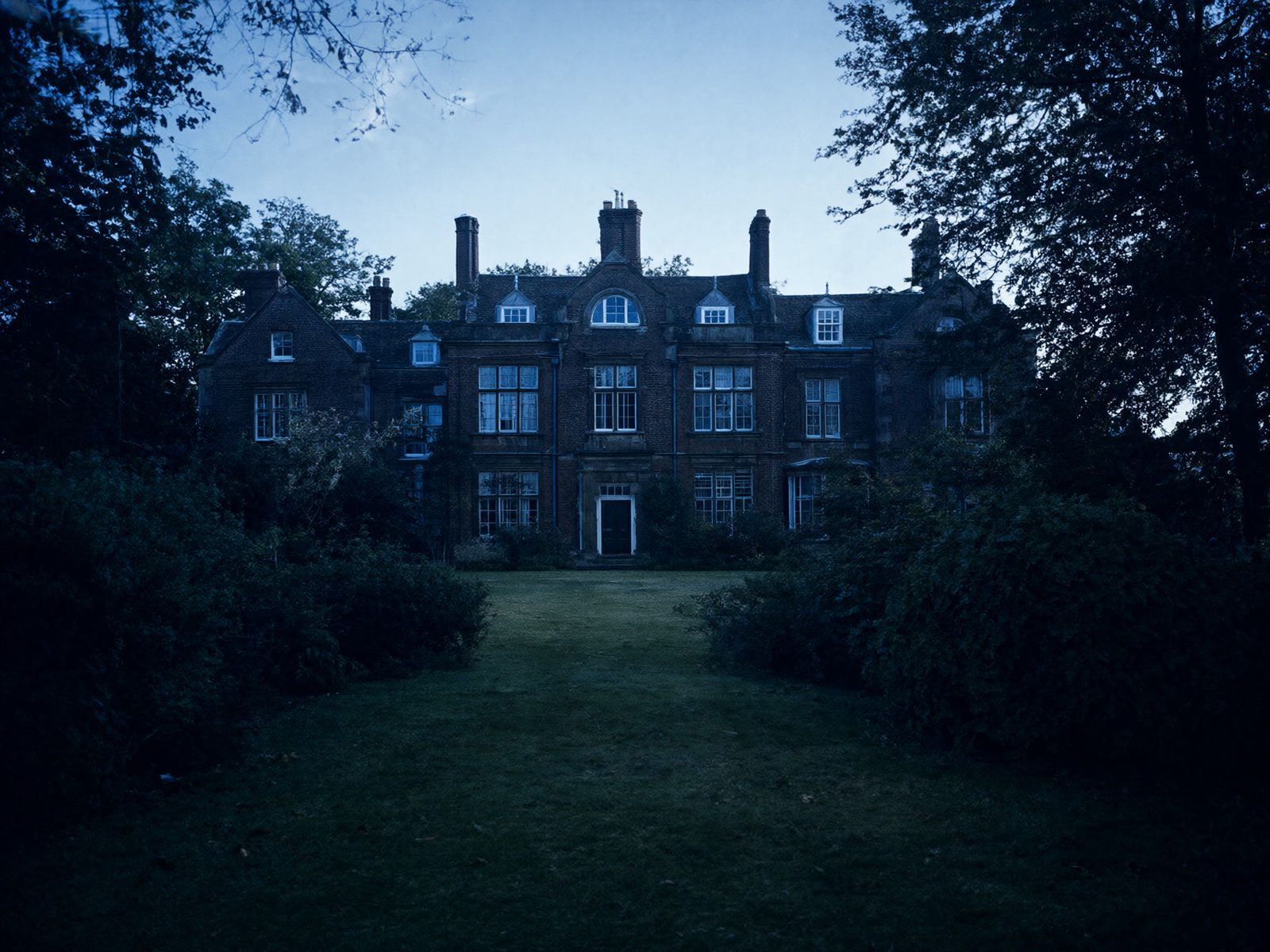
Hauntings and apparitions / Borley, Essex, England
The Rectory at Borley
A Victorian rectory near the Essex–Suffolk border gathered reports of a phantom nun, footsteps, thrown stones and messages on the walls from 1900 into the 1930s. Harry Price went there with a Daily Mirror reporter in June 1929, and in 1937 rented the empty house for a year and recruited 48 observers through an advertisement in The Times. The rectory burned on 27 February 1939; in 1956 a review published by the Society for Psychical Research accused Price of distorting the record, and a later SPR paper defended him.
The leading conventional explanation is ordinary events misreported, some deliberate faking, and an investigator who improved the story. By the Psi Encyclopedia's account, Dingwall, Goldney and Hall (Proc. SPR 51, 1956) held that Price's distortion was "not, we think, now in doubt", and R. J. Hastings (Proc. SPR 55, 1969) found the charges against his integrity largely unfounded; the same source says Marianne Foyster accused her husband of faking some incidents. Neither SPR report was opened here.
AI illustration · not an evidence photograph
File
BR-0005
Date
1900 – 1939 · investigated from June 1929
Place
Borley, Essex, England
AssessmentB · documented at the time; the documenter's account is disputed
The record on file
Witnesses
Three or four daughters of the Bull family (sources differ), who saw a female figure they took for a nun on 28 July 1900; the rector G. E. Smith and his wife in 1929; Marianne Foyster and her household in the early 1930s; Harry Price, his secretary and the Daily Mirror's V. C. Wall; 48 official observers in 1937–38
Evidence
Price's notes and the Daily Mirror's reports of June 1929; the printed instructions issued to observers in 1937; the observers' reports, summarised by Price in 1940; messages pencilled on the walls
Record made at the time
Price's notes and the Daily Mirror's reports from his first visit with the reporter V. C. Wall on 12 June 1929; and the reports of 48 official observers during his tenancy from 19 May 1937 to 19 May 1938, who worked to printed Instructions for Observers (1937) issued by the University of London Council for Psychical Investigation. Price printed this material, edited, in The Most Haunted House in England (1940).
Agency
Harry Price, later under the University of London Council for Psychical Investigation
Borley Rectory stood just inside the Essex border, two and a half miles from Long Melford in Suffolk. The Rev. Henry Dawson Ellis Bull built it in 1863, and for most of its life it was an ordinary, oversized country parsonage. Its reputation rests on a run of reports between 1900 and 1939, and on one investigator, Harry Price, who made it famous and whose account has been argued over ever since.
What was reported
The founding story is a daylight sighting on 28 July 1900. Daughters of the Bull family, walking up the lawn from a garden party, saw a figure in black that they took for a nun, moving along the path the household called the Nun's Walk. Price, writing in 1940 from interviews with surviving sisters in 1929, 1938 and 1939, says that three of them, Ethel, Freda and Mabel, saw it first and that a fourth, Elsie, fetched from the house, saw it too. The Society for Psychical Research's Psi Encyclopedia names four sisters seeing it together, Ethel, Freda, Mabel and Dodie, and the Foxearth and District Local History Society also gives four. Other reports of footsteps, a phantom coach and bells came from the Bull years, but survive mainly in later recollection.
The Rev. Guy Eric Smith and his wife moved in during 1928 and wrote to the Daily Mirror, which ran stories from 10 June 1929 and sent its reporter V. C. Wall. On 12 June 1929 Price arrived with his secretary, Lucie Kaye, and reported glass breaking and pebbles thrown that night. The Smiths left that July. The Rev. Lionel Foyster and his wife Marianne took the living in October 1930, and their years brought the most dramatic claims: thrown stones, small fires, Marianne thrown from her bed and pencilled messages on the walls addressed to her. Price later counted some 2,000 incidents in this period. The Foysters left in 1935. Captain W. H. Gregson bought the empty house in late 1938, and it burned on the night of 27 February 1939.
The record and where it is held
The case stands on this shelf because records were made at the time by people other than the residents. The first is the Daily Mirror's reporting of June 1929, with Price's own notes of his visits. The second is the 1937–38 tenancy. Price rented the rectory from 19 May 1937 to 19 May 1938 and recruited observers through an advertisement in The Times of 25 May 1937 asking for people who were "intrepid, critical, and unbiassed". Forty-eight took part. They worked to a printed booklet, The Alleged Haunting at B— Rectory: Instructions for Observers, issued by the University of London Council for Psychical Investigation and known from its cover as the Blue Book; Price called it "a sort of handbook to the 'ghosts' of Borley Rectory".
Price published the observers' reports only as an edited digest, in The Most Haunted House in England (1940). The originals, with his notes, tenancy papers and drafts, are in the Harry Price archive at Senate House Library, University of London, where series HPC/3 lists reports and diaries by observers of Borley Rectory.
What investigators concluded
Price presented Borley as a genuine haunting. After his death in 1948 the Society for Psychical Research asked Eric Dingwall, Kathleen Goldney and Trevor Hall to re-examine the case from his files and from surviving witnesses. Their report, The Haunting of Borley Rectory, appeared in the Society's Proceedings (vol. 51) and as a book in 1956. By the Psi Encyclopedia's account, they found that the phenomena could have normal explanations, and held that the question of whether Price had given a deliberately distorted account was "not, we think, now in doubt". In 1969 Robert Hastings, also in the Proceedings (vol. 55), re-examined their charges and found the attacks on Price's personal integrity largely unfounded. Neither report was opened for this write-up; their conclusions are taken from the Psi Encyclopedia and other summaries.
The leading conventional explanation
The leading explanation is a mixture of ordinary noises misread, local legend, deliberate faking by more than one hand, and an investigator who shaped the story. It has strong support. Mrs Smith wrote to the Church Times in 1945 that she knew of nothing beyond rats, mice and local superstition, and repeated her disbelief in 1949. The Daily Mail journalist Charles Sutton said after Price's death that he had caught Price with stones in his pockets during a 1929 visit. Marianne Foyster told later interviewers that her husband had faked some incidents, while insisting that others were caused by neither of them.
Its weakness is that it is a collection of particular accusations, each resting on later testimony, rather than one demonstrated account. It does not show who produced each incident, and it cannot be tested against the observers' original reports without going back to the archive.
What remains disputed
The central dispute is the record itself. Price's 1940 digest is the only published form of the 1937–38 reports, and its reliability depends on the integrity that the 1956 report attacked and the 1969 report defended. Whether the observers' manuscripts at Senate House support Price's digest, and how much any of the incidents owed to the residents, Price or chance, has not been settled in print. Even the founding sighting is told differently: Price has three sisters seeing the figure and a fourth fetched to it, later summaries four together.
Sources
The Most Haunted House in England (1940) — Harry Price, Longmans, 1940 (Internet Archive). The 1900 sighting and its witnesses, the June 1929 visit, Times advertisement, Blue Book, 48 observers, tenancy dates and fire.
Borley Blue Book: Instructions for Observers — University of London Council for Psychical Investigation, 1937 (Internet Archive). The printed protocol issued to observers; title page read.
Borley Rectory(archived) — Melvyn Willin, Psi Encyclopedia, Society for Psychical Research, 2015, updated 2026. Chronology, Foyster statements, Sutton, and the 1956 and 1969 reports' citations and conclusions.
Harry Price archive(archived) — Senate House Library, University of London. Borley tenancy papers, drafts and the extent of the archive.
The Haunted Rectory(archived) — Foxearth and District Local History Society. Four Bull sisters, the 2,000 incidents, Mrs Smith's 1945 and 1949 denials, Sutton, the SPR inquiry.
Corrected The full file: Price does not name only three witnesses to the 1900 sighting: he says Ethel, Freda and Mabel saw it first and that a fourth sister, Elsie, was fetched and saw it too, and his account draws on interviews from 1929, 1938 and 1939. The text now says so, and gives the Psi Encyclopedia's four names.
Corrected The full file: Price's secretary is named Lucie Kaye in his own book, not Lucy; the spelling is corrected.
Corrected The full file: The observers' booklet is titled The Alleged Haunting at B— Rectory, not of; the title is corrected.
Corrected The full file: The statement that Gregson's insurers rejected his claim as arson appeared in none of the cited sources, two of which describe the fire as an overturned lamp, and it has been removed.
Corrected The Bull daughters who saw the figure in 1900 are now given as three or four, since sources differ; the file previously said three.
Added The full file, a long-form write-up with its sources, added.

 INDEPENDENT FIELD ARCHIVE