In 1959 the American Embassy in Kathmandu filed a despatch restating Nepal's rules: pay a 5,000-rupee permit fee, photograph or capture the yeti, but do not kill it except in self-defence, and hand over any photographs, any captured animal and any reports of its existence to Nepalese officials. In 2017 nine purported yeti specimens were sequenced: one dog, and eight bears.
The bears at issue are themselves endangered — the one conservation fact in this file.
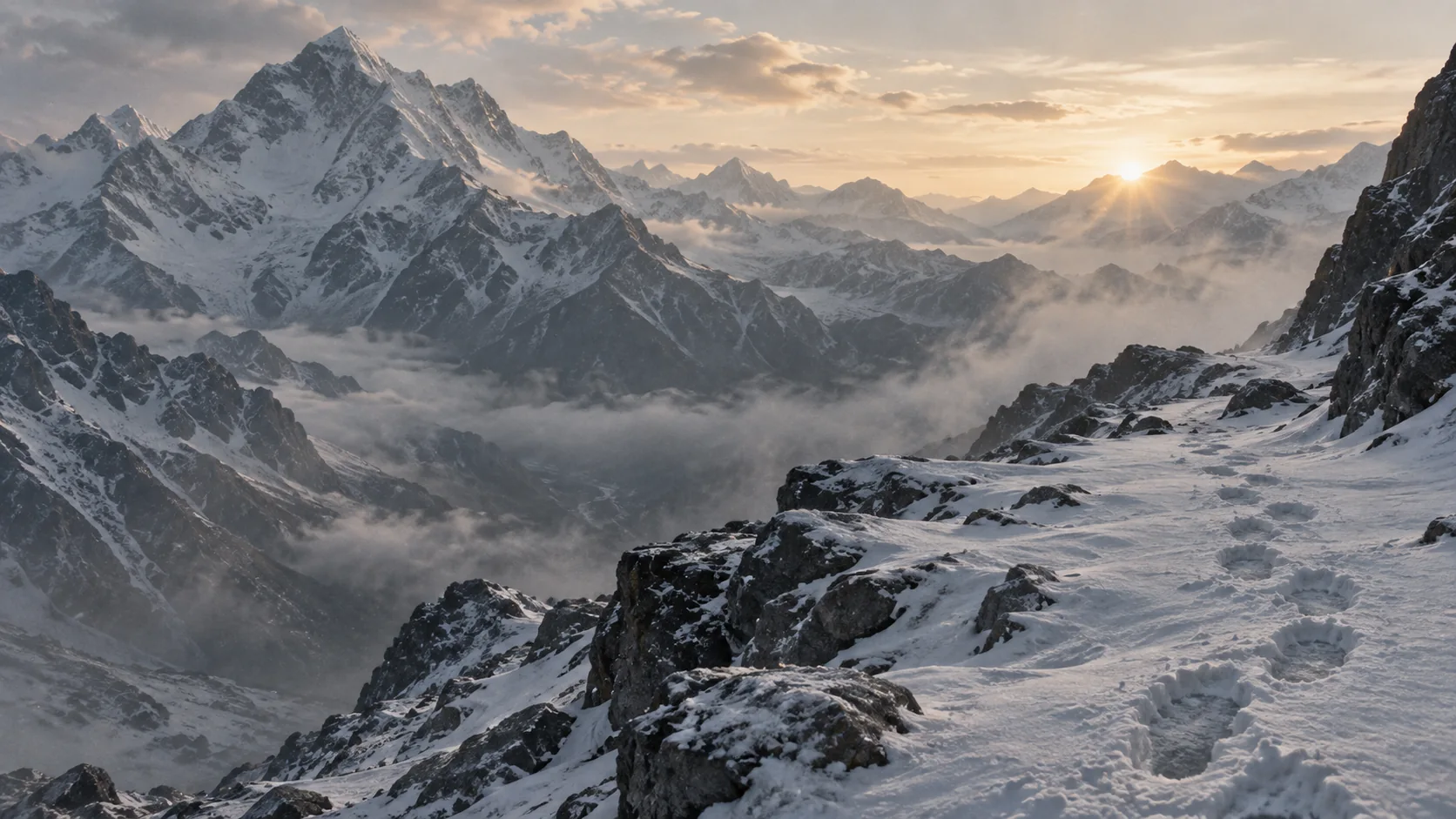
AI illustration · imagined landscape, not an evidence photograph
File
CR-0007
Date
1899 → 2017
Place
Himalayas: Nepal, Bhutan, Tibet
Record
a permit regime, then a sequencing result
Evidence
DNA of nine specimens
Agency
Nepal (permits, 1959); Bhutan (sanctuary, 2003)
Assessment
A · tested, reconciled
The full file
The yeti file has three strands that are often run together: a set of footprint photographs taken by two British mountaineers in 1951, a set of Nepalese rules for anyone hunting the animal, recorded by the American Embassy in 1959, and a series of genetic tests on objects said to come from yetis, the most thorough of them published in 2017. Each strand has its own paper trail. Only the third was tested in a way that could have found an unknown animal.
The 1951 footprints
In November 1951, after the British Everest reconnaissance, Eric Shipton, the physician Michael Ward and the Sherpa Sen Tensing crossed the Menlung La, west of Everest near the Nepal–Tibet border. On the glacier below they found a line of tracks in thin snow over hard névé. The date is given differently in different accounts. The journalist Peter Gillman puts it on the afternoon of 9 November, while Ward's own 1999 account gives only the month. The height also varies: Ward recalled about 15,000–16,000 ft, and Gillman reports that W. H. Murray, who followed two days later, gave about 18,000 ft.
Shipton took four photographs. Two showed the trail with Ward and his rucksack for comparison. The other two showed a single sharp print beside an ice axe and beside Ward's boot. Ward estimated the print at 12–13 inches long and nearly twice as broad as his boot. Shipton's report in The Times appeared on 6 December and three of the photographs followed on 7 December. In it he described the tracks as mostly distorted by melting, "slightly longer and a good deal broader than those made by our mountain boots".
The evidence and where it is
The photographs survive as published plates and press prints. A set of four prints was offered at Christie's in 2014. Ward suggested that the negatives had been mixed up in the archives of the Mount Everest Foundation. The 1959 despatch is in the US National Archives (identifier 24194175). Its catalogue pages disagree on the record group: one names the Department of State's records, the other those of the Agency for International Development. The despatch restates rules that, according to the National Archives, Nepal had drawn up about two years earlier. Expeditions paid a 5,000-rupee royalty for a permit. They could photograph or capture a yeti but kill one only in self-defence. Any photographs, captured animal or reports had to go to the Nepalese government. The National Archives notes that the memo does not mean the US government believed in the yeti.
Of the nine specimens tested in 2017, a tooth came from a stuffed exhibit at Reinhold Messner's mountain museum in Italy; the rest came through Icon Films, makers of a 2016 television programme. Their present whereabouts are not published.
What investigators concluded
The early analysis worked from the photographs alone. In Oryx in 1973, McNeely, Cronin and Emery called Shipton's print "the type specimen of yeti footprints". They rejected langurs and bears, which have the wrong proportions, and argued for an unknown bipedal primate of the montane forests. Gillman records that the Natural History Museum had concluded at the time that a langur could have made the tracks. Ward never doubted that the tracks were real: "This was no hoax," he wrote in 1999. He proposed instead a barefoot local person with a deformed foot, or one print laid over another.
The genetic work came later. In 2014 Bryan Sykes and colleagues sequenced a short mitochondrial fragment from 30 hair samples. Two Himalayan hairs, from Ladakh and Bhutan, matched a Palaeolithic polar bear. A published comment showed that the match was in fact to a modern polar bear sequence. Sykes's team corrected the reference but kept its conclusion. In 2017 Tianying Lan, Charlotte Lindqvist and colleagues sequenced the nine purported yeti specimens, including the mitochondrial genome of what they think is the same Ladakh hair. Eight were bears: six Tibetan brown bears, one Himalayan brown bear and one Asian black bear. The ninth was a dog. A skin scrap from a monastery's "yeti hand" relic was black bear. A femur from a cave on the Tibetan Plateau was Tibetan brown bear. The Ladakh hair fell among Himalayan brown bears.
The leading explanation
The leading explanation is local bears. On the specimens, the 2017 paper speaks of evidence "strongly supporting the biological basis of the yeti legend to be local, extant bears". Its strengths are that the method could have found an unknown primate and did not, that it covered material from several regions, and that it overturned the one anomalous result from 2014. Its weakness is its scope. It tested objects that people had kept or collected, not the animals behind the sightings, and nine specimens cannot cover every report. It also says nothing directly about the 1951 footprints, which have no organic material to test.
What remains disputed
The Menlung print is still unresolved. In the Alpine Journal in 2001, Gillman argued that the accounts had changed: Ward described two separate sets of tracks only after the anthropologist John Napier questioned him. Gillman also argued that the sharp close-up looks unlike the melted trail beside it. He concluded that Shipton had probably shaped a single print by hand, and reported that Edmund Hillary thought this possible. Ward, Bourdillon's widow and Murray rejected the idea of a hoax. No one has offered a test that could settle it. Ward's own verdict holds: "We will never know for certain what man or animal made the footprints".
The Yeti Footprints(archived) — Peter Gillman, Alpine Journal, 2001. The date, The Times publication, the inconsistencies between accounts and the hoax argument.
The Yeti — Not a Snowman(archived) — McNeely, Cronin and Emery, Oryx 12(1), 1973. The 1970s case for an unknown primate, based on the Shipton print.
Corrected The full file: The National Archives says only that the yeti memo does not mean the US government believed in the yeti, not that neither government did; the text now says so.
Corrected The 1959 rules allowed the yeti to be killed in self-defence and set a 5,000-rupee permit fee; the file previously said simply that it must not be killed.
Added The full file, a long-form write-up with its sources, added.

 INDEPENDENT FIELD ARCHIVE