The full file
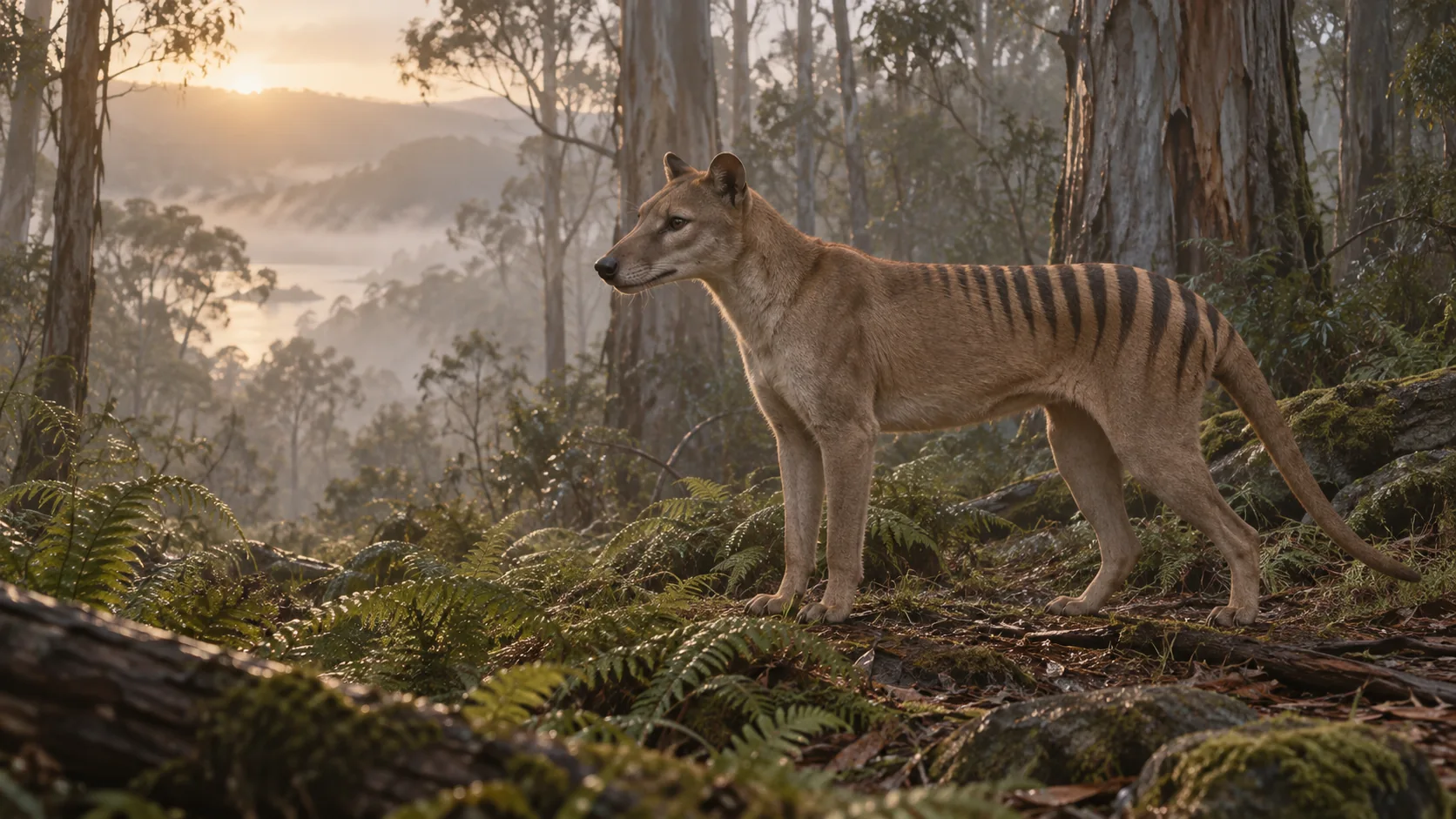
On the night of 7 September 1936 a thylacine died in its enclosure at Beaumaris Zoo, on the Queen's Domain in Hobart. No other captive animal of the species remained, and no wild one has been caught, shot or photographed in a way that could be verified since. The thylacine, Thylacinus cynocephalus, the striped marsupial carnivore known as the Tasmanian tiger, had been granted protected status in Tasmania 59 days earlier. What followed was not a legend about an unknown animal but a long, unresolved argument about when a known one actually disappeared.
What was reported
The species had already vanished from mainland Australia thousands of years before European settlement, leaving Tasmania as its last range. Settlers treated it as a threat to sheep. Private bounties were being paid by about 1830, and from 1888 to 1909 the Tasmanian government paid £1 for each adult killed; the National Museum of Australia counts more than 2,180 government bounties awarded. The last known shooting of a wild animal was in 1930.
The reports did not stop with the 1936 death. People across Tasmania continued to describe dog-like animals with stripes across the back, in the bush, on roads and at the edges of farmland. The best known came from Hans Naarding, a Parks and Wildlife Service ranger, who said that one night in autumn 1982, near Togari in the far north-west, he woke in his car at about 2 a.m. and held an animal in his torch beam for about three minutes. He described a full-grown male six or seven metres away and said he had counted its stripes. The service took the report seriously and, according to Australian Geographic, searched the region for a year, without result.
The evidence and where it is held
The physical record ends in the 1930s. In 2022 Robert Paddle and Kathryn Medlock, curator of vertebrate zoology at the Tasmanian Museum and Art Gallery (TMAG), identified the skin and skeleton of the 1936 animal in the museum's collection, traced through a taxidermist's report in TMAG's unpublished 1936/37 annual report. The animal had been prepared as an education specimen, which is why it had gone unnoticed. They reported, in a paper in Australian Zoologist in 2023, that it was an old female caught by the trapper Elias Churchill in southern Tasmania and sold to the zoo in May 1936. The much-photographed male often called "Benjamin" was a different animal; the National Museum of Australia now describes the male last-thylacine story as a myth. The remains are held, and displayed, at TMAG in Hobart.
Everything after 1936 is testimony. Barry Brook and colleagues assembled it into the Tasmanian Thylacine Sighting Records Database: 1,237 records from 1910 onwards, each rated for reliability, from confirmed kills and captures to brief glimpses by untrained observers. Australian Geographic reports that the database also holds 99 physical records, such as carcasses and skins, all from before 1936. The database's analysis code is public on GitHub.
What investigators concluded
The International Union for Conservation of Nature listed the species as extinct in 1982, according to the National Museum of Australia, and the Tasmanian government declared it extinct in 1986. Sources disagree on the first date: Australian Geographic gives 1986 for the IUCN as well. Tasmania's Parks and Wildlife Service states that no conclusive evidence of a live thylacine has been found since 1936.
Statistical work since has split. In 2018 Colin Carlson, Alexander Bond and Kevin Burgio, writing in Conservation Biology, modelled physical evidence and sightings together and put the most likely extinction date at 1940, with their most optimistic scenario ending in 1956. Brook's group published a rebuttal arguing that the analysis was deficient, and the authors replied in turn. In 2023 Brook and co-authors, in Science of the Total Environment, found that the high-quality records alone implied extinction in the 1940s to 1970s, but that modelling the full record, with each sighting weighted by its probability of being genuine, allowed extinction as late as the late 1980s to early 2000s, "with a small chance of persistence" in the south-western wilderness. They placed the last likely subpopulation in the south-west.
The conventional explanation
The leading explanation is that the thylacine is extinct and that post-1936 sightings are misidentifications of dogs, foxes or other animals, memory errors, or hoaxes. Its strengths are considerable: no body, photograph or verified trace for nearly ninety years, despite searches and, according to Australian Geographic, more than half a million camera-trap nights across the state without a detection. The zoologist Jack Ashby, who was not involved in the 2023 study, called continued survival "extraordinarily unlikely". Its weakness is that it has to treat hundreds of reports, some from trained wildlife staff such as Naarding, as wrong without being able to show why each one is wrong.
What remains disputed
The disagreement is over method, not over whether the animal existed. The two published estimates use overlapping data and reach dates roughly half a century apart, because they make different assumptions about how much an unverified sighting by an experienced observer should count. Australian Geographic reports that Brook's model left about a five per cent chance that a few animals persist today. The extinction itself is not seriously contested; its date is.
Sources
- Resolving when (and where) the Thylacine went extinct (archived) — Brook, Sleightholme, Campbell, Jarić and Buettel, Science of the Total Environment 877, 2023. The 1,237-record database and both extinction windows.
- New study reveals that the Tasmanian tiger might have survived to 1980s or later — University of Tasmania, 2023. Brook's own summary, the 1888–1909 bounty period and the south-western refuge.
- Estimating the extinction date of the thylacine with mixed certainty data — Carlson, Bond and Burgio, Conservation Biology, 2018. The 1940 most-likely date and 1956 upper bound.
- Extinction of thylacine (archived) — National Museum of Australia. The 1936 death, protection 59 days earlier, bounties, the 1930 shooting and the "Benjamin" myth.
- Thylacine (archived) — National Museum of Australia. IUCN 1982 and Tasmanian 1986 declarations.
- Tasmanian tiger (archived) — Tasmania Parks and Wildlife Service. The 1986 declaration and the absence of conclusive evidence since 1936.
- Long lost last Tassie tiger remains found in museum cupboard (archived) — Australian Geographic, 2022. The identification of the last animal and its remains at TMAG.
- Is the truth still out there? (archived) — Australian Geographic, 2024. The Naarding sighting, camera-trap effort, record breakdown and Ashby's view.
- ttsrd: R code for the Tasmanian Thylacine Sighting Records Database (archived) — Barry Brook. The public analysis code.

 INDEPENDENT FIELD ARCHIVE