The full file
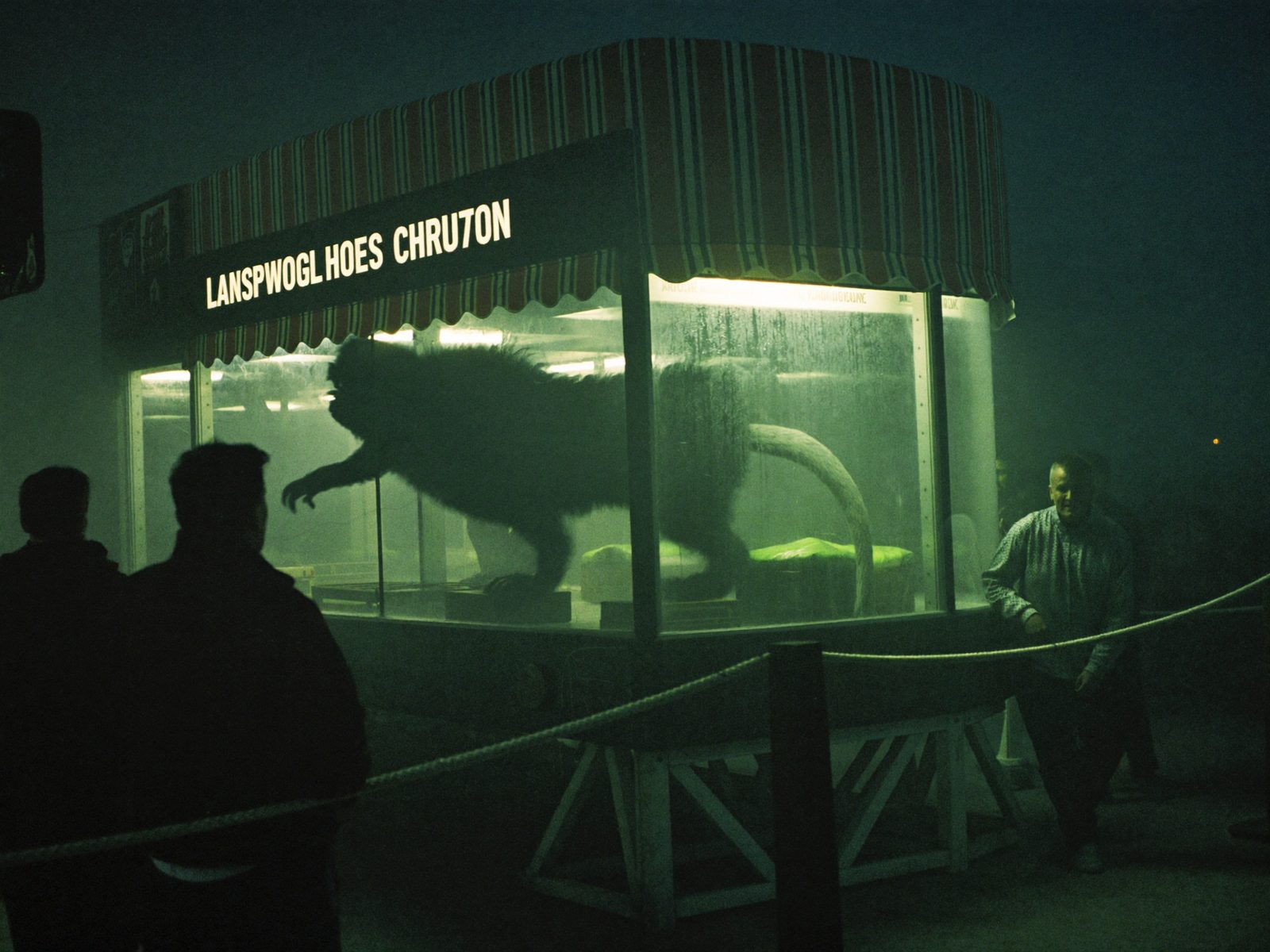
From May 1967 a Minnesota showman named Frank D. Hansen toured the fairs of the Upper Midwest with a trailer, a refrigerated coffin and, inside it, a hairy, man-shaped figure about six feet long, half visible through a block of ice. Visitors paid 35 cents to look. For a few months in 1968 and 1969 the exhibit was treated by two well-known naturalists as a scientific discovery, and by the Smithsonian Institution as a question worth asking the FBI about. The answer, when it came, was a price: $3,500, in latex rubber and hair.
What was reported
Hansen told the zoologist Bernard Heuvelmans that he had been showing the figure since 3 May 1967. The Smithsonian's staff newspaper, the Smithsonian Torch, later confirmed showings at the Wisconsin State Fair in August 1967 and at the International Livestock Exhibition in Chicago in November 1968. It was in Chicago that Terry Cullen, a young naturalist at the University of Minnesota, saw it and alerted the writer Ivan T. Sanderson. On 14 December 1968 Sanderson, then hosting Heuvelmans in New Jersey, proposed that the two of them go and look.
On 17 December they met Hansen at his home at Rollingstone, in Winona County, and examined the figure in its trailer over the following days, through four layers of glass and in poor light. Hansen's account of where it came from was second-hand and vague: found in ice by fishermen off Kamchatka or in the Bering Sea, then bought in Hong Kong by an owner he declined to name. He told Heuvelmans he did not know what it was, and that it might be a skilful oriental fabrication, like the composite "mermaids" sold in Indian Ocean ports.
The evidence and where it is held
The only evidence was the figure itself, and nobody with scientific training ever examined it outside the ice. Heuvelmans's description, published in Brussels on 10 February 1969 in the Bulletin de l'Institut royal des Sciences naturelles de Belgique, gives it a height of 1.80 m, dark brown hair 7 to 10 cm long, an open fracture of the left forearm and a destroyed eye. He reported the smell of a decomposing corpse at one corner of the coffin, and named the creature Homo pongoides, a new species or subspecies of living hominid. Sanderson published his own description in the Italian journal Genus the same year, and wrote the story for Argosy magazine; sources disagree on whether that issue was April or May 1969.
The figure survived Hansen's touring years, which ran on into the 1980s, and stayed in a freezer at his Minnesota home afterwards. It was offered on eBay in 2013, bought by Steve Busti and installed at the Museum of the Weird in Austin, Texas, where a 2025 newspaper report says it remains.
What investigators concluded
Heuvelmans's paper reached John Napier, the primatologist at the Smithsonian's Museum of Natural History. Napier wrote to Hansen asking to examine the specimen. According to the Torch of April 1969, the request was refused, Hansen left on holiday for "Florida or California or somewhere", and his relatives said the owner had reclaimed the body. The Secretary of the Smithsonian, S. Dillon Ripley, then wrote to J. Edgar Hoover asking the FBI to help locate it, to decide "whether it is a hoax or possibly a major scientific discovery". His grounds were that a journal had described the body as human, with apparent bullet wounds, and that it was said to have come from the Far East. The FBI is not recorded as having examined the figure; a later newspaper account says the Bureau and the Winona County sheriff were satisfied Hansen was not carrying a real corpse.
Two months later the Torch of June 1969 reported, from what it called informed sources, that the Iceman was "made from latex rubber and hair" by a group of exhibits specialists on the West Coast, at a cost of $3,500. A man involved in making it called it "a fantastic, magnificent fabrication". Napier now said he was all but certain it was a fake. Hansen, for his part, began describing what he exhibited as a model, and gave at least three further origin stories over the years, including a 1970 magazine article claiming he had shot the creature himself.
The conventional explanation
The leading explanation is the one in the record: a carnival gaff, a manufactured figure built for exhibition. Its strengths are that it rests on the Smithsonian's own enquiry rather than a sceptic's guess, that Hansen's stories contradicted each other, that he consistently refused a close examination, and that the object, once the ice melted in 2013, plainly looked moulded. Its weakness is that no maker has been named in any document examined here, and that it explains the smell Heuvelmans reported only by assumption.
What remains disputed
Hansen claimed for a time that the figure seen in 1968 had been replaced by a copy. Sanderson and Heuvelmans compared their photographs with later ones and concluded it was the same object, which removes any separate "original" body. Who sculpted the figure is still uncertain: a Los Angeles sculptor, Howard Ball, is named in some popular accounts, but none cites a document. Customs trouble is also recorded: in July 1969 officials at Pembina, North Dakota, refused the exhibit passage from Canada until Senator Walter Mondale's office intervened.
Sources
- Ripley Asks FBI Aid to Hunt Iceman (archived) — George J. Berklacy, The Smithsonian Torch no. 4, April 1969, p. 2 (Smithsonian Institution Archives). Napier's request, Hansen's refusal, Ripley's letter to Hoover and its stated grounds, the 1967 and 1968 showings.
- Iceman Mystery Loses Steam (archived) — The Smithsonian Torch no. 6, June 1969, p. 4 (Smithsonian Institution Archives). Latex rubber and hair, West Coast exhibits specialists, $3,500, the maker's remark, Napier's verdict.
- Note préliminaire sur un spécimen conservé dans la glace, d'une forme encore inconnue d'hominidé vivant: Homo pongoides (archived) — Bernard Heuvelmans, Bulletin de l'Institut royal des Sciences naturelles de Belgique 45(4), 1969. The examination dates, Rollingstone, Hansen's account, the description and the new name.
- The mysterious death and strange afterlife of the 'Minnesota Iceman' (archived) — Jeremy Fugleberg, Forum Communications, 2025, drawing on the Rochester Post Bulletin archive. Hansen's origin stories, the Pembina refusal and Mondale, the FBI and sheriff, the eBay sale and the museum.
- Minnesota Iceman photos (archived) — Andy Campbell, HuffPost, 2013. Busti's purchase from Hansen's family, the years in a home freezer, the Museum of the Weird display.
- Thawing the Minnesota Iceman (archived) — Brian Dunning, Skeptoid, 2017. Cullen's role, the Genus paper, Hansen's 1970 Saga article, the photograph comparisons, the 2013 thaw.

 INDEPENDENT FIELD ARCHIVE