land / Bossburg, Stevens County, Washington, United States
Cripplefoot
In November 1969 tracks with a crippled right foot appeared in soft ground near a dead mining town's dump, and weeks later more than a thousand of them were found in snow crossing a river bottom. An anthropologist studied the casts and argued afterwards that the crippled foot's bone structure was too anatomically consistent to have been invented, and other specialists found the tracks credible too. The same file records what else the town produced over the following months. A prospector said he had the animal held in an abandoned mine shaft, and then that he had its foot in his freezer, taking bids to fifty-five thousand dollars and showing nobody anything. Nine months later came a film of the crippled animal, which unravelled when an investigator followed some local children to the location and found the ground inconsistent with the account of the shooting.
Whatever the casts are, the case assembled around them was partly manufactured, and the men who made it wrote it down.
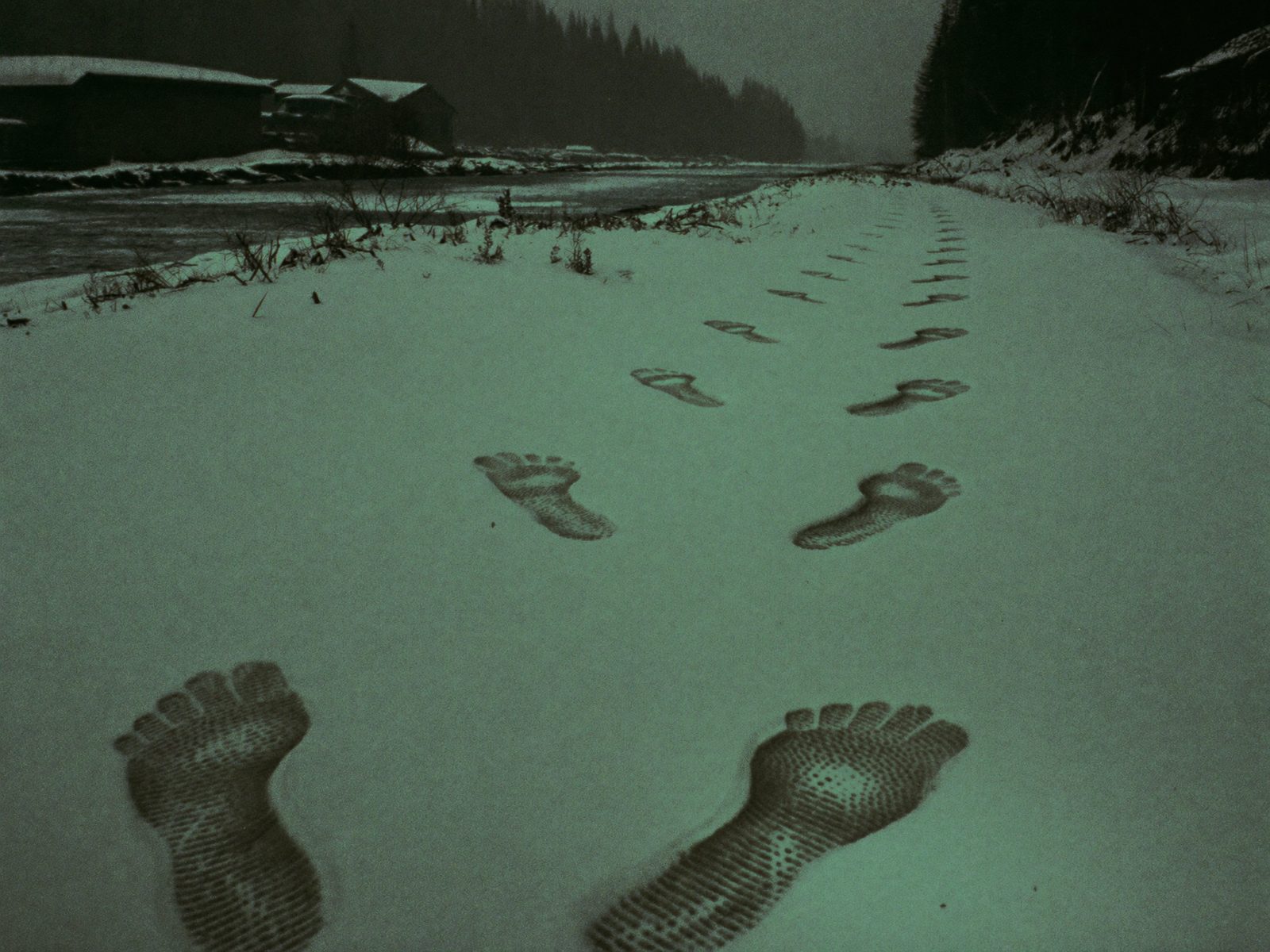
AI illustration · imagined scene, not an evidence photograph
File
CR-0068
Date
24 November 1969 → October 1970
Place
Bossburg, Stevens County, Washington, United States
Record
Track finders, three investigators, and a town of sightseers
Evidence
Plaster casts; a trackway of 1,089 prints in snow; a film
Agency
None
Assessment
C · reported, with a documented hoax layer
The full file
On 24 November 1969, according to the account René Dahinden gave the journalist Don Hunter, a butcher from Colville named Joe Rhodes found a line of very large, human-shaped footprints near the community rubbish dump at Bossburg, a former mining settlement on the Columbia River in Stevens County, Washington, a few miles south of the Canadian border. One foot looked badly deformed. By the time Dahinden arrived from Alberta a few days later, sightseers had trampled most of the prints. The track-maker became Cripplefoot, and the town became the centre of Bigfoot hunting for most of a year.
What was reported
Dahinden found one print that someone had protected under a cardboard box. It was a right foot, and he photographed and cast it. The bigger find came on the morning of 13 December, after fresh snow. Dahinden, the local guide Ivan Marx and a young man named Jim Hopkins were checking meat baits along the reservoir behind the Grand Coulee Dam when Marx stepped out of the car, ran back shouting that he had found tracks, and drove off at once to fetch his cameras. They had just passed a parked jeep, and Dahinden, suspecting hoaxers, had its occupants identified; questioned later, they said they had seen the tracks and left in a hurry. The trail ran from the river bank across the railway and the highway, stepped twice over a wire fence about 43 inches high, climbed a hillside, doubled back and ended at a steep bank above the water. A careful count gave 1,089 clear prints. The right foot was twisted outward, with a toe missing or folded under and two lumps on its outer edge.
Accounts differ on the start. Brian Regal, a historian of science, writes that Marx had seen strange tracks at the dump beforehand and was the one who telephoned John Green; the anthropologist David Daegling says Marx did not discover the first tracks. Regal also describes the deformity as on the left foot, against every other source consulted, which put it on the right.
The evidence and where it is
The record is plaster casts and photographs of both feet, made by Dahinden, the Washington State University anthropologist Grover Krantz and others. Krantz later gave casts of the print to the Phoebe A. Hearst Museum of Anthropology at the University of California, Berkeley, which exhibited them in 2008. No hair, tissue or sighting came with the tracks.
What investigators concluded
The casts converted two scientists. Krantz, who saw the tracks in place (within weeks of the first find by Regal's account; a 2002 obituary says 1970), reconstructed the foot skeleton from the position of the lumps and bends and concluded that the heel bone was longer and the ankle set further forward than in a human foot, as an animal of the implied weight would need. He set this out in Northwest Anthropological Research Notes in 1972 and argued that faking it was beyond any imaginable hoaxer. The primatologist John Napier, then at the Smithsonian, read the right foot as a club-foot and, as Daegling quotes him, found it hard to imagine a hoaxer "so subtle, so knowledgeable—and so sick". Jeff Meldrum of Idaho State University has since identified the condition as metatarsus adductus.
The same months produced a market. At the end of January 1970 a prospector, Joe Metlow, told the hunters he had a sasquatch and had already sold it; bids rose until Dahinden offered $55,000, which he probably could not have paid, and Metlow walked away. He then offered a sasquatch foot kept in a freezer, and backed out of the viewing. In October 1970 Marx announced a film of the crippled animal, reportedly shot after an anonymous caller said a car or train had struck a creature north of town. Peter Byrne paid Marx a monthly retainer of $750 against the film, held in a safe deposit box. The rancher Don Byington's children said they knew where it had been shot; they led Byrne to the spot, where a branch the creature brushed proved to be under six feet from the ground, against Marx's estimate of nine feet. Marx had also used a telephoto lens, not the one he described, and had recently bought furs in Spokane. The safe deposit box held only exposed black film. Regal calls the film "laughably fake".
The leading conventional explanation
The usual reading is a deliberate hoax in a place that was by then full of people with money to spend on proof. Daegling argues that such tracks need only knowledge that foot deformities exist, the skill to carve an enlarged one and modest time to lay them, and that the Bossburg ledgers supply the motive. The setting supports him: the zoologist Roger St Hilaire noted that the tracks kept close to roads and turned back onto hard ground where they could not be followed. The weakness is that no maker, tool or confession has ever been identified, and the anatomical argument from Krantz and Napier has not been answered point by point.
What remains disputed
Who made the tracks is unknown. The Metlow and Marx episodes, documented by the hunters themselves, show the market around the casts, not their origin. Dahinden's own position is reported both ways: Hunter's book has him increasingly persuaded by the crippled print, while Regal writes that he soon came to believe it faked.
Sources
Sasquatch — Don Hunter with René Dahinden, 1973 (Signet edition 1975). Dahinden's first-hand account: Rhodes, 13 December trackway, the jeep, 1,089 prints, Metlow, the Marx film and Byrne's investigation.
Corrected The full file: Regal dates Krantz's first sight of the tracks only to 'a few weeks' after the Thanksgiving 1969 find, not specifically to December 1969; the text now says 'within weeks of the first find by Regal's account'.
Corrected The first tracks, in November 1969, were in soft ground; the trackway of more than a thousand prints, weeks later, was in snow. The file previously put both in snow.
Corrected The anthropologist argued that the crippled foot's bone structure was too anatomically consistent to invent; the file previously said he relied on fine ridge detail, which belongs to other, later casts.
Sources The source on file is now a HistoryLink essay rather than a Wikipedia article.
Added The full file, a long-form write-up with its sources, added.

 INDEPENDENT FIELD ARCHIVE