land / Bluff Creek Road, Six Rivers National Forest, California
The Word Made On A Front Page
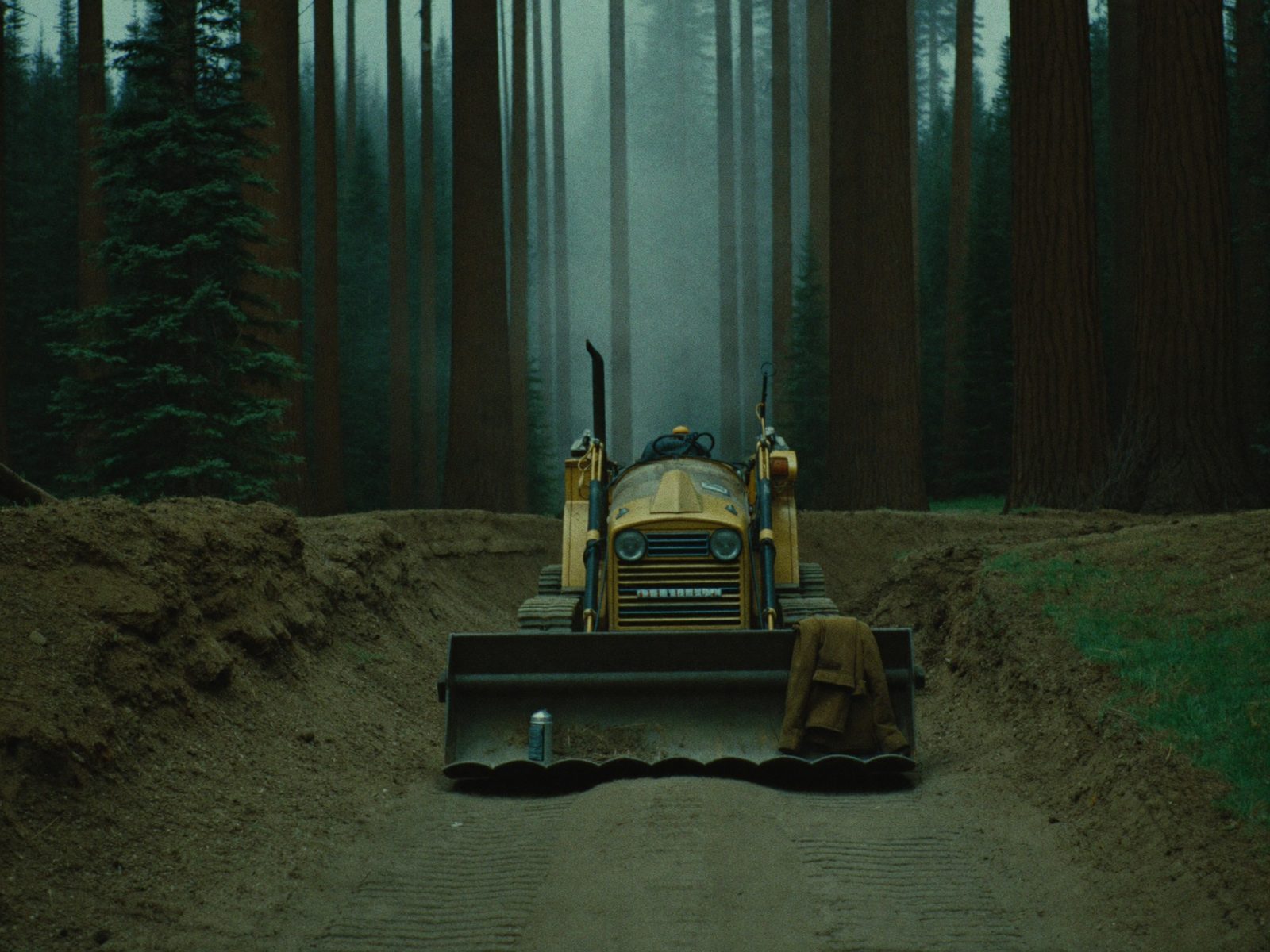
On the morning of 27 August 1958 a bulldozer operator named Jerry Crew found tracks about sixteen inches long and seven wide pressed deep into the graded dirt around his machine, on a logging road being cut through old-growth fir. He told his foreman, Wilbur Wallace. The crew already had a run of unexplained incidents on that road, and the company's co-owner, his brother Ray, was known locally as a prankster. On 6 October a columnist put the story on the front page and closed the crew's nickname, Big Foot, into one word, and the wire services carried it to the rest of the country. The crew named it; the newspaper made it famous. Wallace denied the tracks were his and threatened to sue his accusers for slander. After his death in 2002 his family produced sixteen-inch carved wooden feet and said he had made the tracks. That account came after his death; in his lifetime he always denied it.
The claim has an explanation. The word it produced does not need one.
AI illustration · imagined scene, not an evidence photograph
File
CR-0065
Date
27 August 1958 → 6 October 1958
Place
Bluff Creek Road, Six Rivers National Forest, California
Record
A bulldozer operator, and the crew working the same logging road
Evidence
Plaster casts of the tracks; sixteen-inch carved wooden feet; a family's account
Agency
None in 1958. A newspaper instead
Assessment
D · demonstrated false
The full file
In the late summer of 1958 a road crew cutting a logging road into the Six Rivers National Forest of northern California began finding very large, humanlike footprints in the graded dirt. Within six weeks a local newspaper had put one of the men and his plaster cast on its front page, and a nickname the crew had been using became the word "Bigfoot". Forty-four years later the family of the man most often suspected said he had made the tracks himself.
What was reported
On the morning of 27 August 1958 Jerry Crew, a bulldozer driver working on Bluff Creek Road, found large tracks around his machine. Most accounts give them as about sixteen inches long and seven wide, set deep in the soft dirt. The San Francisco Chronicle called him Gerald Crews, and sources disagree on his employer. The Seattle Times says Wallace Construction; Buhs names both the Granite Logging Company and the Wallace brothers' firm. The foreman on the job was Wilbur "Shorty" Wallace, whose brother Ray was one of the owners.
According to Mental Floss, the crew had already put up with a run of odd incidents on the road, including a spare tyre thrown into a gully, and the men called whatever was responsible "Big Foot". In mid-September, the historian Joshua Blu Buhs writes, fresh tracks appeared. Coralie Bemis, whose husband also worked on the road, wrote to Andrew Genzoli, who wrote a column for the Humboldt Times in Eureka. On 21 September Genzoli printed her letter, adding: "Maybe we have a relative of the Abominable Snowman of the Himalayas." The paper's Willow Creek correspondent, Betty Allen, followed it up and found stories with what she called a "legendary flavor".
The evidence and where it is held
The physical evidence from 1958 is Crew's cast. Buhs says Genzoli met Crew on the first Saturday of October, 4 October, and arranged for him to be photographed holding it; the picture ran on the front page of the 6 October issue, though Buhs also says it ran the next day, and Genzoli later called it a Sunday morning story. Crew would not smile for the camera, saying that if he did, someone "would accuse me of trickery". Mental Floss credits that article with closing the crew's two words into one. The story went out on the wires: the earliest Chronicle piece its librarian has found is dated the same day, and Genzoli later remembered reporters from the New York Times and the Los Angeles Times. Within a fortnight the television quiz show Truth or Consequences offered $1,000. Buhs and Mental Floss say the prize was for explaining how the tracks were made; History.com says it was for proving the creature existed.
Genzoli's papers are held by Special Collections at Cal Poly Humboldt in Arcata. Where the original 1958 cast is now has not been established here. The other object in the case appeared only in 2002: a pair of carved alder-wood feet, which Wallace's nephew Dale Lee Wallace told the Seattle Times he owned.
What was concluded at the time and since
No official body looked into the tracks. The county's suspicions in 1958, Mental Floss records, ran from a "big-footed Swede" among the loggers to Omah, a giant from Hoopa tradition, and locals already suspected Ray Wallace. Wallace denied it, said the prints were a bear's and threatened to sue his accusers for slander, though only Mental Floss records the threat. He then spent decades promoting the creature, with sound recordings, posters, films and photographs, and a press release offering $1 million for a baby Bigfoot.
Ray Wallace died in a nursing home in Centralia, Washington, on 26 November 2002, aged 84. His family then said he had had a friend carve sixteen-inch wooden feet, and that he and Wilbur had worn them to make the 1958 prints. His son Michael told the Seattle Times, in words the Associated Press repeated: "The reality is, Bigfoot just died." Wikipedia's account of the family's statements adds that he also planted hair and dung for researchers to find. Its claim that the hair came from bison on his own animal farm rests on a page by an advocacy group that no longer carries it.
The conventional explanation
The accepted explanation is a practical joke on a work crew by the men who ran it, made into a national story by a slow-news newspaper and the wire services. Its strengths are that the Wallaces were on the site, Ray had a known taste for pranks, the family named the method and kept the tool, and he went on making Bigfoot material for the rest of his life. Its weakness is that the account comes from relatives after his death rather than from Wallace, who denied it while he lived, and the feet have not been compared with the 1958 cast in any published study.
What remains disputed
Jeff Meldrum, an anthropologist at Idaho State University, told the Seattle Times that blaming the whole record on carved feet strapped to boots "just doesn't wash". The Bigfoot Field Researchers Organization argues that the feet do not match photographs of the 1958 tracks and that family members told the story differently. Mark Chorvinsky, who had long argued that Wallace was behind it, replied that "anything can be faked". What none of this touches is the name. However the tracks were made, the word was the crew's, and a newspaper front page of October 1958 gave it to the country.
Family says father was Bigfoot(archived) — Associated Press, via Deseret News, 2002. Wallace's death on 26 November 2002, the carved feet worn by Ray and Wilbur, and Michael Wallace's words.
How the Bigfoot Legend Began(archived) — Becky Little, History.com, 2018. The September column, Betty Allen's reporting and a second version of the television prize.
Andrew Genzoli Collection(archived) — Cal Poly Humboldt Special Collections, via Online Archive of California. Genzoli's career and where his papers are held.
Raymond L. Wallace(archived) — Wikipedia, used as an index. The family's further claims about hair and dung samples, and the dissenting literature.
Wallace hoax behind Bigfoot?(archived) — Bigfoot Field Researchers Organization, undated. An advocacy source, used only for its claim that the feet do not match the 1958 tracks.
Corrected The full file: Buhs gives the date of Crew's front-page photograph inconsistently (he says it ran 'the next day' after Saturday 4 October, but in the 6 October issue), and Genzoli later called it a Sunday morning story; the text now says so instead of stating Monday 6 October flatly.
Corrected The full file: Genzoli recalled visits from reporters and representatives of the New York Times and Los Angeles Times, not telephone calls; the text now says reporters.
Corrected The full file: Michael Wallace's words 'The reality is, Bigfoot just died' were said to the Seattle Times and repeated by the Associated Press; the text no longer attributes them to the AP alone.
Corrected The full file: The Chronicle piece of 6 October 1958 is the earliest its librarian found in the archive, not established as its first report; the text now says that.
Corrected The witnesses are now the crew working the road; the file previously gave thirty men, a figure with no source.
Corrected The family's claim that Wallace made the tracks is now marked as coming after his death, with his lifelong denial noted; their reported claim that he faked evidence with bison hair has been removed.
Added The full file, a long-form write-up with its sources, added.

 INDEPENDENT FIELD ARCHIVE