A giant gecko was found unlabelled in the Marseille collection and described in 1986 as Hoplodactylus delcourti — 370 mm from snout to vent, over 600 mm in total, about half as long again as the next largest gecko. It was linked by inference to the Māori name kawekaweau, on the strength of its stripes. In 2023 DNA was recovered from a bone sample, and the animal turned out to sit in the New Caledonian radiation, most likely from there rather than New Zealand, in a new genus, Gigarcanum — giant secret. No bone found in New Zealand has been securely assigned to the species.
The specimen is real and measured. The country it was filed under is not.
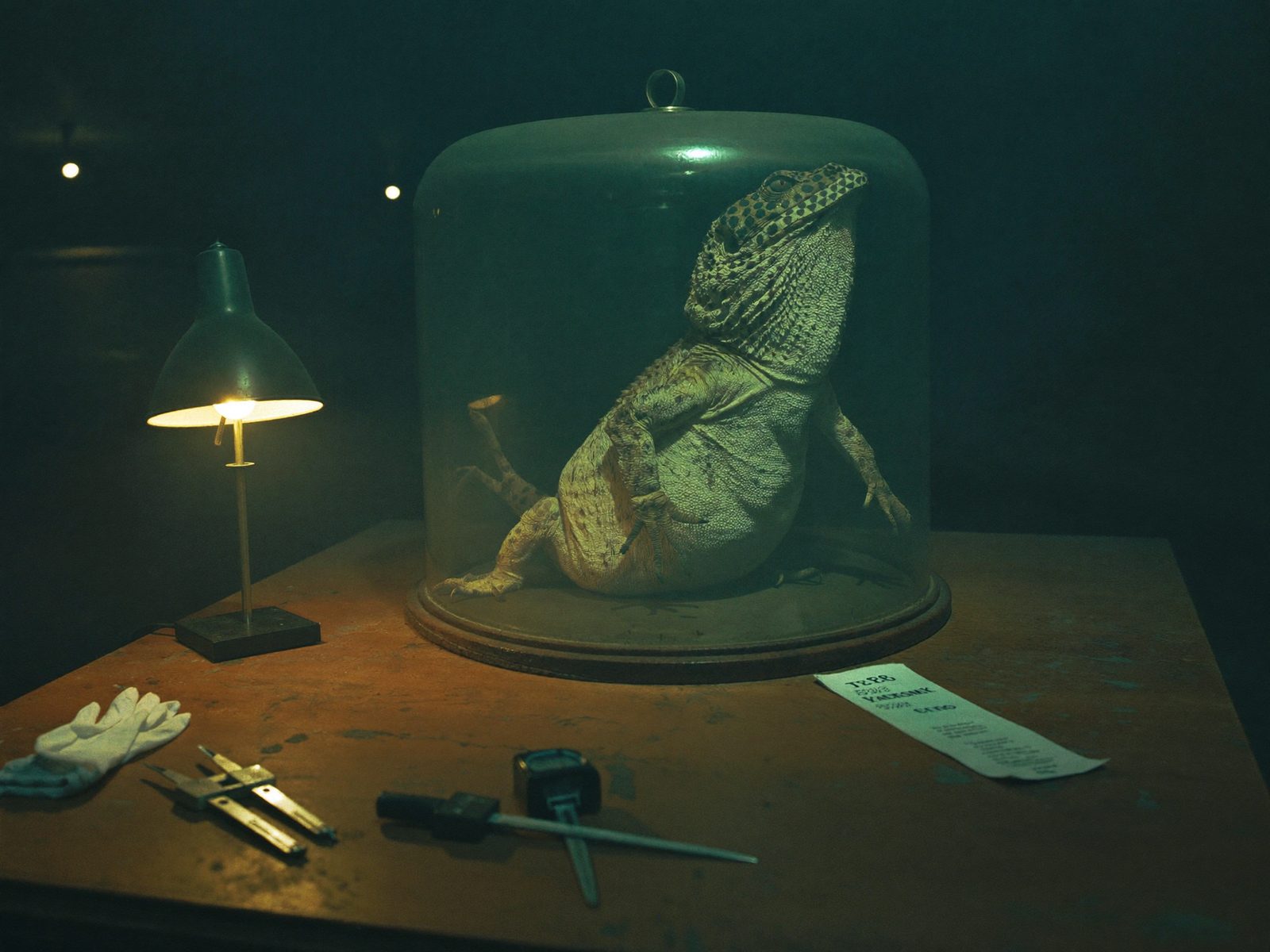
AI illustration · the specimen, not an evidence photograph
File
CR-0060
Date
c. 1870s → 2023
Place
Claimed New Zealand; read as New Caledonia
Record
a single museum object with no collection data
Evidence
The holotype, measured; then archival DNA from its femur
Agency
Muséum d'Histoire Naturelle de Marseille; described in New Zealand Journal of Zoology
Assessment
A · tested, and the answer inverted the case
The full file
Two separate things are bound together in this case: a lizard described to European writers in nineteenth-century New Zealand, and a stuffed gecko in a French museum with no label at all. For about thirty-five years after 1986 they were treated as probably the same animal. A DNA study published in 2023 pulled them apart again.
What was reported
Māori tradition from the northern half of the North Island spoke of the kawekaweau, also given as kaweau, a large forest lizard. Two written reports carry most of the weight. In 1871 the ornithologist Walter Buller, as quoted in New Zealand Geographic, described it as "a beautiful striped lizard, sometimes attaining a length of two feet". He said it had once been common in the forests north of Auckland, and that F. E. Maning of Hokianga had recently obtained two live ones: a cat ate one and the other escaped. In 1873 Gilbert Mair published an account in the Transactions of the New Zealand Institute, quoted in both of Bauer and Russell's papers. In 1870 an Urewera chief had killed one under the loose bark of a dead rātā in the Waimana Valley, inland from Whakatāne. Mair wrote it was "about two feet long and as thick as a man's wrist; colour brown, striped longitudinally with dull red". No specimen was kept. Later accounts are vaguer, and by the mid-twentieth century the animal was widely taken to be myth.
The evidence and where it is held
The physical evidence is a single specimen, catalogue number MMNH 1985-38, in the Muséum d'Histoire Naturelle de Marseille. It is an adult male, gutted, dried, tanned and mounted, with a glass eye. The skull, limb bones and one cloacal bone survive, but the backbone does not. In the 1986 description it measures 370 mm from snout to vent, with a 252 mm tail, about 62 cm in all. Bauer and Russell put it 54 per cent longer in the body than the largest gecko then on record, New Caledonia's Rhacodactylus leachianus.
Nothing records where it came from or when it arrived. The describers set 1902 as the latest possible date, because material acquired after that year is dated, and thought it was most likely acquired between 1833 and 1869, a period with no surviving accession records. The 2023 paper puts it in the collection since at least 1870, and the 1830s on the evidence of its preservation. It had been on public display for years before Alain Delcourt, in charge of the museum's reptile collections, recognised it as unusual. New Zealand Geographic (1990) dates his find to 1979; Science News (2023) says only the 1980s, and that Aaron Bauer first examined it in 1983. In 1990 it was lent to the National Museum in Wellington for an exhibition, then returned.
What investigators concluded
Aaron Bauer and Anthony Russell named the species Hoplodactylus delcourti in the New Zealand Journal of Zoology in 1986. Hoplodactylus was then a purely New Zealand genus, and they placed the specimen there on its toe pads, tail annuli and striped pattern. They considered New Caledonia, which would more easily explain a specimen in a French museum, but preferred New Zealand, giving the type locality as "possibly the North Island". The kawekaweau link was a matter of fit: Mair's size and colouring match the specimen. In 1986 they wrote only that the species should be included in any future thinking about the legend. Their 1987 paper in the Journal of Ethnobiology went further, using the folklore to support a New Zealand origin while conceding that "a degree of uncertainty" must remain.
In June 2023 Matthew Heinicke and seven colleagues, Bauer among them, reported in Scientific Reports that they had drilled bone powder from inside the left femur and sequenced it, recovering a complete mitochondrial genome and data for twelve of the fifteen marker genes they compared. The gecko did not group with Hoplodactylus or any New Zealand lineage; statistical tests rejected that placement. It sat firmly inside the New Caledonian radiation, nearest to Rhacodactylus, Mniarogekko and Eurydactylodes. The authors moved it to a new genus, Gigarcanum, from the Latin for giant and secret.
The conventional explanation
The accepted reading now is that the specimen is a real, extinct giant gecko from New Caledonia or nearby, collected and mounted early in the nineteenth century, and unconnected with the kawekaweau. Its strengths are the genetic result and the fossil record: careful study of New Zealand's subfossil reptiles has produced no remains clearly belonging to the species. Its weakness is that it, too, rests on inference about place. The 2023 authors write that it "most likely" lived in New Caledonia because its relatives did and because these geckos rarely cross the sea. They state that the Loyalty Islands, or even New Zealand, cannot be ruled out without a locality or more remains.
What remains unexplained or disputed
The specimen's collector, voyage and date are unknown, and no second specimen of Gigarcanum has been found anywhere. One small bone collected in Otago in the 1870s has been read as a gecko cloacal bone from an animal about 60 cm long; others interpret it differently. The kawekaweau itself is left without a body. Heinicke's team note that no known New Zealand reptile, living or extinct, fits Mair's description better than this gecko. The DNA does not say what Buller's and Mair's lizards were; it says the Marseille specimen is very probably not one of them.
Hoplodactylus delcourti n. sp. (Reptilia: Gekkonidae), the largest known gecko — Aaron M. Bauer and Anthony P. Russell, New Zealand Journal of Zoology 13:141–148, 1986 (archived author copy; DOI 10.1080/03014223.1986.10422655). The holotype, its measurements, the 1833–1869 and 1902 dating, the type locality and Mair's account.
Kawekaweau — myth or monster?(archived) — Tony Whittaker (byline as printed), New Zealand Geographic issue 6, 1990. Buller's 1871 words, the 1979 find, the 1990 Wellington loan and the Otago cloacal bone.
Corrected The full file: The 2023 DNA study recovered data for twelve of the fifteen marker genes it compared (two of them mitochondrial), not 'parts of twelve other genes'; the text now says so.
Corrected The verdict on the specimen's origin is softened from rejected to doubted: the 2023 DNA study found New Caledonia most likely, without ruling out New Zealand. A disputed bone found in New Zealand is now acknowledged.
Added The full file, a long-form write-up with its sources, added.

 INDEPENDENT FIELD ARCHIVE