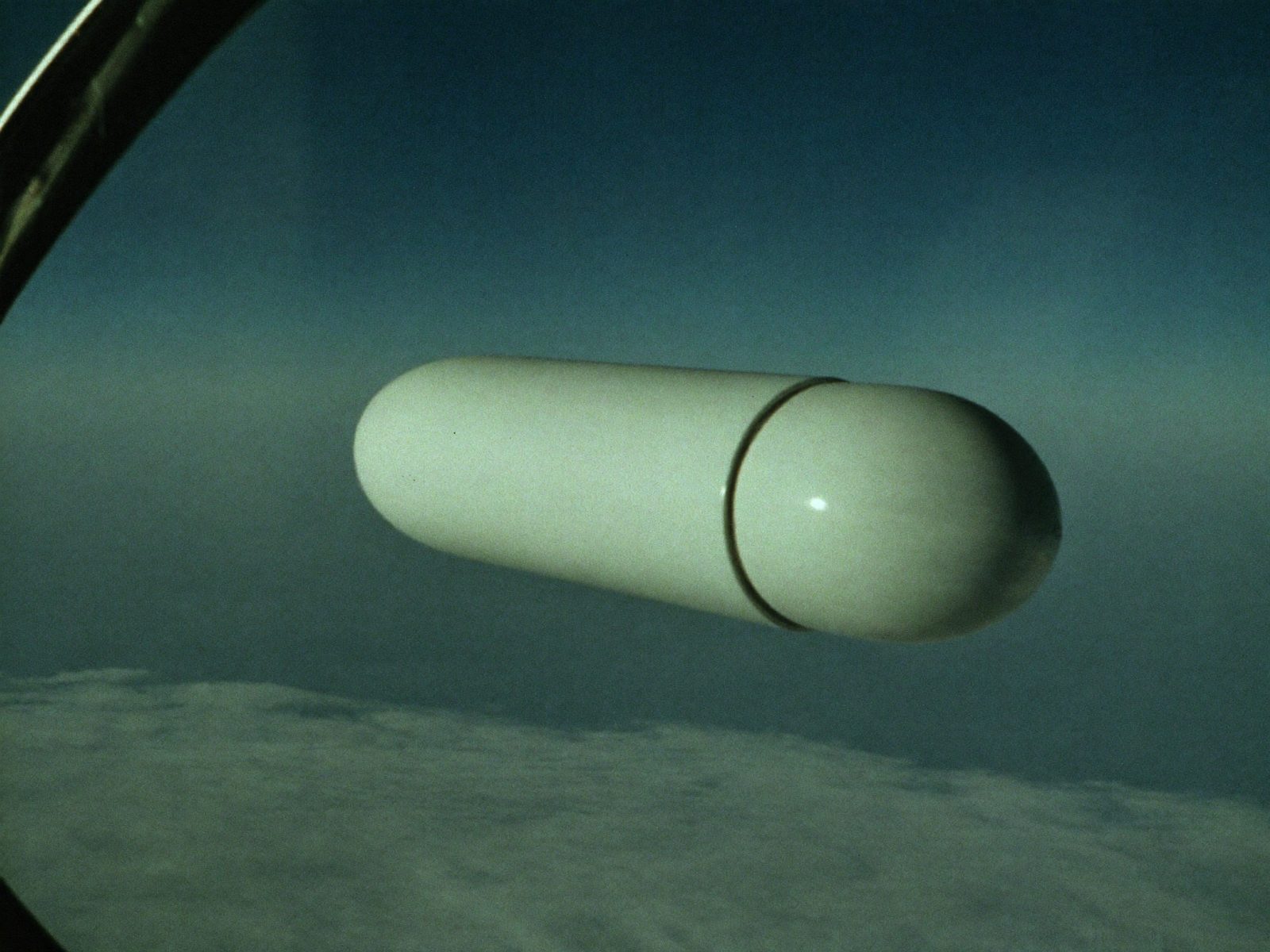
The radar ship Princeton had been tracking contacts dropping rapidly from about eighty thousand feet to twenty thousand for weeks. Sent to look, Fravor found a smooth white forty-foot object, no wings, no wash hovering over a roiled patch of white water. He spiralled down toward it and it climbed to meet him, then left. The DoD released the footage in 2020, and Fravor testified under oath in 2023.
The case that restarted it all. AARO has published no resolution of it.
Four Navy aircrew — Cdr David Fravor, Lt Alex Dietrich and two weapons-systems officers
Evidence
Ship radar over preceding weeks, four aircrew's daylight account, and a FLIR tape recorded on a separate sortie afterwards
Agency
US Navy; AARO lists it unresolved
Assessment
A · instrumented (radar + FLIR + aircrew)
The full file
In November 2004 the Nimitz carrier strike group was at sea off southern California, early in the training cycle that would precede a deployment to the Persian Gulf. On 14 November two F/A-18F Super Hornets of Strike Fighter Squadron 41, the "Black Aces", launched for a routine air-combat exercise and were redirected by the guided-missile cruiser USS Princeton to investigate an unknown contact. What the four aircrew saw over the next few minutes, and what a second crew filmed afterwards, became the best-known military sighting of the century.
What was reported
The lead aircraft was flown by Commander David Fravor, the squadron's commanding officer; the second by Lieutenant Alex Dietrich. Each had a weapons-systems officer in the rear seat. In his written statement to the House Oversight Committee in July 2023, Fravor said the Princeton's controller had been watching such objects on the ship's Aegis radar for the previous two weeks, "descending from above 80,000ft and coming rapidly down to 20,000ft". Arriving at the contact's position at 20,000 feet in clear weather and a calm sea, the crews saw a patch of disturbed white water and, above it, a "small white Tic Tac shaped object" with no rotors, rotor wash or wings. Fravor descended towards it while Dietrich held high cover. He reported that the object turned to align with his aircraft, climbed, and as he closed to within about half a mile "rapidly accelerated and disappeared". The white water was gone when he turned back. The Princeton then reported a contact at the flight's training point, some 60 miles away.
The accounts differ on the details. Fravor has estimated the object at about 40 feet long, while CBS's 60 Minutes in 2021 reported him likening it to the size of his own aircraft. The same programme reported the radar contacts as "descending 80,000 feet in less than a second", a figure Fravor's sworn statement does not use. A military report later made public by the Las Vegas station KLAS-TV, as described by New York magazine, gave the descent as 60,000 feet to 50 feet.
The evidence and where it is
Fravor told Congress that the incident was never investigated at the time: "none of my crew were ever questioned, tapes were never taken". The radar data from the Princeton and the aircraft have not been released, and their survival is unknown.
What does survive is a short infrared clip, usually called FLIR1, recorded by Lieutenant Chad Underwood's crew from the squadron on a later sortie. Underwood told New York magazine in 2019 that he tracked the target on radar and the targeting pod but "didn't see it with my own eyeballs". The magazine placed the recording about an hour after Fravor's encounter; a 2021 San Diego Union-Tribune report placed it on the following day. The clip leaked online in 2007 and was published by the New York Times in December 2017. On 27 April 2020 the Department of Defense formally released it with two later Navy videos, stating that the phenomena "remain characterized as 'unidentified'". The video is held in the Naval Air Systems Command FOIA reading room.
What investigators concluded
No contemporaneous investigation took place. Fravor was first approached in 2009 by Jay Stratton, whom he describes as part of the Pentagon's UFO study programme of the time, and he says the resulting report on the incident later circulated publicly. The All-domain Anomaly Resolution Office (AARO), set up in 2022, has published no resolution of the case. Its first director, Sean Kirkpatrick, told ABC News in July 2023 that it sat among the small fraction of unexplained cases, adding: "It's really hard to guess on this, and I don't like to guess." At a Senate hearing in November 2024, Senator Kirsten Gillibrand noted "ongoing public interest in the Nimitz incident" and asked AARO to share what it could; the office's presentation that day resolved other cases, including the 2015 GoFast video, but not this one.
The leading conventional explanation
The most developed mundane reading concerns the video. The analyst Mick West has argued that FLIR1 is consistent with a distant aircraft flying away from the camera, its shape "essentially just the glare of a hot object", with the apparent dart to the left caused by the camera losing its lock rather than by the target moving. Its strength is that it rests on the on-screen sensor data and on how infrared pods are known to behave, and AARO accepted comparable optical explanations for GoFast. Its weakness is scope: it addresses only the clip, which was taken by a crew that never saw the object, and offers no account of the daylight sighting by four aircrew or of weeks of radar tracks. Of West's analysis of another Navy video, Gimbal, Fravor said in 2020 that critics had "never operated the system". A second line of explanation, spurious or spoofed radar returns, would bear on the Princeton data but has not been tested against records that are not public.
What remains open
The case rests on testimony recorded years after the event and on one short video whose subject has not been shown to be the object the pilots saw. The figures for the radar descents vary between accounts, as do the object's size and the timing of the video. The original radar recordings, which could settle much of this, have never been produced. Until they are, the encounter remains unresolved, and the parts of it that are best documented are also the parts that explain least.
Corrected The full file: Fravor's remark that critics had 'never operated the system' was made in 2020 about Mick West's analysis of the Gimbal video, not the FLIR1 clip; the text now says so.
Corrected Only David Fravor testified under oath in 2023; the file previously said the aircrew did.
Corrected The FLIR tape was recorded on a separate sortie afterwards, not minutes later.
Corrected AARO has published no resolution of the case; the file previously said it still lists it as unresolved. The radar descents are now given as from about eighty thousand feet to twenty thousand, without the 'under a second'.
Sources The source on file is now Fravor's own statement to the House Oversight Committee of July 2023 rather than an encyclopedia article.
Added The full file, a long-form write-up with its sources, added.

 INDEPENDENT FIELD ARCHIVE