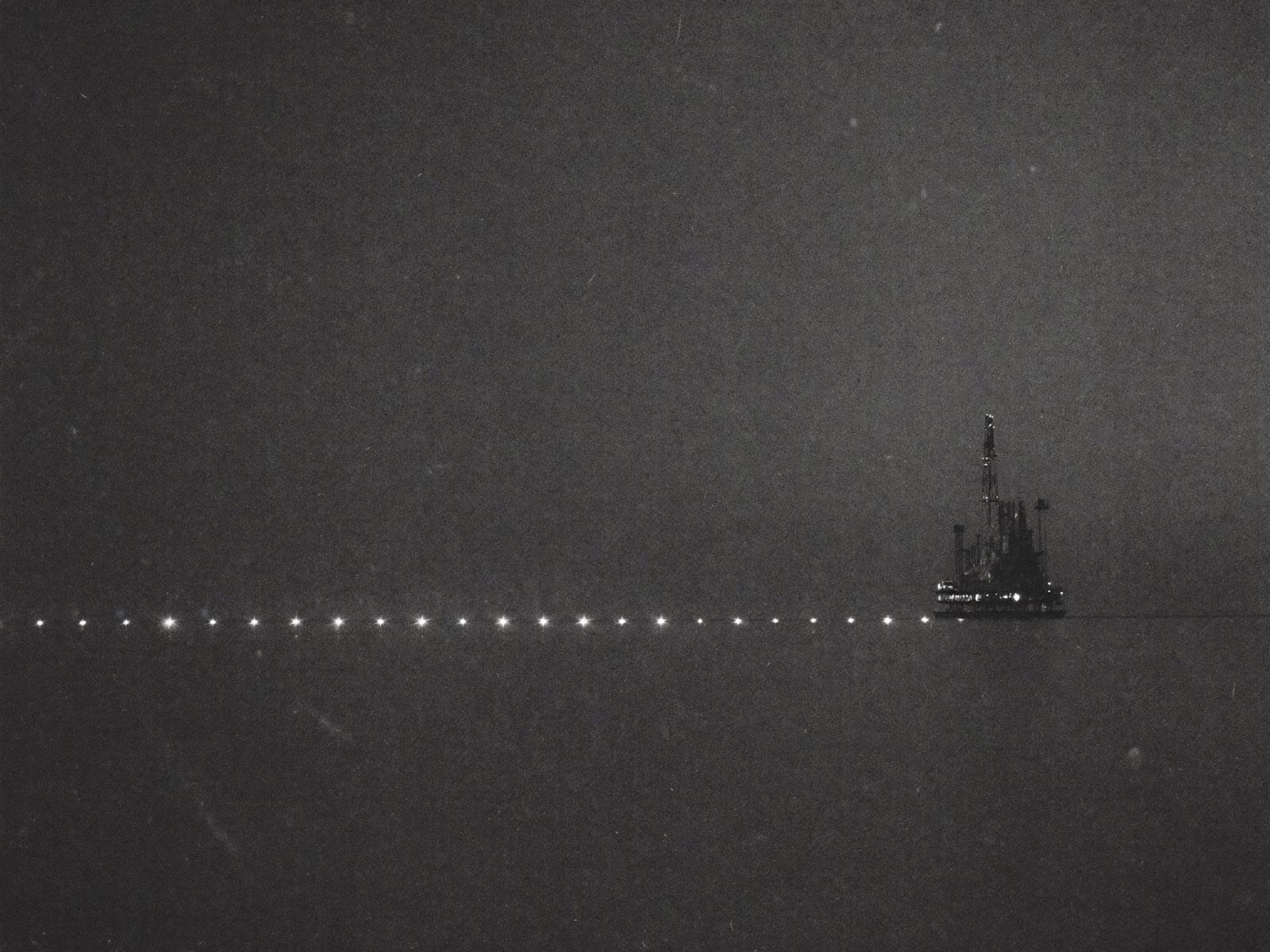
Flying at 3,500 metres, the crew recorded eleven objects, and the Defence Secretary gave the tape to a journalist, who released it. The strongest reading is burn-off flares on offshore oil platforms in the Gulf. Press accounts of the footage grew with each retelling.
A government release is not a government confirmation. This case is the difference.
Mexican Air Force aircrew flying a counter-drug sortie with infrared equipment
Evidence
Infrared video handed by the Defence Secretary to a journalist, who released it two months later
Agency
Mexican Secretariat of National Defence (SEDENA)
Assessment
D · explanation fits better than the object
The full file
On Friday 5 March 2004 a Mexican Air Force C-26A, a twin-turboprop Merlin Metro, was flying a routine counter-drug patrol along the coast of Campeche state on the Gulf of Mexico. It carried a radar and a FLIR Star SAFIRE infrared camera for tracking drug-smuggling aircraft. During the flight the crew recorded a series of hot points of light on the infrared camera that none of them could identify.
What was reported
According to the 2004 press reports, the aircraft was at about 11,500 feet (some 3,500 metres). The radar operator, Lieutenant Germán Marín, said he had been afraid. The camera operator, Lieutenant Mario Adrián Vázquez, said he could not say what the objects were but believed them real. The captain, Major Magdaleno Castañón, said the lights vanished when the aircraft stopped following them. Reporting settled on eleven objects, with only three of them on radar. Some later Mexican coverage gives sixteen. Michael Shermer of the Skeptics Society noted how the story changed in the first week. At first the objects were said to have been found only on later review of the footage; in later versions the crew had seen them, chased them and been surrounded. He called it "like a fisherman's tale, growing with each retelling".
The evidence and where it is held
The evidence is the infrared video, with the camera's recorded pointing angles and zoom, and the crew's account of the radar returns. Its route into public view is part of the case. The Defence Secretary, General Gerardo Clemente Ricardo Vega García, gave a copy to the journalist and UFO proponent Jaime Maussan, who presented it at a press conference on 11 May 2004. Smith's account in eSkeptic dates the Defence Department's own statement and tape to 12 May. Reuters reported that the Air Force itself had released the footage. In answers to transparency requests in 2016 and 2021, the Secretariat of National Defence (SEDENA) confirmed the flight, the three radar echoes and the group of thermal targets. It also said it no longer holds the video, because the tape was handed to Maussan, and pointed requesters to copies on YouTube. Vega García later acknowledged that there was no official record of the handover. Maussan showed the footage again at a public hearing in Mexico's Chamber of Deputies in September 2023.
What investigators concluded
The Defence Department released the tape without an explanation of its own, and no scientific analysis of it was ordered. A 2023 report in La Razón says SEDENA attributed the lights at the time to centellas, or ball lightning; no contemporaneous statement to that effect was found in this research. Ball lightning was also the reading offered to Reuters by Julio Herrera, a nuclear science researcher at Mexico's National Autonomous University. He called it possibly "one of these rare events". The American physicist Bruce Maccabee rejected the idea because ball lightning lasts only seconds, while these lights persisted.
The leading conventional explanation
The explanation most analysts now accept is that the lights were gas flares on oil platforms in the Cantarell field in the Bay of Campeche. The idea came from Captain Alejandro Franz. It was tested by James C. Smith, an aerospace engineer, in eSkeptic, the Skeptics Society's newsletter, on 24 July 2004. Smith located individual flares on Landsat infrared imagery and built a three-dimensional model of the camera's field of view from the angles recorded on the video. He matched the most striking sequence, the "ten UFO" group, to ten flares on three platforms: Akal-C, Akal-J and Nohoch-A. They were 110 to 120 miles away, inside the horizon for an aircraft at that height. In his model the apparent splitting of the lights was parallax as the aircraft moved, and the apparent motion came from cloud passing across a very narrow field of view. He also tied an earlier light to the onshore flares at Atasta, about 82 miles away. Separately, the Infraspection Institute examined the tape at the request of the National Geographic Society. In May 2005 it reported the same conclusion, describing the apparent flight as "merely an optical illusion created by the two-dimensional aspect of the videotape".
The strengths are specific: named platforms with mapped positions, geometry checked against the camera's own data, and a reason why the crew saw nothing by eye. The flares were visible only at high zoom: just visible in a field of view of 3.6 by 2.6 degrees, and clearest in the narrowest, 0.4 by 0.3 degrees. The weaknesses are real too. Smith's Landsat images were several years old, so some flares may have been missing or inactive. The camera elevation readings, which placed the lights above the aircraft, needed corrections of two to five degrees that he could not check against flight data. The flare match covers the "ten UFO" sequence, which had no radar return, and not every light on the tape.
What remains disputed
Smith himself left some lights unmatched. Those that did produce radar returns, he wrote, had the characteristics of ordinary aircraft, but none was identified. Other lights appeared to be at ground level. The Mexican government has never published an analysis, adopted the flare explanation or rejected it. It no longer holds the recording, so the original tape and its full camera data cannot be re-examined. Maussan and others continue to present the video as unexplained. The record shows a government that released footage, not one that endorsed an interpretation of it.
Ovnis en México: avistamientos más famosos — Lucía P. Castillo, UnoTV, 2024. C-26A aircraft, 11 May press conference, SEDENA transparency answers, video no longer held by SEDENA.
Corrected The full file: The text now gives the aircraft's height as about 11,500 feet from the 2004 press reports. This matches Smith's eSkeptic account.
Corrected The full file: The text now gives the Defence Secretary's full name as General Gerardo Clemente Ricardo Vega García. This matches SEDENA's transparency answer as reported by UnoTV.
Corrected The full file: The text now says Vega García acknowledged there was no official record of the handover of the tape. This matches El Imparcial.
Corrected The full file: The text now describes Julio Herrera as a nuclear science researcher, not a nuclear physicist. This matches the Reuters report.
Corrected The full file: The text now says Smith's flare analysis appeared in eSkeptic, the Skeptics Society's newsletter, on 24 July 2004, rather than in Skeptic magazine.
Corrected The full file: The text now gives the camera's actual fields of view from Smith: the flares were just visible at 3.6 by 2.6 degrees and clearest at 0.4 by 0.3 degrees.
Corrected The full file: The text said Reuters reported that the ministry confirmed it had supplied the video. The Reuters report says only that the Air Force had released the footage, and the text now says that.
Corrected The full file: The text said the Infraspection Institute examined the tape in 2005 for a National Geographic Channel programme. The Institute's own item says the National Geographic Society asked it to examine the tape and gives its conclusion in May 2005, and the text now says that.
Sources The full file: The Mediotiempo source line credited it with the three radar echoes and the thermal targets. In that article those details are a journalist's account and are not tied to SEDENA, so the line now cites it only for SEDENA's confirmation that it holds a record of the sighting.
Corrected The Defence Secretary gave the tape to a journalist, who released it; the file previously said the Defence Department released it with a press statement.
Corrected Oil-platform flares are now the leading rather than the accepted explanation: independent analysts argued it, and the Defence Department never adopted it.
Sources The source on file is now James C. Smith's eSkeptic analysis of July 2004 rather than an encyclopedia article.
Added The full file, a long-form write-up with its sources, added.

 INDEPENDENT FIELD ARCHIVE