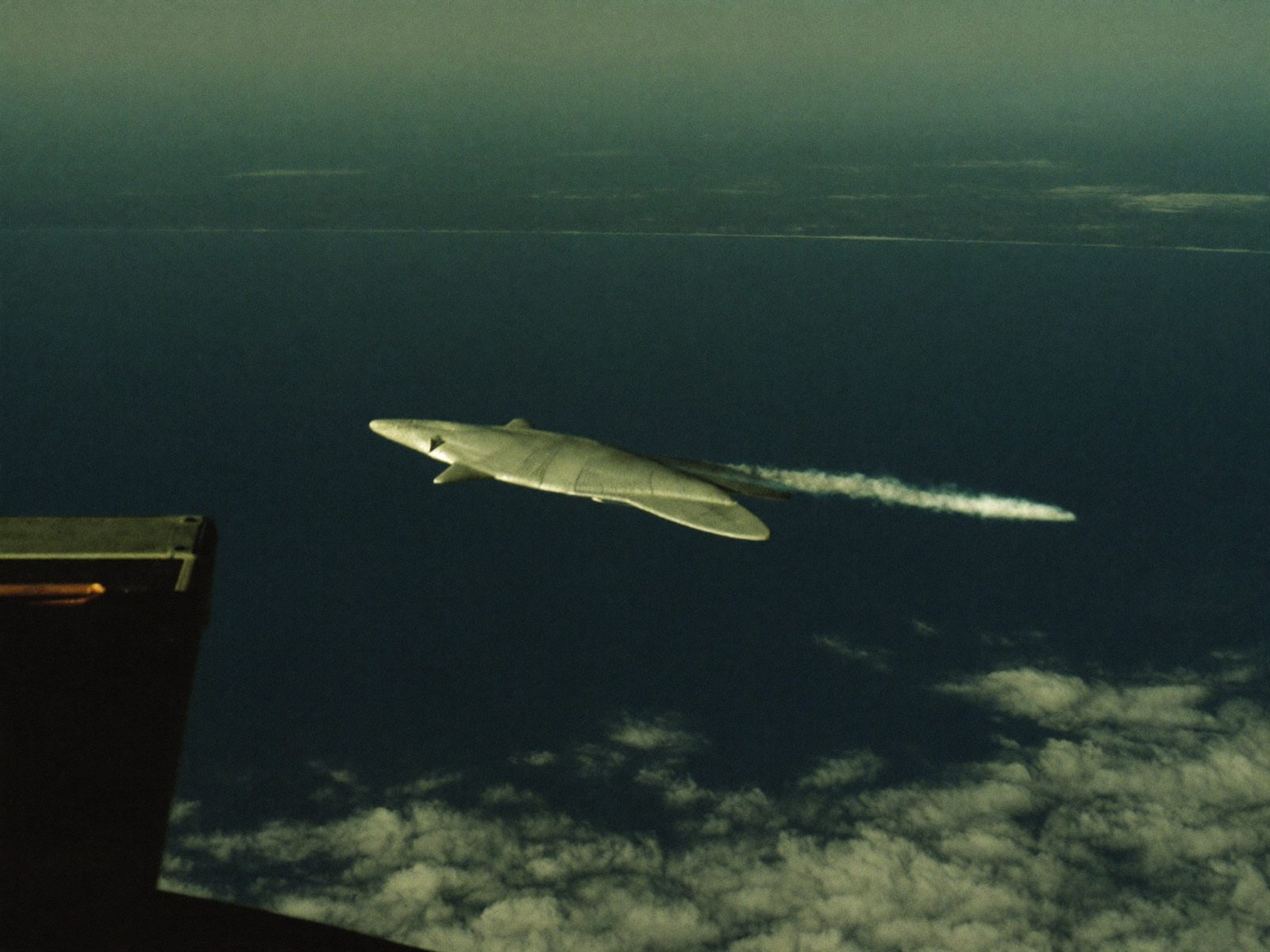
The object kept pace with the helicopter at about 55 kilometres for nine minutes and twelve seconds while the technician filmed it in infrared. The pilot called it on the civil air channel and nothing answered. At eight minutes it released a plume; the object itself read on infrared as hotter than 50 °C.
CEFAA's line: we do not know what it was, but we do know what it was not.
Two Chilean Navy officers on a routine daylight patrol in a Cougar helicopter
Evidence
Nine minutes twelve seconds of MX-15 infrared video; no return on the aircraft's own radar or either ground station
Agency
CEFAA (Chile), with video analysis by GEIPAN (France)
Assessment
A · instrumented (IR video, no radar)
The full file
On the afternoon of 11 November 2014 a Chilean Navy Airbus Cougar AS-532 helicopter was flying a routine daylight patrol north along the coast west of Santiago. The Chilean broadcaster T13 placed the flight between Viña del Mar and San Antonio and the sighting at 13:52. Aboard were a Navy captain with long flying experience and a naval technician who was testing a new WESCAM MX-15 HD infrared camera. The technician noticed an object over the sea, and both men then saw it with the naked eye.
What was reported
According to Leslie Kean's account from the Chilean file, the helicopter was at about 4,500 feet and 132 knots in clear air at about 10 °C; T13 gave the height as about 1,300 metres. The crew judged that the object was keeping pace with them at the same height, some 55 to 65 kilometres away and heading west-north-west. In his written report the captain described a "flat, elongated structure" with two thermal sources that did not line up with its direction of travel. The technician filmed it for nine minutes and twelve seconds, mostly in infrared, until it passed behind cloud. Twice it appeared to release a trail, first at about eight minutes.
The pilot reported the object to a coastal radar station and to the civil aviation radar in Santiago. Both had the helicopter; neither, nor the helicopter's own radar, showed the object, and controllers said no traffic was authorised in the area. The pilot called it repeatedly on the shared civil air channel and received no reply.
The evidence and where it is held
The footage went to CEFAA, the committee within Chile's civil aviation directorate (DGAC) that studies anomalous aerial phenomena. It was made public on 5 January 2017 through Kean's article on the Huffington Post contributor platform. Much more of the file appeared in January 2023, when the DGAC released it to the YouTube channel Omega Click; The Black Vault now hosts it with the channel's permission. As described there, it includes the crew's report forms, a transcript from the camera operator, flight tracks, meteorological data, the Air Force photogrammetry report, the French analysis and a raw video file of about a gigabyte. By then the committee was named SEFAA.
What investigators concluded
CEFAA spent about two years on the case and met at least eight times. The astrophysicist Luis Barrera ruled out re-entering space debris; the Air Force meteorologist Luis Salazar found no balloons and estimated the object was hotter than 50 °C. The Air Force photogrammetry department, led by Alberto Vergara, ruled out a bird, insect, drone, parachute and hang-glider. It reported a solid object that moved independently of the wind. Through France's GEIPAN, the image analyst François Louange and colleagues produced a preliminary 2015 study that proposed a medium-haul airliner on approach to Santiago, its two hot spots being the engines and the plume cabin wastewater. The committee rejected it: such an aircraft would have shown on primary radar and answered the radio, discharges need DGAC permission, and no contrail could form at that height and temperature. CEFAA classed the object as unidentified. Its director, General Ricardo Bermúdez, said: "We do not know what it was, but we do know what it was not."
The leading conventional explanation
Within days of the release, an online group on Mick West's Metabunk site concluded that the object was an airliner climbing out of Santiago. Of two flights in that airspace, LAN flight LA330 and Iberia flight IB6830, they judged the more likely to be IB6830 to Madrid, a four-engined Airbus A340, whose broadcast ADS-B track gives time, height and position. Robert Powell of MUFON's Science Review Board, working from radar data, also named IB6830 as the likeliest candidate. On this reading the two hot spots are the engine pairs on each wing, seen from behind. The trails are contrails that start and stop as the aircraft passes through air of varying humidity. The aircraft was on radar, but much further away than the crew believed, so controllers found nothing where they looked. Universe Today and Skeptoid both judged this the best fit to the facts.
Its strength is that it rests on recorded data: a real aircraft with a logged track in roughly the right part of the sky, and a mechanism for the plume that needs no dumping. Its main weakness, set out in Kean's follow-up of 17 January 2017, is the geometry. At one checked moment Powell placed IB6830 about nine degrees outside the camera's field of view. Making the track fit required assuming an error of about seven degrees in the camera's bearing, and the camera's compass appeared not to be working. Kean also asked why an experienced pilot would not recognise an airliner, and why other traffic did not appear on camera. CEFAA did not adopt the explanation; its interim director, José Lay, said only that the committee respected opinions offered in good faith.
What remains disputed
No revision of CEFAA's classification was found in this research. Asked by The Black Vault in 2023 whether the released file changed his view, Mick West said the airliner still explained it. Omega Click, which obtained the file, disputes that reading. The disagreement turns on the camera's true bearing and the object's distance. Until the airliner identification is tested formally against the flight tracks now in the public file, the official record calls the object unidentified while independent analysis treats it as identified.
The Chilean Navy UFO(archived) — Brian Dunning, Skeptoid, 2022. Summary of the IB6830 identification, the engine and contrail reading, and the distance and radar argument.
Chilean Navy UFO case file release — John Greenewald, The Black Vault, 2023. The 2023 DGAC release of the case file, its contents, Mick West's reaffirmation and Omega Click's dissent.
Corrected The full file: The Metabunk analysts did not first settle on LAN flight LA330 and then move to IB6830; they looked at both flights in that airspace and judged IB6830 the more likely, and the text now says that.
Corrected The status is now contested rather than unresolved: Iberia flight IB6830, on radar and in ADS-B logs, is proposed as the object, with its contrail as the plume. The file previously said no return matched it.
Corrected The reading above 50 °C was for the object itself, not for the plume it released.
Added The full file, a long-form write-up with its sources, added.

 INDEPENDENT FIELD ARCHIVE