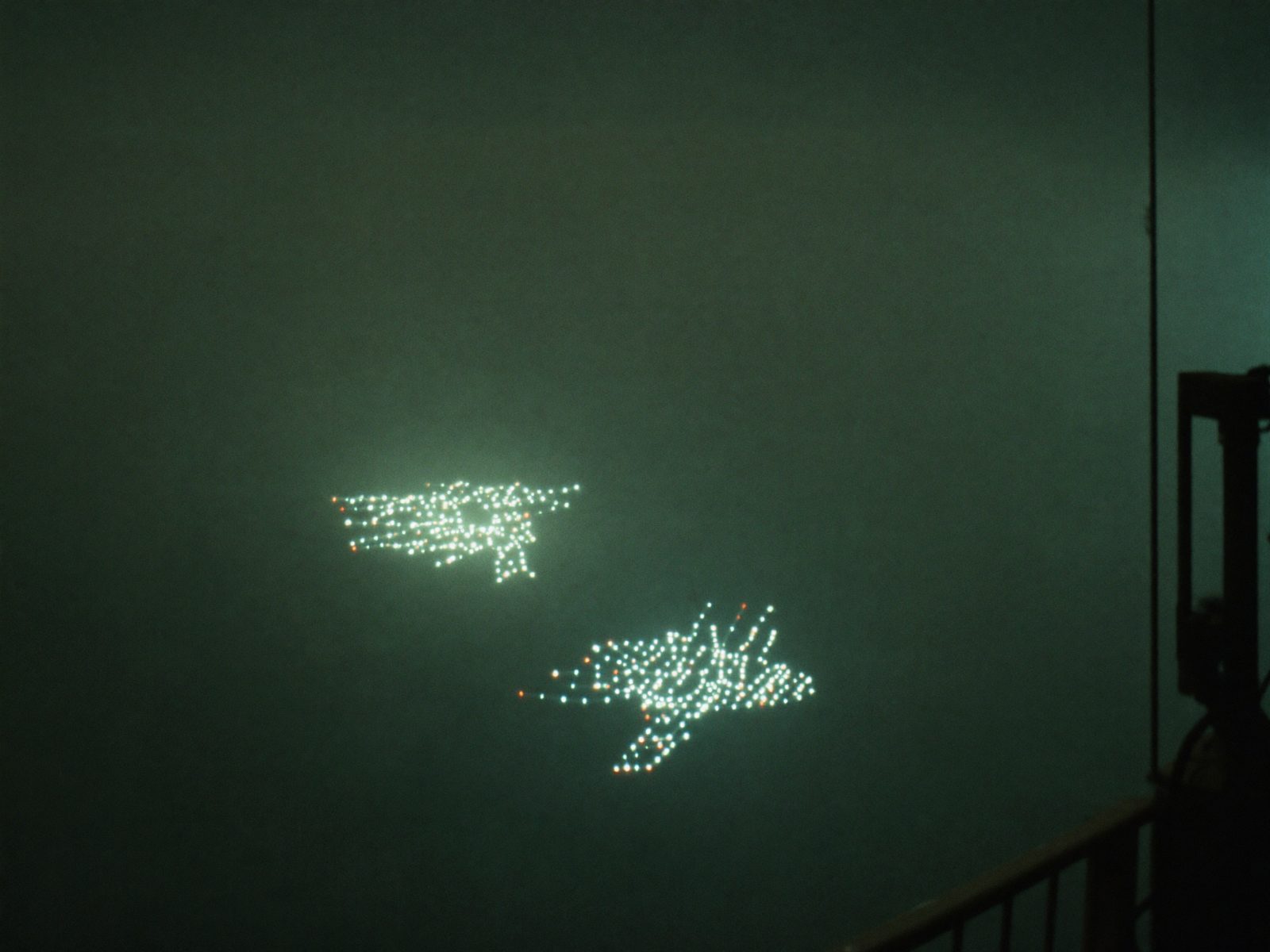
Clusters of objects circled several Navy ships off San Diego in July 2019, and the footage — shown publicly at the May 2022 House hearing — was read as a swarm of unknown craft. In 2022 the Deputy Director of Naval Intelligence told the House the contacts were drones, and the 'pyramids' an artefact of night-vision optics; the Navy reclassified them as unmanned aerial systems. The sphere filmed from USS Omaha has no official explanation.
The clearest example of a swarm whose 'unknown at the time' was mundane in retrospect.
Shipboard FLIR and radar — pyramid-shaped contacts in the Russell video, a sphere in the Omaha video
Agency
US Navy; AARO assessed the footage
Assessment
C · sensor contact, mundane explanation on file
The full file
On the night of 14 July 2019 the destroyer USS Kidd, working in the exercise areas around the Channel Islands off southern California, logged two unidentified "UAVs" at about ten o'clock. Within minutes the neighbouring destroyer USS Rafael Peralta had called out its ship's photographic team. Over the following nights other ships logged lights and radar contacts circling them, sometimes several at once, in poor visibility and many miles from the mainland. Navy deck logs released under the Freedom of Information Act put sightings by the Kidd, Rafael Peralta, Russell and John Finn on 14 and 15 July, with further sightings on 25 and 30 July. Later releases add the cruiser Bunker Hill, which reported up to eleven drones, and the destroyer Ralph Johnson. The witnesses were ships' crews, watch-standers and photographic teams; no aircrew saw the objects at close range.
The evidence and where it is
The paper record is the strongest part of the case. Deck logs, internal emails, briefing slides and draft press statements were first brought to light by the documentary maker Dave Beaty and then obtained under FOIA by the journalists Adam Kehoe and Marc Cecotti, who published them through The War Zone in 2021 and 2022. They show the matter was to be reported to the Pacific Fleet commander and reached the office of the Chief of Naval Operations, and that the Coast Guard, NCIS and the FBI were consulted.
Two pieces of footage made the incident famous. In April 2021 the filmmaker Jeremy Corbell published a short night-vision clip, said to be from the Russell, of blinking triangular shapes above the ship. In May 2021 he published a second clip, said to have been filmed in the combat information centre of the littoral combat ship USS Omaha at about 11 p.m. on 15 July 2019, in which a dark round shape crosses a thermal display and drops out of sight at the sea surface while a voice says, "Whoa, it splashed!" A Pentagon spokesperson, Susan Gough, confirmed in each case only that the material was taken by Navy personnel and was under review by the UAP Task Force. She did not confirm the dates, places or any description of the objects. The Omaha clip has never been officially released, and the size, speeds and fruitless submarine search attached to it come from Corbell, not from any published Navy record.
On 17 May 2022 the Deputy Director of Naval Intelligence, Scott Bray, showed a July 2019 night-vision clip of triangular lights to a House Intelligence subcommittee. The Navy published it the same day as "Navy 2019 West Coast video"; it remains on DVIDS. The Navy's caption does not name the ship. It is generally taken to be the same event as the leaked Russell clip, but the official record does not say so.
What investigators concluded
At first the Navy said it did not know. On 5 April 2021 the Chief of Naval Operations, Admiral Michael Gilday, was asked whether the drones had been identified and answered, "No, we have not," adding that he had "no indications at all" that they were extraterrestrial.
Bray's 2022 testimony closed the question of the triangles. He said the 2019 video had "remained unresolved for several years" until a later swarm off a different coast was filmed the same way while other Navy assets also observed drones. The triangular shape, he said, "is a result of light passing through the night vision goggles" and then the camera. Asked by Adam Schiff whether the effect had been reproduced, he said the task force was "aware of studies that have done that." The Navy's video caption states that the objects were "subsequently reclassified as unmanned aerial systems."
Navy documents released a month later went further. They describe "quadcopter style" drones, attribute some flights to local fishermen and others to likely surveillance from the Hong Kong-flagged bulk carrier Bass Strait, and record a 30 July pass by the Russell in which radio-frequency data was captured.
The conventional explanation
The leading explanation is that the ships were overflown by small drones, operated by someone other than the US Navy. Its strengths are considerable: contemporaneous logs that call the objects UAVs from the first night, multiple ships and radar tracks, a demonstrated optical cause for the "pyramids", and an official reclassification. Its weakness is that the identification of the triangles rests on analogy with a later incident rather than on recovery of a drone, and the operator has never been publicly named. The Omaha sphere sits outside this explanation altogether. No official analysis of it has been published. A distant aircraft, balloon or drone seen low against a thermal horizon, then lost from view, is the obvious mundane reading, but it has not been tested in public against the ship's own sensor data.
What remains open
The case is explained in its main outline: these were drones, and the pyramids were an artefact of the camera. What is still disputed is who flew them, how craft of that size stayed aloft for ninety minutes or more well offshore, and what the Omaha recorded. The Navy documents point at more than one source rather than a single operator, and none of them settles the Omaha footage.
Sources The full file: The text no longer says the Navy video remains on navy.mil as well as DVIDS, because only the DVIDS copy could be confirmed.
Corrected The full file: USS Paul Hamilton was listed among ships whose deck logs record sightings on 14 and 15 July; The War Zone names it only as a ship nearby, so it has been taken off the list.
Corrected The full file: The documents were said to have been obtained under FOIA by Dave Beaty as well as by The War Zone; The War Zone says Beaty uncovered the first details and its own FOIA requests produced the logs, and the text now says so.
Corrected The full file: The documents show only that an NCIS agent said the matter would be reported to the Pacific Fleet commander, not that it reached him; the text now says so, while the office of the Chief of Naval Operations is still given as having received it.
Corrected The drones were identified by the Deputy Director of Naval Intelligence in 2022, not by AARO, and no official source called them balloons. The sphere filmed from USS Omaha has no official explanation.
Added The full file, a long-form write-up with its sources, added.

 INDEPENDENT FIELD ARCHIVE