Two clips from one deployment were treated as smoking-gun footage for years. In November 2024 AARO director Jon Kosloski told the Senate that GoFast's apparent speed is parallax — the object is closer and higher than it looks, and AARO published its GoFast resolution in 2025. It has published nothing on Gimbal, whose rotation analysts such as Mick West attribute to the camera's gimbal and glare, not the object. The footage is real; half of the anomalous reading has been walked back.
The instrumented label is a starting point, not a conclusion. This case is the proof.
F/A-18 aircrew of the USS Theodore Roosevelt strike group
Evidence
Two FLIR clips: 'Gimbal', released with the 2017 New York Times story, and 'GoFast', released in March 2018
Agency
AARO, with interagency analysis
Assessment
C · footage real; GoFast resolved by AARO, Gimbal not addressed
The full file
In the winter of 2014–15 the aircraft carrier USS Theodore Roosevelt was working up for a Gulf deployment, its F/A-18 Super Hornets training in the airspace off the US East Coast between Virginia and Florida. Aircrew from the strike group later told the New York Times that unidentified objects had appeared almost daily from the summer of 2014 to March 2015. Two short infrared recordings from that period, known by the Navy's own file names Gimbal and GoFast, became the most widely viewed pieces of military UAP footage of the following decade.
What was recorded
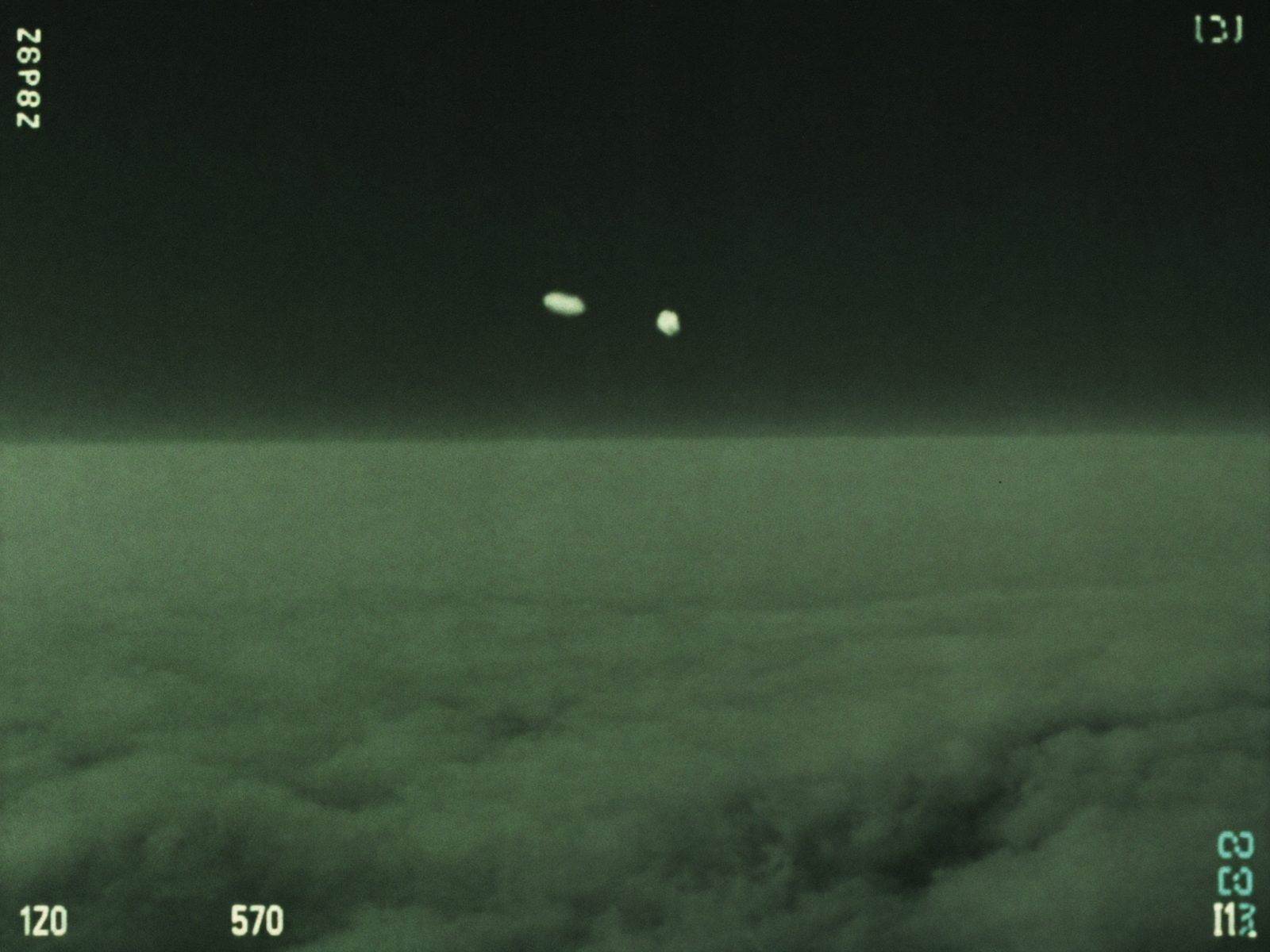
Gimbal shows a dark, elongated shape with a bright surround, seen against cloud, which appears to tilt and turn on its axis while the crew discuss it; one airman refers to a fleet of other objects, though no imagery of a fleet was ever released. GoFast shows a small round object that seems to race low over the waves while a crew member exclaims "Wow, what is that, man?" The Times, reporting in May 2019, placed Gimbal off Jacksonville, Florida, on 20 January 2015 and GoFast "a few weeks later". The Navy's spokesman Joseph Gradisher gave a different account in September 2019: both clips were dated 21 January 2015. The Times named two pilots of the VFA-11 "Red Rippers" squadron, Lieutenants Ryan Graves and Danny Accoin, as sources for the wider encounters, but neither the Navy nor the newspaper has publicly identified the crews who filmed these two clips.
The evidence and where it is
Both were filmed through the jets' infrared targeting pods. Gimbal first circulated with the New York Times reporting of December 2017. GoFast is usually dated to its publication by To the Stars Academy in March 2018, though AARO's director told the Senate in 2024 that it was made public in 2017, and the Department of Defense's 2020 statement refers only to unauthorised releases in 2007 and 2017. In September 2019 the Navy confirmed that the clips were its own and showed unidentified aerial phenomena, but said they had never been cleared for public release. On 27 April 2020 the Department of Defense released them formally, with the 2004 Nimitz clip, through the Naval Air Systems Command FOIA reading room; Gimbal is also on the Defense Visual Information Distribution Service as a 34-second NAVAIR file. What survives publicly is the cockpit display recording, with its on-screen numbers. In its 2025 report on GoFast, AARO stated that "the original file and its accompanying metadata are no longer available", and that it had worked from the public video. No radar data for either clip has been released.
What investigators concluded
At release in 2020 the Pentagon left both objects classed as unidentified. The All-domain Anomaly Resolution Office took up GoFast first. On 19 November 2024 its director, Jon Kosloski, told the Senate Armed Services emerging-threats subcommittee that trigonometry from the display figures placed the object near 13,000 feet, not at the surface, and that "a trick of the eye called parallax" accounted for its apparent speed. AARO's case resolution of 6 February 2025 gave an assessed speed of roughly 5 to 92 mph once the wind at that height was removed, said the object never moved against the wind, and suggested from pixel analysis that it was a metre or less across. It did not identify it.
Gimbal is a different matter. At the same hearing Senator Kirsten Gillibrand cited "ongoing public interest" in the Gimbal video and asked AARO to say what it could; Kosloski's testimony addressed GoFast, not Gimbal. No AARO assessment of Gimbal had been published as of this writing.
The conventional explanations
For GoFast, parallax is now the leading explanation and has official backing. Its strength is that it uses only numbers on the screen: range, camera angles, the aircraft's own altitude and speed. Its result is consistent with a balloon carried on the wind, as independent analysts had proposed earlier. Its weakness is the data gap AARO itself admits: without the aircraft's heading and position the speed can only be given as a range, and the object remains unidentified.
For Gimbal, the leading conventional explanation comes from outside government. The science writer Mick West argued that the shape is "the infrared glare from the engines of a distant jet", and that the apparent rotation is produced by the pod's de-rotation mechanism, which turns the image as the camera's gimbal rolls to keep tracking; a glare, unlike a solid object, would turn with it. The hypothesis is specific and testable against the geometry shown on screen. Its weaknesses are that it has not been confirmed by the Navy or AARO, it depends on modelling the pod's internal behaviour from patents rather than the Navy's own engineering data, and it does not account for the crew's report of other objects on radar.
What remains open
Whether GoFast was a balloon, a bird or something else cannot now be settled from a recording whose source file has gone. The date of both clips remains unsettled in the official record: the Navy says 21 January 2015, AARO's 2025 report says January 2015, and the slides AARO showed the Senate in November 2024 said January 2016. Gimbal remains officially unresolved. The glare and de-rotation account is the most developed explanation on offer, but it is an independent analysis, and the radar picture the aircrew described has never been released.
Sources
'Wow, What Is That?' Navy Pilots Report Unexplained Flying Objects — Helene Cooper, Ralph Blumenthal and Leslie Kean, New York Times, 2019 (archived copy). Squadron, pilots, 2014–15 sightings, Jacksonville and 20 January 2015 for Gimbal, the "fleet" remark, Navy spokesman's comments.
Case: "Go Fast" — Case Resolution(archived) — All-domain Anomaly Resolution Office, 2025. Full AARO assessment and methodology, speed range, object size, loss of the original file and metadata.
Corrected The full file: The opening said aircrew reported unidentified radar returns almost daily; the New York Times reported unidentified objects, and the text now says objects.
Corrected The full file: The date GoFast became public is disputed: it is usually dated to its publication by To the Stars Academy in March 2018, but AARO's director told the Senate in 2024 it was made public in 2017 and the Department of Defense's 2020 statement refers only to unauthorised releases in 2007 and 2017; the text now gives both.
Corrected The full file: The text placed the Gimbal pilot's remark about a fleet of objects on the aircraft's tracking display; the cited sources say only that a pilot refers to a fleet, so the location detail has been removed.
Corrected The verdict is now split, GoFast explained and Gimbal open: AARO addressed only GoFast, as parallax, and has published nothing on Gimbal. The file previously treated both as explained by AARO.
Corrected GoFast was released in March 2018; only Gimbal came out with the 2017 New York Times story.
Sources The source on file is now the transcript of the November 2024 Senate hearing rather than a news report of it.
Added The full file, a long-form write-up with its sources, added.

 INDEPENDENT FIELD ARCHIVE