Residents reported a glowing spiral over the city, and the army was reported to say it could not identify it. The satellite tracker Marco Langbroek matched it to the upper stage of the Falcon 9 that had launched the Zuma payload days earlier, venting fuel before re-entry.
The answer came from an amateur satellite tracker's reconstruction, not from the state.
Residents across Khartoum, and an airline pilot who photographed it
Evidence
Witness reports, the pilot's photographs, a reported military statement, and a published trajectory reconstruction
Agency
Sudanese military
Assessment
C · photographs and a reconstructed trajectory
The full file
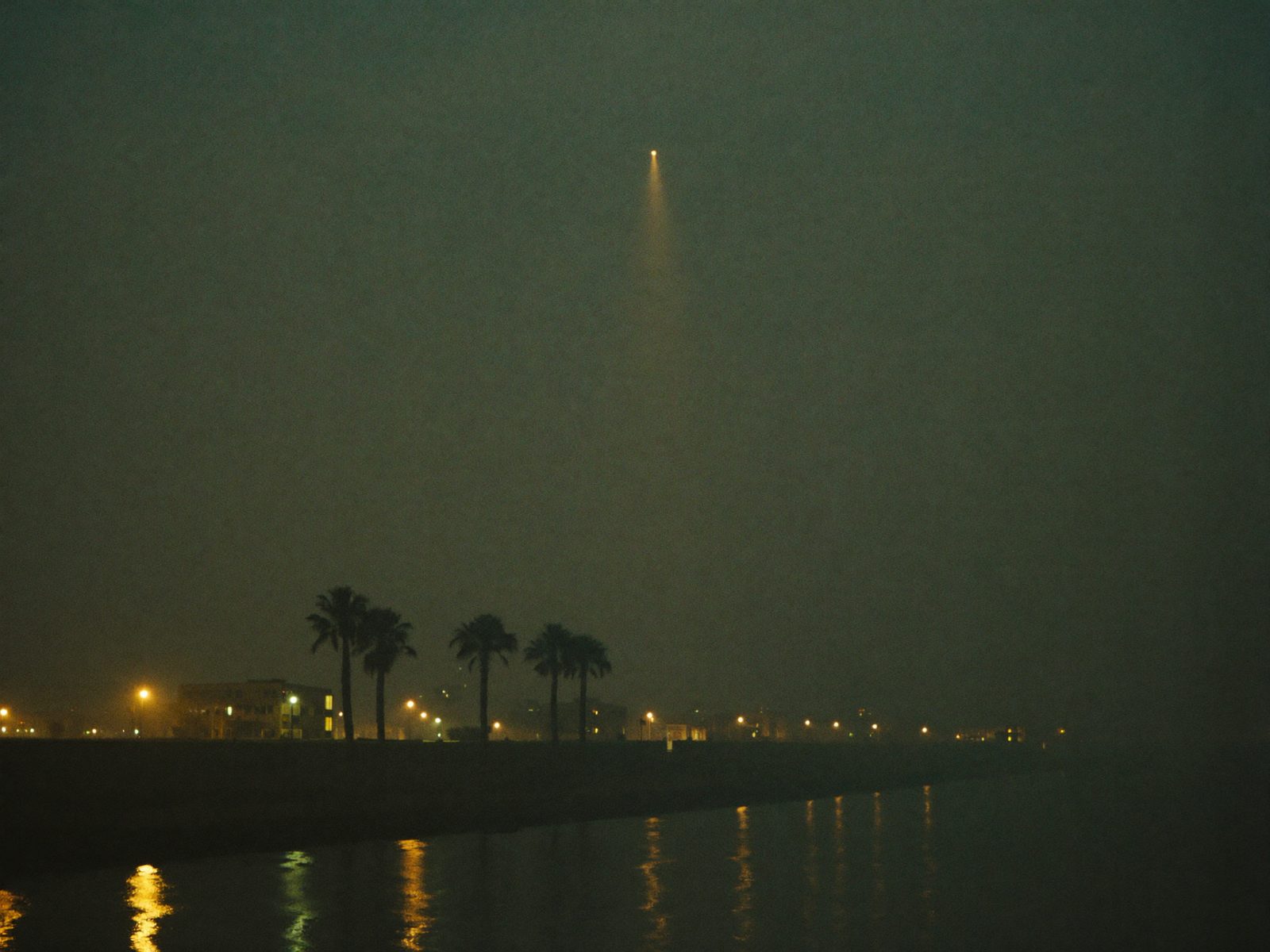
In the early hours of Monday 8 January 2018, people in and around Khartoum saw a bright point of light moving slowly southwards, wrapped in a green-blue glow that spread into curved arms. The clearest account came from the air. Peter Horstink, the Dutch captain of a Martinair Boeing 747-400 freighter on flight MPH8371 from Amsterdam to Johannesburg, was flying at 35,000 feet just north of the city. In a report later translated and published by the Dutch satellite tracker Marco Langbroek, he described a point of light "like a star but somewhat bigger" surrounded by a glow "in the shape of spiral arms, like a spiral galaxy".
The timing is better fixed than most sky reports. Langbroek puts Horstink's photographs at about 03:15–03:20 UTC. Sudan had moved from UTC+3 to UTC+2 on 1 November 2017, so that is roughly 05:15 in Khartoum. One observer on the ground posted a photograph captioned "Seen at 515 over Sudan". Al Arabiya's report of 11 January gave the time as "around 3:15 am local time", which looks like the UTC figure relabelled as local time. Accounts of how long it lasted also differ. Horstink's own estimate was two to three minutes; Al Arabiya, citing Langbroek, says about three.
The photographs and where they are
Horstink took four pictures with a handheld camera from the cockpit, with the lights of Khartoum in the foreground. He still holds the copyright. Langbroek published them with permission on his tracking blog, together with the ground photograph and a second ground image whose author is unknown. A Khartoum resident posted another picture on Twitter, taken by a friend. Measured against the background stars, Langbroek found the glowing cloud about 11 degrees across, some 8 degrees above the horizon at an azimuth near 155 degrees, with Alpha and Beta Centauri beside it. No radar data, official photograph or other sensor record has been released by any Sudanese body.
What the authorities and investigators said
Al Arabiya English reported on 11 January that the Sudanese military had issued a statement that Monday. It quoted the statement as reporting "a bright body flying at low altitude over the Wadi Sayidna military zone", and a "state of extreme readiness" to intercept it. The paper said the military called the object a "suspected" satellite but did not identify it. No copy of the statement from a Sudanese government or army source has been traced, and the later reports checked here all repeat Al Arabiya. The quoted wording is also very close to the army's announcement of May 2015. According to Reuters, the army then said it had engaged a low-flying bright target over Wadi Sidna, near Khartoum, and called it "a reconnaissance imaging target whose identity has not yet been uncovered". Whether the 2018 statement echoed that language or was confused with it in reporting cannot be settled from the available record.
Al Arabiya also said that Langbroek thought the object was likely the US satellite Zuma, which had been reported lost. That is not what he said. His tweet, quoted in the same article, read "This is probably the Falcon 9 venting fuel", and he used the sighting to question the reports that Zuma had failed.
The leading explanation: a rocket stage venting fuel
Zuma, a classified US government satellite built by Northrop Grumman, was launched on a SpaceX Falcon 9 from Cape Canaveral at about 01:00 UTC on 8 January. That puts the Khartoum sighting about 2 hours 15 minutes after launch. On Langbroek's reconstruction, this was the Falcon 9 upper stage near the end of its de-orbit burn, depressurising and venting leftover propellant before re-entering in a hazard zone in the southern Indian Ocean. He estimated re-entry between 03:30 and 03:45 UTC. The zone had been published in maritime warnings with a window opening at 03:00 UTC. Vented propellant lit by sunlight at high altitude, seen from a dark sky below, produces exactly this kind of spiral. Horstink's direction of travel and the stage's expected path over north-east Africa agree. Live Science reported Langbroek's reading at the time, and Smithsonian magazine reported the same upper-stage interpretation of Horstink's photograph.
The strength of this explanation is that it rests on a published launch time, a published re-entry zone and orbital geometry that anyone can check, not on a resemblance. Its weakness is that it is a reconstruction by an independent analyst. SpaceX, Northrop Grumman and the US government never confirmed the stage's track, and Langbroek himself had to revise his estimate of Zuma's orbit upwards, from about 400 km to 900–1,000 km, to make the sighting fit.
What remains disputed
The light over Khartoum is well accounted for. The uncertainty lies elsewhere. Zuma itself remains classified. On 9 January a US official told ABC News that the satellite had fallen into the Indian Ocean, while SpaceX said its rocket had performed correctly. Langbroek argued that a stage seen venting on schedule pointed to a successful launch. Neither the satellite's fate nor the cause of any failure has been officially disclosed. On the Sudanese side, the military statement that gave this case its "satellite" label has not been found in any primary form, and its quoted wording overlaps with an earlier incident. The identification that has held up is not the army's. It came from a pilot's photographs and an amateur tracker's arithmetic.
Corrected The full file: The text said press versions put the sighting at about three minutes or more than three; the cited Al Arabiya report, quoting Marco Langbroek, says about three minutes, and the text now says so alongside the pilot's own estimate of two to three minutes.
Corrected The full file: Smithsonian magazine was said to have reported Langbroek's reading; its article credits the upper-stage interpretation of the pilot's photograph to Space.com's reporting, and the text now says it reported that interpretation.
Corrected The object is now identified, on Marco Langbroek's published reconstruction, as the Falcon 9 upper stage from the Zuma launch, venting fuel; the file previously called it a possible satellite with no tracking data published. The title has changed to match.
Corrected The army was only reported to say it could not identify the object; the file previously had the military naming a satellite. An airline pilot's photographs are now listed as evidence.
Sources The source on file is now Marco Langbroek's SatTrackCam analysis of January 2018 rather than an encyclopedia article.
Added The full file, a long-form write-up with its sources, added.

 INDEPENDENT FIELD ARCHIVE