The full file
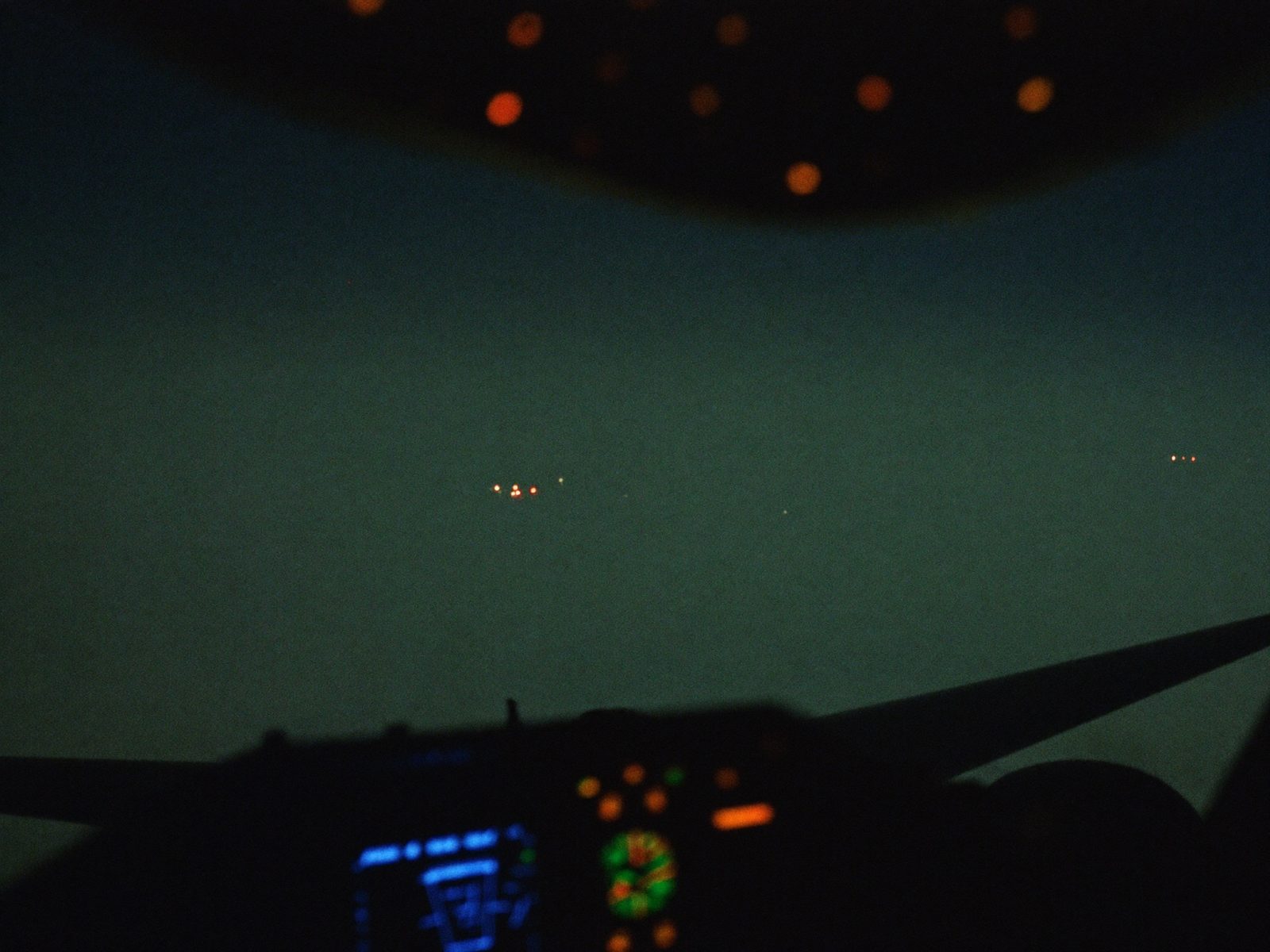
On the evening of 17 November 1986, Japan Air Lines flight 1628, a Boeing 747 freighter carrying a crew of three from Paris to Tokyo by way of Reykjavík and Anchorage, was cruising at 35,000 feet over north-eastern Alaska. At 02:19 UTC on 18 November (17:19 Alaska time, though the FAA's alert report gives 6.19 p.m.), the captain asked Anchorage Air Route Traffic Control Center for traffic information. Told there was none, he reported traffic in the same direction about a mile ahead at his own altitude, showing only white and yellow strobes. The captain was Kenju Terauchi, 47, with first officer Takanori Tamefuji and flight engineer Yoshio Tsukuba.
Half an hour over Alaska
The FAA's December 1986 chronology sets out the radio traffic. At 02:25 the crew said the object was on the aircraft's weather radar, eight miles off at eleven o'clock. At 02:31 Terauchi called it "quite big", and the controller approved any course deviation needed to avoid it. The 747 descended from 35,000 to 31,000 feet; asked whether the traffic had followed, the pilot said it was descending "in formation". Near Fairbanks the jet was turned through 360 degrees. At 02:39 the crew said they no longer had the traffic in sight, but by 02:44 they reported it again, at nine o'clock, and at 02:48 at seven o'clock, behind them. A northbound United Airlines flight was turned to look and at 02:50 reported seeing the JAL aircraft and nothing else. A military C-130 also looked and saw nothing.
Six weeks later Terauchi described two small craft and a mothership about twice the size of an aircraft carrier, and spoke of extraterrestrial origin. Accounts of the distance differ: the FAA's alert report to its Administrator says the sighting lasted over 350 miles, press reports from the turn of the year say 400 miles, and the earliest UPI story, on 29 December, said about 50.
What the record holds
The FAA collected the radio transcript, controllers' statements, crew interviews, the captain's written statement, and about 61 minutes of recorded radar data from the Murphy Dome site. The FAA sold the full package, tapes included. More than 1,500 pages now sit in the US National Archives among the FAA's records (Record Group 237, identifier 733667); The Black Vault, a FOIA archive, has scanned them.
What investigators concluded
In real time the military Regional Operations Control Center at Elmendorf reported a primary return eight miles from the jet, lost it a minute later, and at 02:38 reported a "flight of two". The military told the press its return was clutter. On the civil side, the Anchorage Center manager wrote on 18 December that the centre's recorded radar data "does not confirm the presence of the traffic reported by Flight 1628".
UPI's early reports, however, said an FAA controller had seen an object trail the jet, and the FAA briefly reopened its inquiry in January on the ground, as its spokesman Paul Steucke put it, that "it was a violation of airspace". The final position, in a February 1987 analysis by the Airway Facilities Division, was that the extra target was an uncorrelated primary and beacon return: the radar's echo off the 747's skin and the reply from its transponder landing in different quarter-mile cells, so that one aircraft briefly drew as two. Steucke called it unfortunate that the effect "occurred just when a pilot was reporting seeing something outside his aircraft". The FAA found the crew professional and rational, with no sign of drink or drugs, and named nothing they had seen.
The conventional explanation
Philip J. Klass, of Aviation Week & Space Technology, argued in January 1987 that Terauchi had seen Jupiter, very bright and low on his left in twilight where he first reported the lights, with Mars some 20 degrees to its right. A planet ten degrees up can appear level with an aircraft at altitude and seem to follow it. Terauchi had reported other sightings before, and on 11 January 1987, on the same route, he reported lights again; FAA officials suggested village lights seen through ice-crystal cloud, an explanation he accepted for that night. The first officer, asked whether the November lights could be told apart from a star, answered "No."
The planet explanation fits the drift of the lights, their persistence and the other crews' failure to see anything. Its weakness is that Terauchi described objects ahead of and close to the cockpit, not low on the horizon, and Klass himself revised it. In the summer of 1987 he dropped Mars and proposed moonlight reflected in turbulent ice crystals, with Jupiter mistaken for the main object near the end. Bruce Maccabee, a UFO researcher, wrote that it "verges on scientific garbage"; the sceptic Robert Sheaffer agreed that moonlight on cloud would make a poor display.
What remains disputed
The return on the cockpit weather radar has only Klass's suggestion of an echo from thin ice-crystal cloud. The military report of "a flight of two" at 02:38 sits in the chronology without a published technical explanation beyond the word clutter. Terauchi's later account, that the mothership stayed with him through the 360-degree turn, conflicts with what he told controllers during it. John Callahan, then an FAA official, later said that a CIA representative at a 1987 briefing asked for the meeting to be treated as never having happened; two others present, the CIA analyst Ron Pandolfi and Bruce Maccabee, recalled no such request.
Sources
- FAA Anchorage ARTCC, memorandum and chronology of events, 18 December 1986 (archived) — Federal Aviation Administration, 1986, via The Black Vault. Timed radio and radar sequence, United flight, civil radar finding.
- FAA, "Uncorrelated Radar Signals" and AAL-400 analysis of split image (archived) — FAA Alaskan Region, February–March 1987. The split-image explanation and Steucke's statement.
- FAA alert report to the Administrator and routing correspondence (archived) — FAA, 1986–1987. 350-mile figure, military "clutter", C-130 and UAL 69, crew assessment.
- Japanese Airlines JAL 1628 UFO encounter: document archive (archived) — John Greenewald, The Black Vault. National Archives location of the FAA file, crew interview list, FAA destruction letter.
- Crew of a Japan Air Lines cargo jet reports UFO — UPI, 29 December 1986. First press report, 50-mile figure, Air Force clutter remark.
- JAL pilot describes UFO (archived) — UPI, 31 December 1986. Terauchi's age, experience, aircraft-carrier description, 400-mile figure.
- JAL pilot reports second UFO sighting — UPI, 12 January 1987. The January sighting and the ice-crystal explanation.
- Robert Sheaffer, "JAL 1628: Capt. Terauchi's Marvelous 'Spaceship'" (archived) — Skeptical Inquirer, 2014. Klass's Jupiter–Mars release and later revision, Maccabee's response, crew names and interview answers, Callahan dispute.
- Brian Dunning, "The Japan Air Lines Alaska UFO" (archived) — Skeptoid. Summary of the radar analysis, the 360-degree turn discrepancy and the Callahan account.

 INDEPENDENT FIELD ARCHIVE