The full file
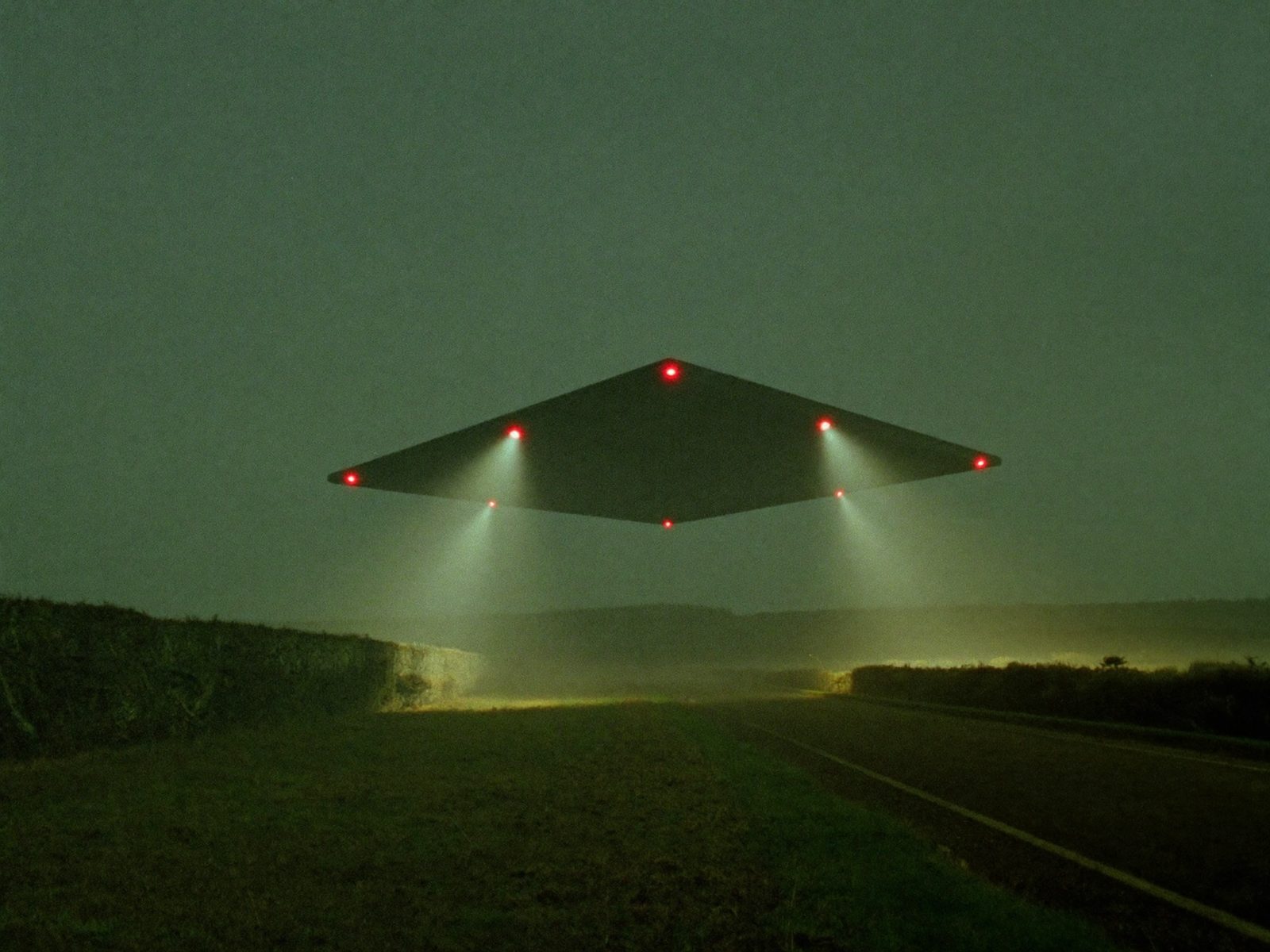
Between late November 1989 and April 1990, several thousand people in Belgium reported lights in the night sky, many of them describing a dark, flat triangle with a bright lamp at each corner. It is remembered chiefly for the night of 30 to 31 March 1990, when the Belgian Air Force sent two F-16 fighters after a contact that ground radar could see and the pilots could not.
What was reported
The wave is usually dated from the evening of 29 November 1989, when two gendarmes on patrol near Eupen, Heinrich Nicoll and Hubert von Montigny, reported a slow, low craft carrying three lights in a triangle. Other witnesses came forward over the following days; the commonly quoted total for that first night is 143 people, in about thirty groups plus gendarmes. Auguste Meessen, a physicist at the Université catholique de Louvain who worked with the Belgian study group SOBEPS, counted about 500 visual observations by 30 March. SOBEPS eventually held some 2,000 to 2,600 reports for the whole wave; sources differ on the figure.
On 30 March, at about 23:00, a gendarme named Renkin telephoned the Air Force's Control Reporting Centre at Glons from his home at Ramillies to report three unusual lights towards Thorembais-Gembloux. A patrol from Wavre, including a Captain Pinson, confirmed them. Glons, and then the military radar at Semmerzake, reported a contact in the same area. Two F-16s took off from Beauvechain at 00:05 on 31 March. Over the next fifty minutes they made nine interception attempts. In three of them a pilot briefly locked his radar onto the target, which then appeared to change speed and height sharply; at one point the readout ran from 150 to 970 knots. The aircraft landed at 01:10 and 01:16. The Air Force report records that "in no case, the pilots have had a visual contact with the UFOs".
The evidence and where it is
The main document is the Air Force's own report on the night, written by Major Lambrechts. No official online copy has been found; the text circulates as an English translation. Colonel (later General) Wilfried De Brouwer, Chief of Operations of the Air Staff, presented the radar results at a press conference on 11 July 1990. A summary he sent to the British Ministry of Defence is now at The National Archives in Kew (DEFE 24/1960 and DEFE 24/1970), released in 2009. The F-16 radar recordings were studied by the Air Force's electronic warfare centre and by Meessen; they have not been published in full.
The best-known image of the wave, the Petit-Rechain photograph, is a slide of a dark triangle with a light at each corner, taken near Verviers in April 1990. Accounts give its date as 4 April; Roger Paquay, writing in 2011, gives 4 or 7 April. The slide was examined at the Royal Military Academy and elsewhere without a firm conclusion. On 26 July 2011 its photographer, named by RTL only as Patrick, told the channel it was a painted polystyrene model fitted with lights and made to fool workmates. "We never realised that the photograph would leave the factory," he told VRT.
What investigators concluded
The 1990 report could not explain the night. It excluded stealth aircraft, remotely piloted vehicles, microlights and AWACS, and argued against balloons, planets and holograms. It also recorded two problems that fit a solid craft poorly: no sonic boom despite measured supersonic speeds, and eight lights seen from the ground while radar held only one contact at a time. In his account to the British MoD, De Brouwer confirmed the lock-ons but said the pilots could not explain them. Later, in Leslie Kean's 2010 book, he wrote that the Air Force had decided "the evidence was insufficient to prove that there were real crafts in the air" that night.
Meessen first concluded in 1991 that no conventional cause fitted the F-16 data. He later revised this. He attributed the ground-radar echoes that started the scramble to masses of humid air, and argued that the F-16's Doppler speed readings can be falsified by interference within such diffuse targets. He still thought the witnesses reliable, and reported two radar tracks he could not identify.
The leading conventional explanation
The leading explanation has two parts: misread radar, and visual reports multiplied by publicity. On the radar side, Meessen's work and sceptics such as Brian Dunning point to anomalous propagation and clear-air echoes, which can produce contacts that appear to jump in speed and height; Dunning further argues the three locks were the two F-16s locking onto each other. On the visual side, Renaud Leclet's study, published in 2008 by the French sceptical group CNEGU, argues that many sightings, including the Eupen reports, were military helicopters. Contemporary press accounts from Eupen mention a light humming, and SOBEPS's own early bulletin recorded one gendarme describing something like a turbine at the rear. Sceptics also note that many first-night reports were taken after a week or more of press appeals.
Its strength is that each element is documented and ordinary; its weakness is that no single helicopter flight has been matched to a specific report. The mutual-lock claim also rests on Dunning's reading rather than on the Air Force's published text.
What remains open
The radar contacts of 30 to 31 March have not been firmly identified. The full radar data are not public. Whether the wave contained a residue of unexplained sightings, as De Brouwer and SOBEPS maintained, or none at all, as sceptics argue, remains disputed.
Sources
- Report concerning the observation of UFOs in the night from March 30 to March 31, 1990 — Belgian Air Force (Maj. Lambrechts), 1990; English translation, archived copy. Timeline, nine attempts, three locks, no visual contact, exclusions.
- UFO files release, August 2009: highlights guide (archived) — The National Archives (UK), 2009. De Brouwer's account to the MoD in DEFE 24/1960 and DEFE 24/1970; lock-ons confirmed, cause unexplained.
- Étude approfondie des mystérieux enregistrements radar des F-16 — Auguste Meessen, a revised version (after 2000) of his 1998 Inforespace study of the same title. The 11 July 1990 press conference, around 500 reports by 30 March, the humid-air echoes and the Doppler artefact.
- The Belgian Wave of 1989–1992: a neglected hypothesis (archived) — Renaud Leclet, ed. Maillot, Munsch, Scornaux and van Utrecht (CNEGU), 2008. The helicopter hypothesis, Eupen noise and turbine testimony.
- Le mystère du célèbre OVNI des années 90 élucidé : « Une supercherie » — RTL Info, 26 July 2011. The photographer's admission, 4 April 1990 date, polystyrene model.
- Belgian UFO picture was really a forgery (archived) — VRT NWS, 27 July 2011. Independent report of the admission; the photographer's quotation.
- The Petit-Rechain photograph — Roger Paquay, SUNlite 3(2), 2011. The 4 or 7 April date and the history of the slide analyses.
- 30 years later, we still don't know what really happened during the Belgian UFO wave (archived) — Jeva Lange, The Week, 2020. Eupen gendarmes' names; De Brouwer's later statements via Kean (2010).
- The Belgian UFO Wave (Skeptoid #538) (archived) — Brian Dunning, 2016. 143 first-night witnesses gathered after press appeals; the mutual-lock and clear-air-echo arguments.

 INDEPENDENT FIELD ARCHIVE