The full file
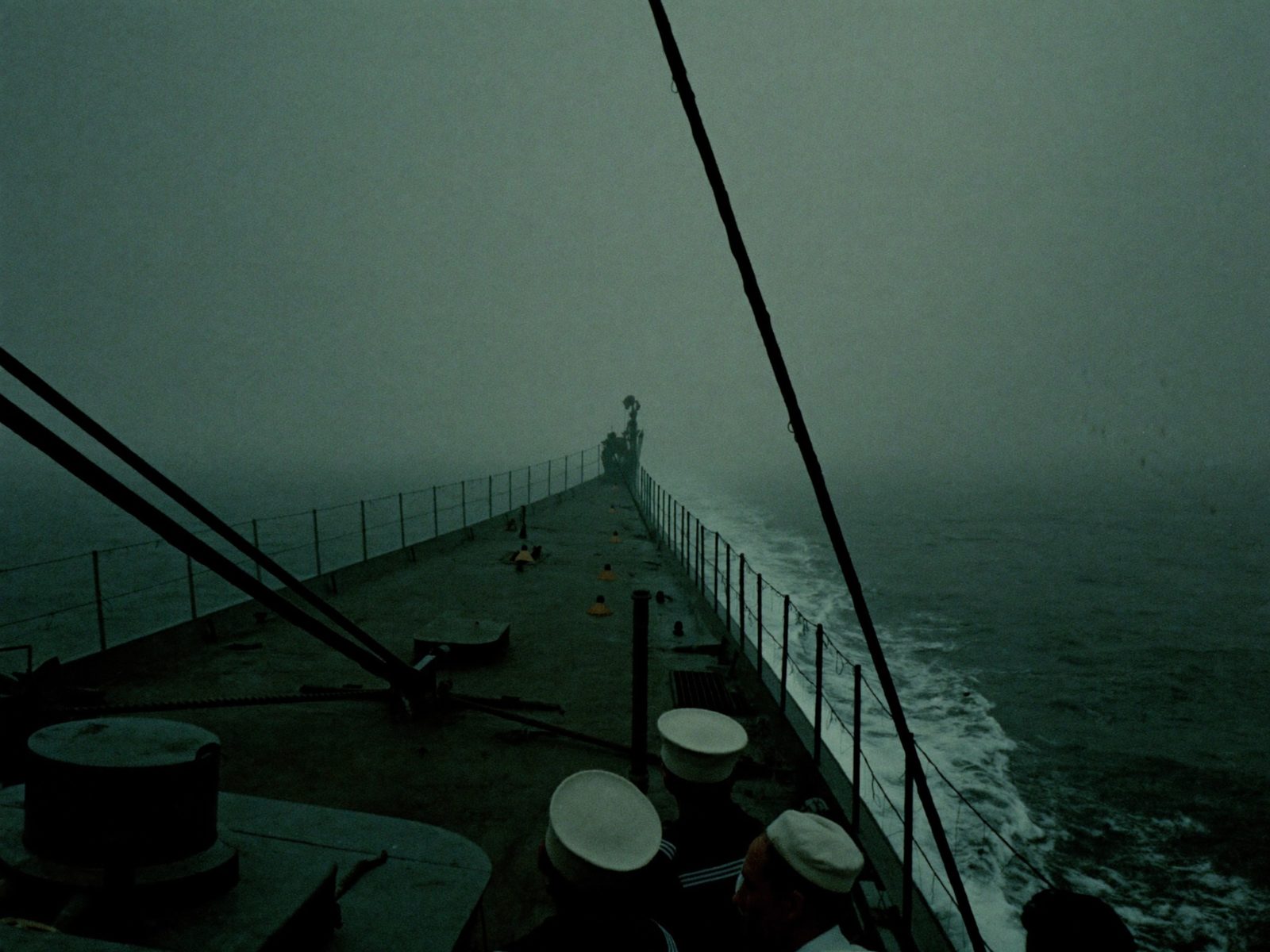
On the afternoon of 6 August 1848 HMS Daedalus, a corvette homeward bound from the East Indies, was in the South Atlantic between the Cape of Good Hope and St Helena. Several of her officers watched a large animal pass close to the ship. Their captain's account became the best-known sea-serpent report of the century, and the subject of a public exchange with the anatomist Richard Owen.
The report
The ship reached Plymouth on 4 October. Within days The Times printed a second-hand story of a sea-serpent seen from the frigate: about 60 feet of body, jaws "full of large jagged teeth", twenty minutes in sight. The Admiralty wrote to the captain, Peter M'Quhae, asking whether it was true. His reply, dated Hamoaze, 11 October, and addressed to Admiral Sir W. H. Gage at Devonport, is the core document of the case.
M'Quhae gave the time as 5 p.m. and the position as 24°44′S, 9°22′E, roughly 300 miles off the south-west African coast. The weather was dark and cloudy, with a long swell. Midshipman Sartoris saw something approaching from before the beam and reported it to Lieutenant Edgar Drummond, the officer of the watch, who was on the quarterdeck with the captain and William Barrett, the master. The quartermaster, the boatswain's mate and the man at the wheel also saw it.
M'Quhae described "an enormous serpent", head and shoulders held about four feet above the water, with "at the very least 60 feet of the animal" at the surface, judged against the length of the maintopsail yard. Behind the head the body was 15 or 16 inches across, dark brown and yellowish-white at the throat. He saw no fins, only something like a horse's mane or a bunch of seaweed washing about its back, and no undulation. It held a steady course at 12 to 15 miles an hour and was in sight for twenty minutes.
The evidence and where it is
There is no specimen. The record is paper: M'Quhae's letter, printed in The Times on 13 October; engravings made under his direction from a sketch taken at the time, which the Illustrated London News published on 28 October; and the journal of Lieutenant Drummond. All three were reprinted within weeks in The Zoologist, volume 6. A search of The National Archives' online catalogue did not turn up the original despatch or drawing as a separately listed item, so their present location is not established here. Drawings from Drummond's diary came to light in 1997, supplied by an M. Drummond to The Log of Mystic Seaport.
Drummond's entry differs from his captain's in ways that matter. He saw only the head and a "back fin" some twenty feet behind it; the head was long, pointed and flattened on top, perhaps ten feet long, and dipped occasionally under a wave. He put the nearest distance at perhaps 100 yards and the sighting at five minutes by naked eye and about fifteen more through a glass.
What was concluded
Owen's answer, a long letter dated 9 November 1848, argued from M'Quhae's own description. A rounded cranium, a short muzzle, smooth skin and a mane-like growth on the shoulders were, he wrote, the characters of a warm-blooded mammal, not a reptile. He proposed a large seal, most probably a sea-elephant or a sea-lion carried north on an iceberg, swimming with its head raised, its long wake read as the rest of the body. A true sea-serpent, he added, would long since have left a vertebra in some museum. He claimed "no unmeet confidence" in his identification.
M'Quhae replied in The Times of 21 November. The head, he said, was flat, not vaulted; the animal was too long and too unlike any seal; and his officers had judged its length before deciding it was a serpent, not after. He stood by his official report. An anonymous letter from "an officer" of the ship, rejecting a later suggestion that the object was floating weed, followed in The Times in February 1858; later accounts date it to the 13th and the 16th.
The leading conventional explanation
Owen's seal was the only identification made at the time, and it was never tested. Its strength is that it treats the visible head and the wake as the whole of the evidence. Its weakness is size: Owen himself gave the sea-elephant 20 to 30 feet, a third to a half of the length reported, and he had to set the length estimate aside to make it fit.
The fullest modern reading is the evolutionary biologist Gary Galbreath's, published in Skeptical Inquirer in 2015. Giving priority to Drummond's journal, written closer to the event than M'Quhae's report, he identified the animal as a sei whale skim-feeding at the surface, its flat, pointed upper jaw raised and its lower jaw out of sight. That fits the pointed head, the overhanging jaw, the pale throat and the occasional fin. Galbreath concedes that a sei's dorsal fin is normally prominent, and his case leans most on the less detailed of the two witness accounts.
What remains open
The two officers' accounts cannot both be right: one saw sixty feet of finless body that never went under, the other a head and a fin that sometimes did. Which to prefer decides the identification. The press date of the first story is also unsettled: The Zoologist gives The Times of 9 October, later writers 10 October.
Sources
- The Zoologist, vol. 6 (1848), pp. 2306–2316 and 2323–2324 — ed. Edward Newman, London, 1848. Reprints Drummond's journal, the first Times story, M'Quhae's despatch, Owen's letter and M'Quhae's reply in full.
- Where Be Monsters? The Daedalus Sea Serpent and the War for Credibility (archived) — Matthew Willis, The Appendix, 2014. Reception history, the questions in Parliament and the 1858 letter.
- The strange tale of the Daedalus sea-serpent (archived) — Matthew Willis, Quarterdeck, Friends of HMS Trincomalee, 2014. The ship's service, the return date and the 1858 Times letter dated 13 February.
- The 1848 "Enormous Serpent" of the Daedalus Identified (archived) — Gary J. Galbreath, Skeptical Inquirer, 2015. The sei-whale reading, its acknowledged weaknesses, Drummond's 1997 drawings and the 1858 letter dated 16 February.
- Richard Owen, the "Sea-Serpent Killer" (archived) — David Bressan, Scientific American blog, 2012. Owen's private collection of sea-serpent reports and the reception of his letter.
- The National Archives Discovery catalogue (archived) — The National Archives, searched 2026. Lists M'Quhae's service record but no separately described despatch or drawing.

 INDEPENDENT FIELD ARCHIVE