The full file
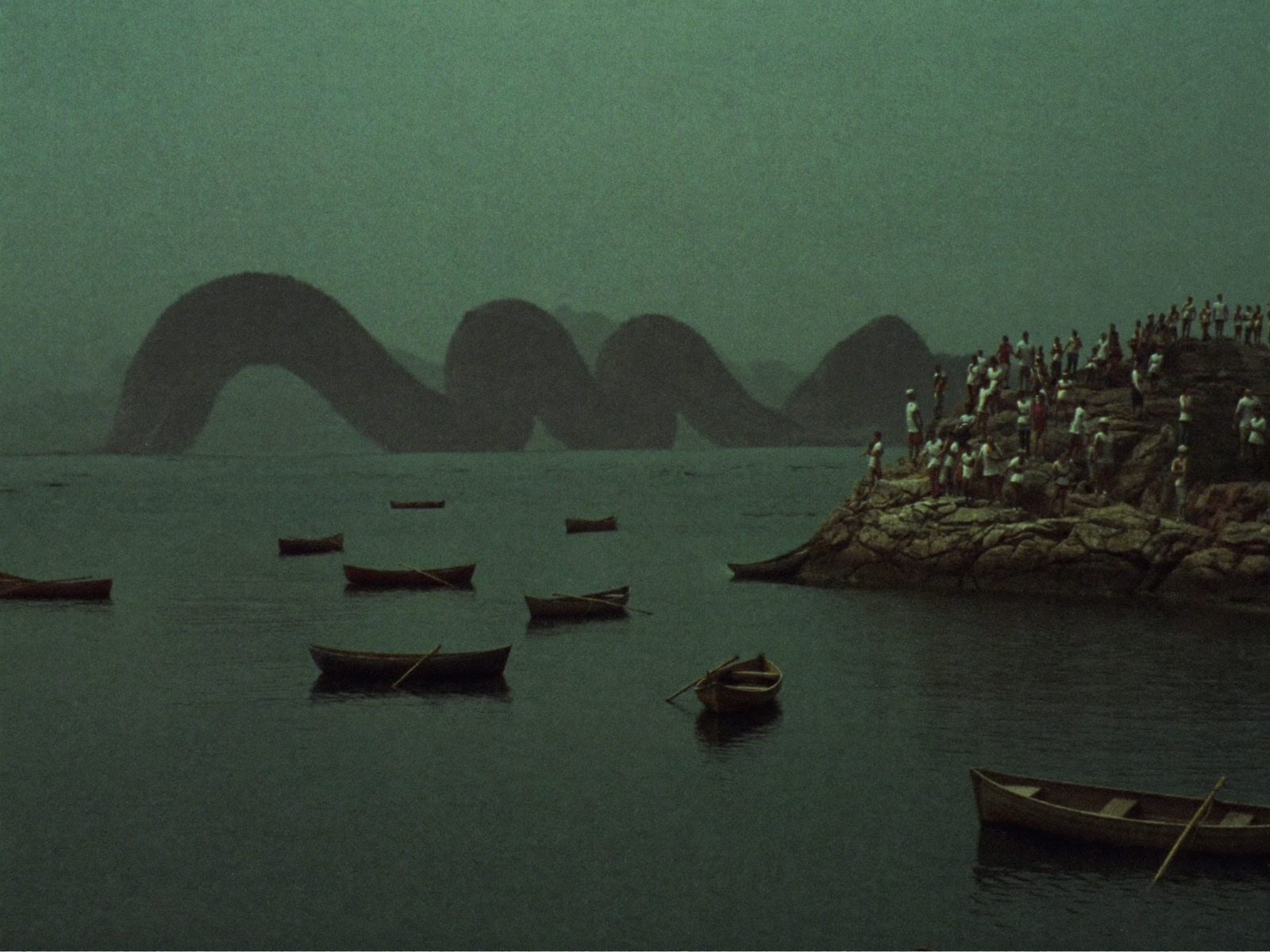
In August 1817 a long, dark animal was reported, day after day, in the harbour of Gloucester on Cape Ann, about thirty miles from Boston. It produced something unusual for a monster: sworn statements taken under written rules for a learned society, which then named a new genus of snake from a specimen that turned out to be ordinary.
The reports
Later accounts, following the cryptozoologist Bernard Heuvelmans, say two women saw the animal enter the harbour on 6 August; no deposition records that sighting. The earliest sworn date is 10 August, when the mariner Amos Story watched it for an hour and a half from the shore near Ten Pound Island. On 12–14 August the shipmaster Solomon Allen 3rd watched it from a boat and from the beach and put it at eighty to ninety feet. On the afternoon of 14 August the ship's carpenter Matthew Gaffney, in a boat with his brother Daniel and Augustin Webber, fired a musket at its head. Within days the Boston Daily Advertiser of 18 August spoke of a "prodigious snake" seen by hundreds.
The depositions and the snake
On 18 August the Linnaean Society of New England appointed a committee of three: the federal judge John Davis, the physician Jacob Bigelow and Francis C. Gray. They asked Lonson Nash, a Gloucester justice of the peace, to examine witnesses on oath, separately, with no one told what the others had said, and sent him twenty-five set questions. Nash returned eight depositions on 28 August, and more were taken in Boston and elsewhere.
The statements agree that the animal was dark and fast, but differ on the essentials. Allen saw fifty distinct portions moving from side to side. Nash, who watched for nearly half an hour on 14 August, wrote that the motion was vertical, that he never saw more than eight portions, and that the "bunches" were probably the effect of that motion. Gaffney said he was within thirty feet and stated, "I aimed at his head, and think I must have hit him"; the animal sank "like a rock" and resurfaced a hundred yards away. William Pearson, in another boat, put the range at about thirty yards.
On 27 September Gorham Norwood and a Mr Colbey killed a snake of just under three feet near Loblolly Cove, on the eastern shore of Cape Ann. Its spine was bent into some forty humps. The committee's report says it was killed on the seashore; Nash paced the spot and found it 150 paces from high-water mark. Exhibited in Boston as the serpent's young, it was examined by the committee, which was allowed to cut open its side.
The printed Report (Boston, Cummings and Hilliard, 1817) survives in several libraries, among them the Massachusetts Historical Society and Harvard's Museum of Comparative Zoology, whose copy is digitised. The snake itself is in the Smithsonian's National Museum of Natural History, catalogued in ethanol as USNM 115617, the holotype of the name the committee gave it. The sources consulted here do not locate the manuscript depositions.
What the society concluded, and what came after
The committee, judging the snake distinct from all known serpents in its "flexuous" spine, erected the genus Scoliophis and named it Scoliophis atlanticus. It then argued that the great serpent and the small one were probably the same species, noting that all the Gloucester depositions had reached it before the snake was found. In 1819 the Charleston writer William Crafts mocked the affair in a three-act satire, The Sea Serpent; or, Gloucester Hoax.
The correction came from the same city. At a meeting of the Boston Society of Natural History in 1863 its president reported that the specimen had been rediscovered and proved to be a black snake, Coluber constrictor, with a diseased spine. Dr C. Pickering added that the late Professor Peck had been "in a minority of one" on the committee in holding that view, although the printed report names only Davis, Bigelow and Gray. In 1868 J. A. Allen, cataloguing the state's reptiles in the same Proceedings, called Scoliophis "that famous myth" and quoted Dr De Kay's earlier judgement that the name should be expunged. That verdict concerned the snake; the society did not rule formally on the sightings.
The leading explanation
The leading conventional explanation is misidentification of known marine animals, most often a whale or a group of whales moving in line. Pickering passed on an old whaler's view in 1863 that the serpent was a humpback feeding. In 2019 Joe Nickell proposed a pod of narwhals, reading the "sting" in a contemporary broadside as a tusk, and the marine biologist Robert France argued for large animals, probably bluefin tuna, entangled in ropes and floats. In favour: Nash and Gaffney both describe vertical, not snakelike, motion, the animal sank straight down, and hump counts from eight to fifty fit several animals better than one. Against: the witnesses were working mariners who knew whales, no candidate fits every statement, and narwhals live far to the north.
What remains open
No carcass, bone or tooth of the large animal was ever recovered, so the snake explained only itself. The depositions are a careful record of what Gloucester's seamen believed they saw, but they disagree with each other, and the animal or animals behind them are still argued over.
Sources
- Report of a Committee of the Linnaean Society of New England, relative to a large marine animal, supposed to be a serpent, seen near Cape Ann — Davis, Bigelow and Gray, 1817 (Museum of Comparative Zoology copy). The committee's method, the depositions of Story, Allen, Gaffney and Pearson, Nash's letters, the Norwood snake and Scoliophis atlanticus.
- Proceedings of the Boston Society of Natural History, vol. 9 (1862–63) — Boston Society of Natural History, 1863. Page 245: the specimen identified as a diseased black snake, Pickering on Peck and the humpback explanation.
- Proceedings of the Boston Society of Natural History, vol. 12 (1868–69) — J. A. Allen, 1868. Pages 184–5: Scoliophis as "that famous myth", De Kay's judgement.
- GBIF occurrence record for USNM 115617 (archived) — Smithsonian NMNH Extant Biology dataset. The holotype's catalogue number, locality, date and preparation.
- "It appeared so strange and wonderful…" (archived) — Massachusetts Historical Society, 2019. The Boston Daily Advertiser report, the committee, and the society's holdings.
- Here there be monsters, or the Gloucester serpent (archived) — Brian Benoit, Readex, 2012. Contemporary newspaper coverage from August 1817 and the 1819 play.
- Gloucester sea-serpent mystery: solved after two centuries (archived) — Joe Nickell, Skeptical Inquirer, 2019. The 6 August claim via Heuvelmans, the broadside and the narwhal hypothesis.
- William Crafts, Jr (archived) — South Carolina ETV, History of SC Slide Collection. Crafts as a Charleston writer and author of The Sea Serpent (1819).
- A review of Robert L. France's Disentangled (archived) — Darren Naish, Tetrapod Zoology, 2019. France's entanglement argument and its limits.
- Coluber constrictor (archived) — The Reptile Database. Scoliophis atlanticus Davis et al. 1817 as a synonym, with holotype USNM 115617.

 INDEPENDENT FIELD ARCHIVE