In August 1982 Smithsonian scientists led by the herpetologist George Zug met to examine a short videotape of something long moving in the bay. A Johns Hopkins laboratory produced an enhanced version. No finding was ever published, and the funding ran out. The Fish and Wildlife Service then adopted the monster for two environmental-education booklets, and the state still keeps a page on it that includes reasons to be sceptical. What has been identified in the bay is something else with the same name: a Florida manatee, tagged by USGS, which returns most springs.
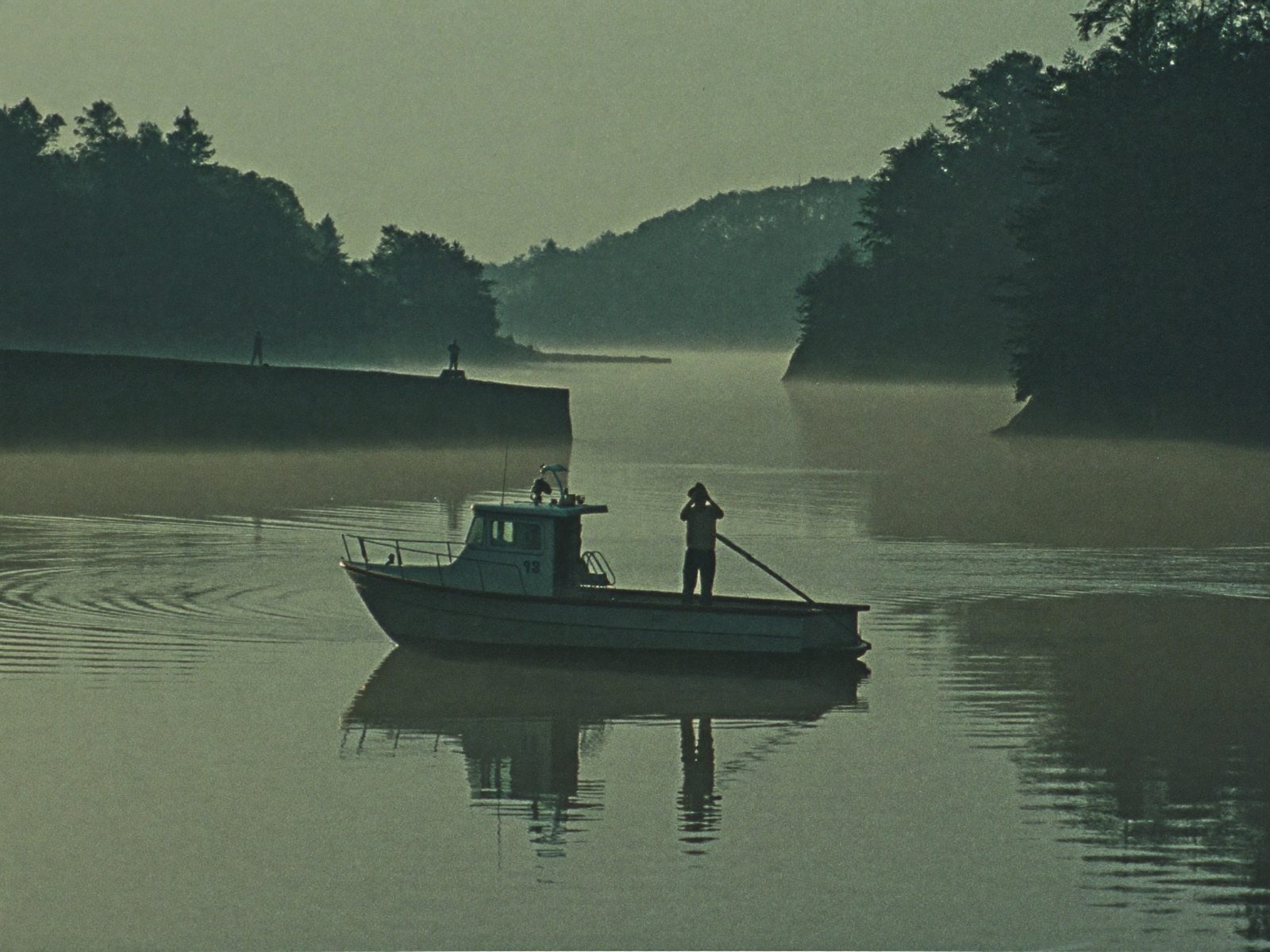
AI illustration · imagined scene, not an evidence photograph
File
CR-0036
Date
1936 → 2014
Place
Chesapeake Bay, Maryland
Record
sporadic reports, several decades, mostly from the shore
Evidence
A 1982 videotape, reviewed but never published on
Agency
Smithsonian Institution; Maryland DNR; US Fish and Wildlife Service
Assessment
B/C · documented process, untested animal
The full file
Chessie is the name given to a long, dark, serpentine animal reported in the Chesapeake Bay and its tidal rivers, chiefly between 1978 and the mid-1980s. Later compilations push it back to 1936, but the case rests on shoreline reports, one home videotape from 1982 and a single afternoon of review at the Smithsonian Institution. The name has since been attached, with more success, to a Florida manatee.
The reports
The earliest claim is a 1936 sighting from the air over the Bush River in Maryland, said to have been made from a helicopter. It appears in regional books, and a 2024 Maryland Department of Natural Resources post repeats it as "a 1936 flyover", but no contemporaneous account of it has surfaced.
The modern record begins in the summer of 1978, on the Virginia side of the Potomac. The Rappahannock Record of 24 August 1978 reported that Donald Kyker, a retired CIA officer, and his wife had seen an animal of 25 to 30 feet, which neighbours also saw. In 1980 reports came from the Potomac, the Patuxent, the Gunpowder River and Kent Island; in October more than 25 people on a fishing trip off Smith Point described the same thing, and their captain rejected the suggestion of a turtle. Some later summaries date the start of this wave to 1977; the newspaper record surveyed by the Library of Virginia and by the historian Eric Cheezum begins in 1978. In August 1984 the Kent Island Bay Times reported a third consecutive week of sightings off the Eastern Shore; reports then thinned out, and the most recent widely cited sighting was in 2014.
The evidence and where it is
The central item is a videotape made by Robert and Karen Frew from their home on Kent Island on 31 May 1982, Memorial Day. Accounts of it differ. The Christian Science Monitor of 27 July 1982 described a three-minute tape of a dark object about 35 feet long, filmed from roughly 200 yards. The Enigma Project, the Maryland group that took up the case, gave the recording as under two minutes and the range as about 100 feet. UPI reported the Frews' own estimate of 20 to 40 feet.
The Smithsonian also saw photographs taken near the Choptank River in 1981 by Katherine Pennington of Ellicott City. What survives in public hands is the curatorial file kept by George Zug, then chairman of vertebrate zoology at the National Museum of Natural History: Smithsonian Institution Archives accession 12-057, one box of correspondence, clippings, manuscripts, negatives and transparencies on Chessie and the Loch Ness animal. The archive does not list a videotape. A 2024 review of Cheezum's book reports that the original footage was lost and that only a copy remains.
What investigators concluded
On Friday 20 August 1982 the Enigma Project's Michael Frizzell brought the tape and eyewitnesses to the museum. The following Monday Zug told UPI that there was "not enough visible evidence on the tape for a positive identification". He added that a log, birds, a marine mammal or an optical effect seemed poor fits. Later accounts of seven scientists, with the National Aquarium and the state present, do not appear in that report.
In September 1982 staff at the Johns Hopkins University Applied Physics Laboratory offered to enhance the tape by computer. The Enigma Project described the result as a serpentine shape, while a Virginia paper reported the laboratory's view as inconclusive: either a long, undulating animal or a shorter one trailing a wake. The laboratory's internal funding ran out, and no report was published.
The leading explanation
The leading conventional explanation is a known animal seen briefly and at a distance, most often a manatee. As early as 1978 the Virginia Institute of Marine Science listed candidates from a pound-net pole to a water snake. In 1994 a male Florida manatee was found near Kent Narrows, captured near the mouth of Queenstown Creek and flown back to Florida by the Fish and Wildlife Service, the National Aquarium, Maryland's Department of Natural Resources and Sea World. He had been named Chessie, the USGS notes, after "legendary sightings of a 'sea monster'". Tagged, he came back the following spring and went on to New England in 1995; a USGS biologist matched him from his scar in July 2011. Sources disagree on the details of the 1994 rescue: the aquarium stay is given as several days by the USGS and as nearly two weeks by the Baltimore Sun in 2011, and one 2025 newspaper dates the episode to 1993. Maryland's DNR also suggests the Atlantic sturgeon, and Cheezum has said he thinks the sightings were probably manatees.
Its strength is that manatees do reach the bay and are unfamiliar there. Its weakness is description: witnesses described a slender animal, eight to ten inches thick by the Enigma Project's summary, and a manatee is bulky and rolls at the surface. None of the sources here documents a manatee in the bay during the 1978–84 wave.
What remains open
The Frew tape has never been formally analysed, and the original may not exist. The 1936 report is also doubtful as told: Sikorsky's VS-300, which began modern helicopter flight in the United States, first flew in September 1939, though an autogyro could have been described that way. The Fish and Wildlife Service's Chesapeake Bay Estuary Program used it in children's conservation booklets, one surviving as Chessie Returns! (reprint 1993), and a 1984 Maryland bill to protect it failed in committee.
The return of Chessie and friends(archived) — Christian Science Monitor, 27 July 1982. Contemporary description of the Frew tape, its length, range and the explanations then offered.
The Legend of Chessie(archived) — Casey Clauberg, Library of Virginia, 2025. Index of Virginia newspaper reports, 1978–1986, the VIMS candidates and the APL view.
"Chessie" (The Chesapeake Bay Phenomenon)(archived) — Michael Frizzell, Enigma Project, undated. The investigators' own account of the tape, the APL enhancement and the end of funding; claim history only.
Chessie(archived) — Randy Cepuch, Washington Independent Review of Books, 2024. Review of Cheezum's history: 1978 start, 1981 photographs, lost original tape, the 1984 bill.
Chessie Returns!(archived) — US Fish and Wildlife Service, Chesapeake Bay Estuary Program, reprint 1993. The service's use of Chessie for environmental education.
Corrected The full file: The 1984 reports are now attributed to the Kent Island Bay Times, which ran a third consecutive week of sightings off the Eastern Shore in August 1984; the text previously said only that reports clustered around Kent Island.
Corrected The full file: The Fish and Wildlife Service's Chessie booklets are now described as conservation booklets rather than anti-litter booklets, which is how the surviving copy presents them.
Corrected The full file: A sentence saying nothing was reported in 1979 was removed to keep the piece within length; the Library of Virginia source still supports it.
Corrected The 1982 examination is now credited to Smithsonian scientists led by the herpetologist George Zug; the file previously listed seven Smithsonian scientists, the National Aquarium and Maryland's natural resources department, which could not be confirmed.
Sources The source on file is now an archived copy of the USGS Sound Waves report of 2011, the earlier USGS news link having gone dead.
Added The full file, a long-form write-up with its sources, added.

 INDEPENDENT FIELD ARCHIVE