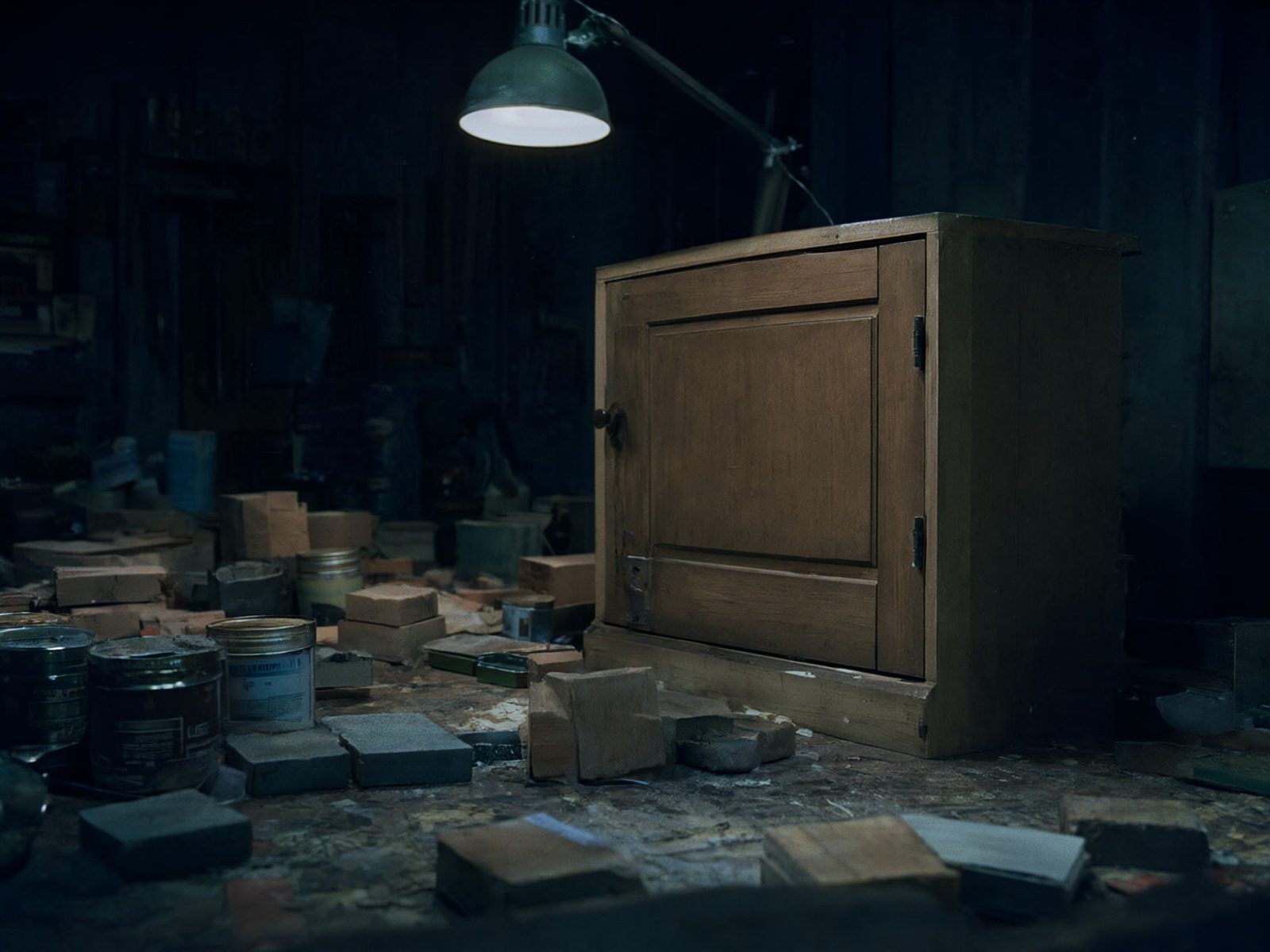
In 2003 a Portland furniture dealer sold a small wine cabinet on eBay. The story that went with it, in the listings as the Forward later quoted them, was that it had belonged to a Polish Holocaust survivor who said a dybbuk lived in it, and since then it had brought a stroke, nightmares and strange smells to everyone who kept it. The buyer, a student in Missouri, resold it in February 2004, blaming it for sleeplessness, car trouble and his hair falling out, and the Forward reported the sale. In 2021 Mannis told Input the story was his own invention; he had bought the cabinet from an attorney at a yard sale, and a former co-worker said the hair inside it was his.
The leading explanation is the author's own. Mannis told Input: "The Dybbuk Box is a story that I created", written "to become an interactive horror story in real-time". Accepted.
AI illustration · not an evidence photograph
File
BR-0032
Date
2003 listing · resold February 2004 · confession 8 July 2021
Place
Portland, Oregon, USA
AssessmentD · confessed by its author
The record on file
Witnesses
Kevin Mannis, the Portland furniture dealer who wrote the first eBay listing; Iosif Neitzke, the Missouri student who resold the cabinet in 2004; two of Mannis's former co-workers, who confirmed his account in 2021
Evidence
The Forward's report of the 2004 auction, which quotes both listings, and Mannis's 2021 interview with Input
Record made at the time
Max Gross, "A Box Full of Bad Luck: Haunted Wine Cabinet Goes to Highest Bidder", The Forward, 13 February 2004, quoting the 2003 and 2004 eBay listings; and Kevin Mannis's confession to Charles Moss, Input, 8 July 2021, which Moss checked with two of Mannis's former co-workers.
In June 2003 Kevin Mannis, who ran a small furniture business in Portland, Oregon, sold a small wooden cabinet on eBay for $140. The listing came with a first-person story: the cabinet had belonged to a Polish Holocaust survivor, whose granddaughter called it a "dybbuk box" and said it must never be opened. After Mannis bought it, the story went, light bulbs broke in his shop, his mother suffered a stroke on the day he gave it to her, and every relative who took it gave it back. A dybbuk, in Jewish folklore, is the spirit of a dead person that clings to a living one. In July 2021 Mannis told the journalist Charles Moss that he had made the story up.
What was reported
The buyer was a college student in Missouri, named as Iosif Neitzke by the Forward and as Iosif Nietzke by the Los Angeles Times. In early February 2004 he relisted the cabinet, adding his own account to Mannis's. He blamed it for sleeplessness, car trouble and light bulbs burning out, and wrote of "large vertical dark blurs in my peripheral vision" and of his hair falling out. On 9 February 2004, the Times reports, it sold for $280 to Jason Haxton, director of a medical museum in Kirksville, Missouri. Haxton described his own symptoms to the Times, and in 2011 published The Dibbuk Box with Truman State University Press. The story became the 2012 film The Possession. In 2016 the cabinet passed to the television presenter Zak Bagans; Moss reports a sale at an undisclosed price, while the investigator Kenny Biddle, writing in Skeptical Inquirer, says Haxton donated it.
The record, and where it is held
What puts the case on this shelf is press reporting made at the time by people other than the owners. Max Gross's report in the Forward of 13 February 2004, still on the paper's website, quotes both listings within days of the second auction. Leslie Gornstein's longer piece in the Los Angeles Times of 25 July 2004 quotes the listings, interviews Mannis and Haxton, and puts the story to rabbis and folklorists. The listings themselves are known through these reports and through copies Haxton posted online. The cabinet is on display at Bagans's Haunted Museum in Las Vegas, where Biddle saw it in October 2018 and where Moss places it in 2021.
The two 2004 reports do not agree in every detail. The Forward, quoting the second listing, has the survivor dying in 2001 and the cabinet bought at auction; the Times has an estate sale in autumn 2001, then quotes Mannis saying he had in fact bought it in 2000. The Forward lists two 1920s pennies, two locks of hair and a small statue engraved shalom; the Times adds a dried rosebud, a goblet and a candlestick.
What was concluded
The press was sceptical from the start. The folklorist Elliott Oring told the Times there was "too much piling on of incidents", and Rabbi Eli Schochet noted that nothing explained why a dybbuk would inhabit this box. Brian Dunning, on the Skeptoid podcast in 2014, pointed out that a dybbuk in tradition possesses a person, not an object. Biddle, in January 2019, matched the cabinet's design to a mini-bar of the 1950s and 1960s made by Robert Karoff of New York, who filed a patent for the design in 1957, concluding it is "not a Jewish wine cabinet from Spain but instead a minibar from New York". He also cited an October 2015 Facebook post in which Mannis called himself "the original creator of the story".
Moss's article for Input, 8 July 2021, made it explicit. Mannis told him: "I am a creative writer. The Dybbuk Box is a story that I created", written "to become an interactive horror story in real-time". He said he had bought the cabinet at a yard sale from an attorney, not from a survivor's granddaughter, and that the carving on its back and the stone inside were his own work. Two former co-workers, Curt Morris and Matthew Christensen, backed his account, and Christensen said of a lock of hair in the box, "That's my hair, yeah."
The leading conventional explanation
The explanation on file is the author's own: a piece of fiction written for an eBay listing. It is strong because it comes from the person who wrote the story, is supported by two people who knew him at the time, and agrees with Biddle's identification of the cabinet as an ordinary mass-produced piece. The later owners' misfortunes need nothing more than coincidence and expectation; they are their own accounts, and no record made by anyone else supports them.
Its weakness is the source. Mannis has told the story more than one way: in 2004 he gave the Times a detailed account of the events as real, while allowing that "all of this stuff has an explanation that doesn't necessarily point to this box". Moss also reports that Mannis still holds some events in the story to have happened, which Moss could not verify.
What remains disputed
The disagreement now is about belief, not evidence. Haxton told Moss the confession does not undo his own experiences; Bagans wrote that he did not believe it was "the full truth". Neither has produced a record that supports a supernatural reading. Where and when Mannis acquired the cabinet, and which parts of the 2003 story he regards as true, rest on his word alone.
A jinx in a box?(archived) — Leslie Gornstein, Los Angeles Times, 25 July 2004. June 2003 listing at $140, sale on 9 February 2004, interviews with Mannis and Haxton, folklorists' comments.
The Dibbuk Box(archived) — Kenny Biddle, Skeptical Inquirer online, 14 January 2019. Mini-bar identification, the 2015 Facebook post, the cabinet on display in Las Vegas.
The Haunted Dybbuk Box(archived) — Brian Dunning, Skeptoid, 19 August 2014. The folklore of the dybbuk, the eBay prices, Haxton's book.
Corrected The full file: The 2004 Los Angeles Times quotation from Mannis is now given in full: 'all of this stuff has an explanation that doesn't necessarily point to this box'.
Corrected The full file: Biddle identified the cabinet as a mini-bar of the 1950s and 1960s made by Robert Karoff of New York, who filed a patent for the design in 1957; the text no longer says it was patented in 1957.
Corrected The Holocaust-survivor backstory is now attributed to the eBay listings as the Forward later quoted them, rather than stated as the story the cabinet was sold with.
Added The full file, a long-form write-up with its sources, added.

 INDEPENDENT FIELD ARCHIVE