Cursed objects and places / Swallownest, near Rotherham, South Yorkshire, England
The Picture That Would Not Burn
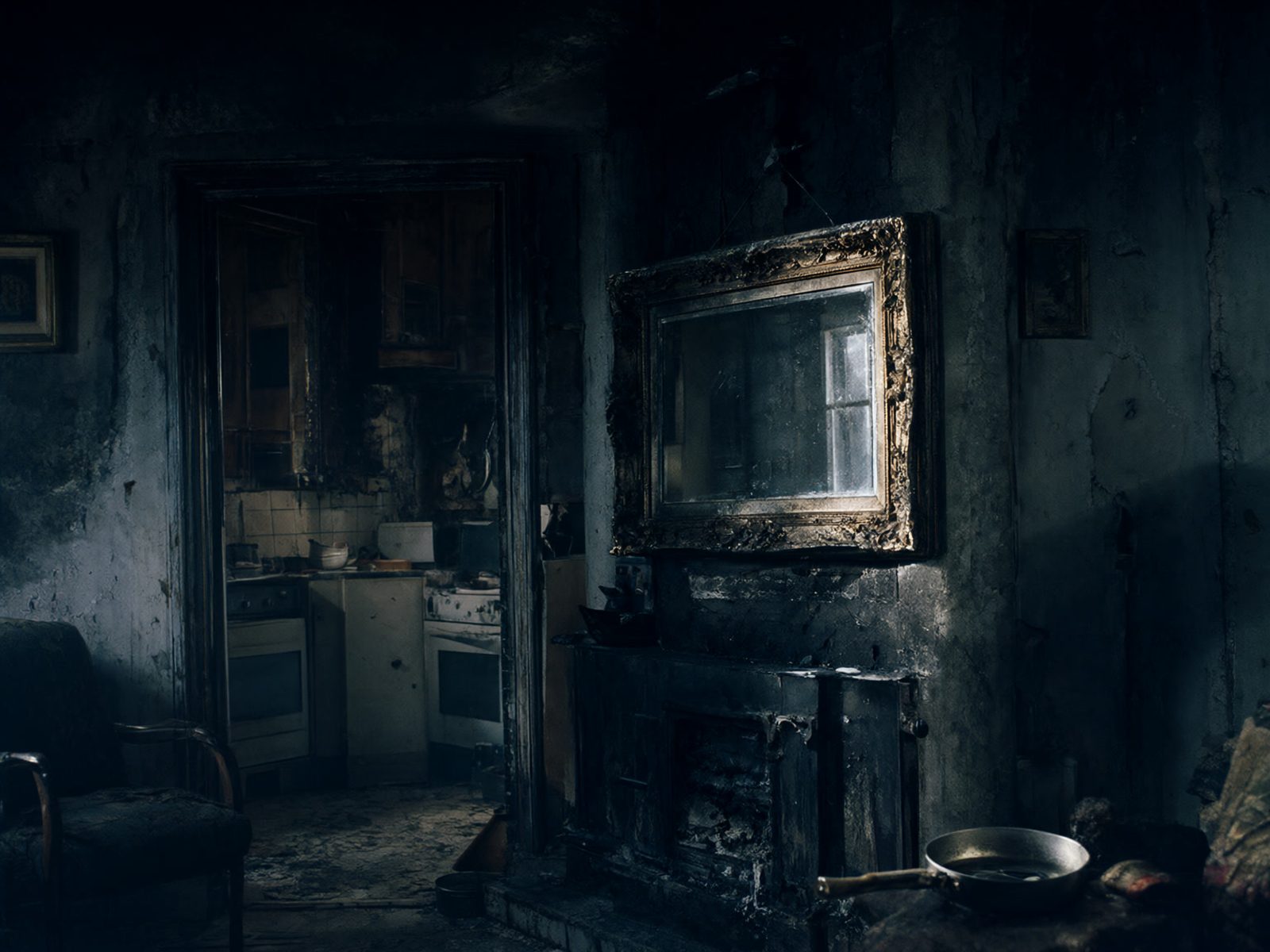
A redundant miner's family in Swallownest blamed a mass-produced print of a crying boy, signed G. Bragolin, for a chip-pan fire that badly damaged their council house; the framed print in the lounge came through untouched. A firefighter relative said he kept finding the same picture at house fires, and The Sun took the story national on 4 September 1985, then collected readers' copies and burned them on a bonfire near Reading for Halloween. Most of the fires, when investigated, had ordinary causes: chip pans, discarded cigarettes, faulty heaters.
The leading explanation is the fire service's own, given at the time: Mick Riley said the prints were on high-density hardboard, "very difficult to ignite", and that any connection with the fires was "purely coincidental". The Sun itself put sales of the print at an estimated 50,000, so copies were bound to hang in houses that caught fire. Accepted; The Sun did not print the statement.
AI illustration · not an evidence photograph
File
BR-0030
Date
2 September – 31 October 1985
Place
Swallownest, near Rotherham, South Yorkshire, England
AssessmentD · a specific mundane cause, stated by the fire service at the time
The record on file
Witnesses
Ron and May Hall, whose council house caught fire; Ron's brother Peter Hall, a Rotherham firefighter; Alan Wilkinson, a Rotherham fire station officer; Mick Riley, Chief Divisional Officer of the South Yorkshire Fire Service
Evidence
Reports in the Sheffield Star, the Rotherham Star and The Sun from September and October 1985 and a fire service statement printed by the Star, all traced on microfilm by the folklorist David Clarke
Record made at the time
John Murphy, "Family Hit by Curse", Sheffield Star (Rotherham edition), 2 September 1985, p. 7; Martyn Sharpe, "Blazing Curse of the Crying Boy!", The Sun, 4 September 1985, p. 13; and Mick Riley's statement, cited by Clarke from the Rotherham Star of 25 October 1985. Clarke reproduces the Star clipping from his own collection and found the rest in a British Library microfilm search in 2017; the newspapers themselves were not opened for this entry.
Agency
South Yorkshire Fire Service; later the folklorist David Clarke (Sheffield Hallam University)
The "curse of the Crying Boy" began as a local fire report in South Yorkshire in the week after the 1985 August bank holiday, became a national tabloid campaign within days, and ended, as far as the press was concerned, on a bonfire at Halloween. Its birth can be dated to the day, and the fire service's explanation was on record before the story was over.
What was reported
On Monday 2 September 1985 the Rotherham edition of the Sheffield Star ran a page-seven story by John Murphy, "Family Hit by Curse". Ron and May Hall, a redundant miner and his wife, blamed a print of a crying boy, signed G. Bragolin, for a chip-pan fire that badly damaged their terraced council house in Swallownest; their adult son, who had been cooking, was pictured with his arm bandaged. The downstairs rooms were badly damaged, but the framed print in the lounge appeared untouched. Ron's brother Peter, a firefighter at Rotherham, was reported to have warned them that the same print turned up at every house fire he attended.
Two days later, on 4 September, The Sun ran Martyn Sharpe's version on page 13 as "Blazing Curse of the Crying Boy!", quoting May Hall and stating that an estimated 50,000 copies had been sold in British department stores. Over the following weeks the paper printed readers' accounts of fires in homes with the print, and a Rotherham station officer, Alan Wilkinson, was reported to have logged some fifty "crying boy" fires since 1973. The prints themselves were mass-produced reproductions of several different paintings, not one image: many were signed Bragolin, but at least one fire in October involved a print of Childhood by the Scottish artist Anna Zinkeisen.
The record and where it is held
The case stands on this shelf because records made at the time by people other than the families survive: the Star and Sun reports of September and October 1985, and a statement from the South Yorkshire Fire Service printed by the Star. The folklorist David Clarke of Sheffield Hallam University reproduces the original Star clipping from his own collection, and in July 2017 searched the microfilm of five national and six regional papers at the British Library, finding 38 stories between 2 September 1985 and 1 April 1986. The newspapers were not opened for this write-up; their contents are taken from Clarke.
What investigators concluded
The fire service gave its view within weeks. After a further fire in a council house in East Herringthorpe, Rotherham, which it attributed to an electric fire left too close to a bed, Chief Divisional Officer Mick Riley said that a large number of prints had been sold and that any connection with the fires was "purely coincidental". The prints survived, he said, because they were on "high density hardboard, which is very difficult to ignite". Clarke cites the statement from the Rotherham Star of 25 October 1985. The Sun did not print it. Wilkinson himself told reporters he did not accept a supernatural cause and put most of the fires down to carelessness, though he could not say how individual prints came through.
Instead, on 24 October The Sun invited readers to send in their copies for destruction. According to Clarke, drawing on Peter Chippindale and Chris Horrie's history of the paper, some 2,500 arrived. The London and Thames Valley fire brigades declined to take part, calling the plan "a cheap publicity stunt", and on 30 October two van-loads were burned on land near Reading. The paper reported the bonfire on Halloween.
Clarke's later work concludes that the curse was made by journalists. Murphy told him in 2017 that a firefighter at the scene had called the run of surviving prints strange, and that the phrase "curse of the crying boy" was his own: "In effect I think I created the idea that there was a curse."
The leading conventional explanation
The leading explanation is the fire service's own: a very common print on board that resists ignition, hanging in homes that caught fire for ordinary reasons. Its strength is that each part is checkable. The Sun's own sales estimate put tens of thousands of copies on British walls, sold, the paper said, particularly in working-class areas of northern England, where a share of them would be present at house fires by chance alone; the investigated fires had ordinary causes, chiefly chip pans, cigarettes and heaters; and prints on hardboard or varnished board would be expected to outlast curtains and furniture. In 2010 Steve Punt tested a print for BBC Radio 4's Punt PI; by Atlas Obscura's account of the programme, it singed and holed but did not burn through, and Punt and the construction researcher Martin Shipp suggested a fire-retardant varnish.
Its weakness is that nobody counted. There is no tally of how many burned homes held a print and lost it, so the survivals were never set against the losses, and Wilkinson's fifty fires rest on his recollection as reported in the press.
What remains disputed
The fires are not seriously disputed; details of the record are. Clarke cites a 1985 tabloid figure of 250,000 prints sold against The Sun's 50,000. Accounts differ on the artist: Clarke's 2026 paper calls Bruno Amadio, who signed as Bragolin and as Franchot Seville, Italian and places his studio in Venice, while his earlier online account calls him Spanish. The later legend of a Spanish orphan named Don Bonillo comes from an online account by Tom Slemen in 2000, and Clarke found nothing in it that could be corroborated beyond the pseudonym Franchot Seville.
Sources
Tears for Fears: the curse of the crying boy(archived) — David Clarke, Revenant 13, 137–158, 2026. Dates, names, headlines, Riley's statement, the British Library microfilm search, the bonfire and Murphy's 2017 interview.
The Curse of the Crying Boy(archived) — David Clarke, first published in Fortean Times 234, 2008; online text 2010. Earlier version of the account; cross-check for the fires, the statement and the bonfire.
Corrected The full file: The Star story ran the Monday after the weekend that followed the 26 August bank holiday, not at the end of the bank holiday itself; the text says 'in the week after the 1985 August bank holiday'.
Corrected The full file: Clarke's paper says the Halls' downstairs rooms were badly damaged, not gutted; the text now says badly damaged.
Corrected The full file: Clarke found at least five different crying-boy images among the prints, so the text now says 'many', not 'most', were signed Bragolin.
Corrected The full file: It was The Sun, not Clarke's own finding, that said the prints sold particularly in working-class areas of northern England; the text now attributes this to the paper.
Corrected The full file: Atlas Obscura describes Martin Shipp as a construction researcher, not a fire researcher; the text now says construction researcher.
Corrected The full file: Murphy told Clarke that the phrase 'curse of the crying boy' was his own, rather than the single word 'curse'; the text now says the phrase.
Corrected The full file: The Don Bonillo legend comes from an online account by Tom Slemen in 2000, not a print publication, and Clarke says only the pseudonym Franchot Seville in it can be corroborated; the text now says so.
Sources The full file: Clarke's online article was first published in Fortean Times 234 in 2008, with the online text dated 2010; the source line now says this instead of 'revised 2010'.
Corrected The newspapers David Clarke traced on microfilm now include the Rotherham Star; the file previously listed only the Sheffield Star and The Sun.
Added The full file, a long-form write-up with its sources, added.
Also filed under Cursed objects and places
The Dybbuk boxThe Wine Cabinet on eBay · 2003 listing · resold February 2004 · confession 8 July 2021

 INDEPENDENT FIELD ARCHIVE