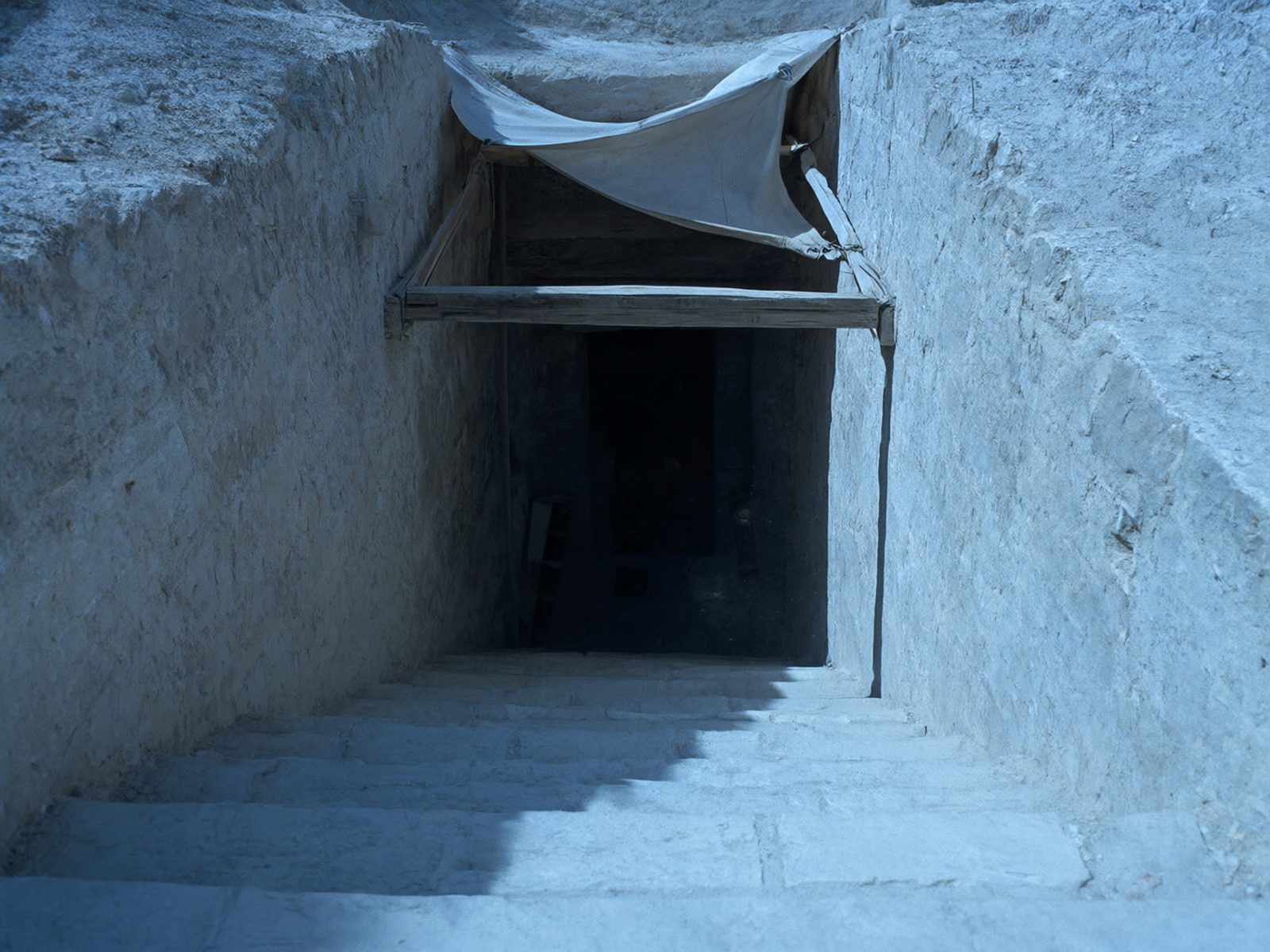
Cursed objects and places / Valley of the Kings, Luxor, Egypt
The Curse That Came by Newspaper
Lord Carnarvon, who paid for Howard Carter's excavation of Tutankhamun's tomb, died in April 1923 of blood poisoning that followed an infected insect bite. With The Times holding an exclusive deal on the tomb, other papers turned to outside commentators: Marie Corelli had already asked in the Express whether it was really a mosquito bite, and Conan Doyle was quoted as saying the supernatural may have been responsible. No curse inscription has been found in the tomb.
The leading explanation is that the curse was a press story and the deaths ordinary. In 2002 Mark Nelson compared the 25 Westerners present at the key openings with the 11 who were not and whose dates of death were known, and found no significant difference in survival (mean age at death 70 against 75, P=0.87). Accepted, with Nelson's own caveat that so small a group could miss a subtle effect.
AI illustration · not an evidence photograph
File
BR-0031
Date
March–April 1923 · cohort study 2002
Place
Valley of the Kings, Luxor, Egypt
AssessmentD · a specific mundane cause, death by infection, on record at the time
The record on file
Witnesses
Lord Carnarvon, who funded the excavation and whose illness and death started the story; the novelist Marie Corelli and Sir Arthur Conan Doyle, who gave the press the supernatural reading
Evidence
Press coverage from March and April 1923, including the Literary Digest's round-up of 21 April 1923; Mark Nelson's cohort study of the 25 Westerners exposed to the tomb, BMJ, 2002
Record made at the time
"What Killed Lord Carnarvon?", The Literary Digest, 21 April 1923: a press round-up quoting Marie Corelli's "rare book", Conan Doyle as reported by the New York World, and a New York Times dispatch, beside the issue's diary entry on Carnarvon's death "of blood poisoning" from "the bite of a poisonous insect". Corelli's piece in the Express of 24 March 1923 is quoted by the University of Manchester; it was not opened.
Agency
The press at the time; later Mark R. Nelson, BMJ (2002)
In the early hours of 5 April 1923 George Herbert, fifth Earl of Carnarvon, died in Cairo. He had paid for Howard Carter's work in the Valley of the Kings, and seven weeks earlier he had been present when the sealed doorway to Tutankhamun's burial chamber was opened: on 16 February by Carter's diary, on 17 February in Nelson's study. Within days of his death the British and American press were discussing whether the king had taken his revenge. The "curse of Tutankhamun" was born in those columns.
What was reported
Carter's pocket diary for 1923 records the illness plainly. Carnarvon left Luxor for Cairo on 14 March; on 20 March Carter followed him "on account of Lord C's illness"; the entry for 5 April reads "Lord C. died 2 a.m." The cause given at the time was an infected insect bite. Lady Burghclere, Carnarvon's sister, wrote in the biographical sketch that opens Carter's first volume (1923) that a mosquito bit him, "the wound got poisoned", and that three weeks of illness followed. Mark Nelson's 2002 paper gives the medical sequence as erysipelas at the site of the bite, then septicaemia and pneumonia.
The supernatural reading came from outside the excavation. Carnarvon had placed all publicity in the hands of The Times, an arrangement Carter later said the excavators welcomed. According to the Egyptologist Joyce Tyldesley, quoted by the University of Manchester, the exclusive left other journalists with nothing to report from the site, and papers turned to writers of fiction for comment. Marie Corelli asked in the Express of 24 March 1923, while Carnarvon still lived, whether it was really a mosquito bite that had infected him. After his death, Sir Arthur Conan Doyle, then in America, was quoted by the New York World as believing that "the supernatural may have been responsible".
The record and where it is held
What places the case on this shelf is a press record made at the time by people other than the dying man: "What Killed Lord Carnarvon?" in The Literary Digest of 21 April 1923. It gathers the commentary of that fortnight: Corelli citing a "rare book" in her possession that threatened "the most dire punishment to any rash intruder into a tomb"; Conan Doyle on a guardian "elemental"; a New York Times dispatch reporting that people across Britain were sending Egyptian objects to the British Museum for fear of the king's Ka; and a rebuttal from the New York Herald, which put the death down to an insect bite, exhaustion and pneumonia. The same issue's diary of foreign news records the death "of blood poisoning" following "the bite of a poisonous insect". The issue is scanned on the Internet Archive. Carter's diary, item TAA i.2.22 of the Tutankhamun Archive, is held at the Griffith Institute, University of Oxford, which publishes a transcription.
No physical evidence bears on the curse itself. No curse inscription has been found in the tomb, and Tyldesley thinks one highly unlikely.
What investigators concluded
Carter dismissed the stories in the preface to his second volume (1927) as "ridiculous", adding that the tomb had been found sterile when opened. In 1934 Herbert Winlock of the Metropolitan Museum noted, as Nelson reports, that only six of the 24 people present at the opening had died.
The only formal test is Nelson's historical cohort study in the BMJ (2002). From Carter's records he identified 44 Westerners in Egypt at the time of four key events between February 1923 and November 1926: the opening of the sealed doorway, of the sarcophagus, of the coffins, and the examination of the mummy. Twenty-five were present at one or more of them; death dates were found for 11 of the 19 who were not. Mean age at death was 70 in the exposed group and 75 in the unexposed (P=0.87), and mean survival after exposure 20.8 years against 28.9 (P=0.95). He found "no significant association between exposure to the mummy's curse and survival".
The conventional explanation
The accepted explanation is that the curse was a press creation and Carnarvon's death an ordinary one. A man of 57, weakened according to the Manchester account by a near-fatal motor accident in Germany in 1901, died of a bacterial infection in an age before antibiotics; the cause was published within days, and the supernatural reading was supplied by commentators with no access to the tomb. Its strength is that every element of the legend can be traced to a named writer in a dated paper. Its weakness, which Nelson states himself, is that the study is small: the confidence intervals are wide, the records of the unexposed are less complete, women are over-represented among them, and a subtle effect could have been missed.
What remains disputed
Little that bears on the curse. The date of death appears as 5 April in Carter's diary and in Manchester's account, 4 April in the Digest's American chronology, and 6 April in Lady Burghclere's sketch; Carter's 2 a.m. entry in Cairo explains the first two, and the third looks like an error. Corelli's Express article was not opened for this write-up and is known here only through the Manchester quotation. Later theories of moulds or bacteria in the tomb were already answered in part by Carter's claim of sterility, a claim Nelson doubts, and none has been tied to any death.
Howard Carter's diary for 1923(archived) — Griffith Institute, University of Oxford (TAA i.2.22). The opening of the sealed doorway on 16 February, Carnarvon's departure to Cairo on 14 March, his illness, and his death at 2 a.m. on 5 April.
The Tomb of Tut-ankh-Amen, vol. 1 — Howard Carter and A. C. Mace, 1923 (Internet Archive scan). Lady Burghclere's sketch of the illness and its date of 6 April; Carter on the Times arrangement.
The Tomb of Tut-ankh-Amen, vol. 2 — Howard Carter, 1927 (Internet Archive scan). Carter's preface rejecting the curse stories and asserting the tomb's sterility.
Corrected The full file: The sealed doorway to the burial chamber was said to have been opened on 17 February 1923; Carter's diary records it on 16 February, while Nelson's BMJ study gives 17 February, and the text now gives both.
Corrected The full file: Conan Doyle was described as 'lecturing' in America; the Literary Digest says only that he was in America, and the text now says that.
Corrected The full file: Nelson's study was said to have poorly documented women and the unexposed; Nelson says the records of the unexposed were less complete and that women were over-represented among them, and the text now says so.
Corrected Nelson compared the 25 Westerners present at the key openings with the 11 who were not and whose dates of death were known; the file previously left the comparison group unspecified.
Added The full file, a long-form write-up with its sources, added.
Also filed under Cursed objects and places
The Crying Boy curseThe Picture That Would Not Burn · 2 September – 31 October 1985
The Dybbuk boxThe Wine Cabinet on eBay · 2003 listing · resold February 2004 · confession 8 July 2021

 INDEPENDENT FIELD ARCHIVE