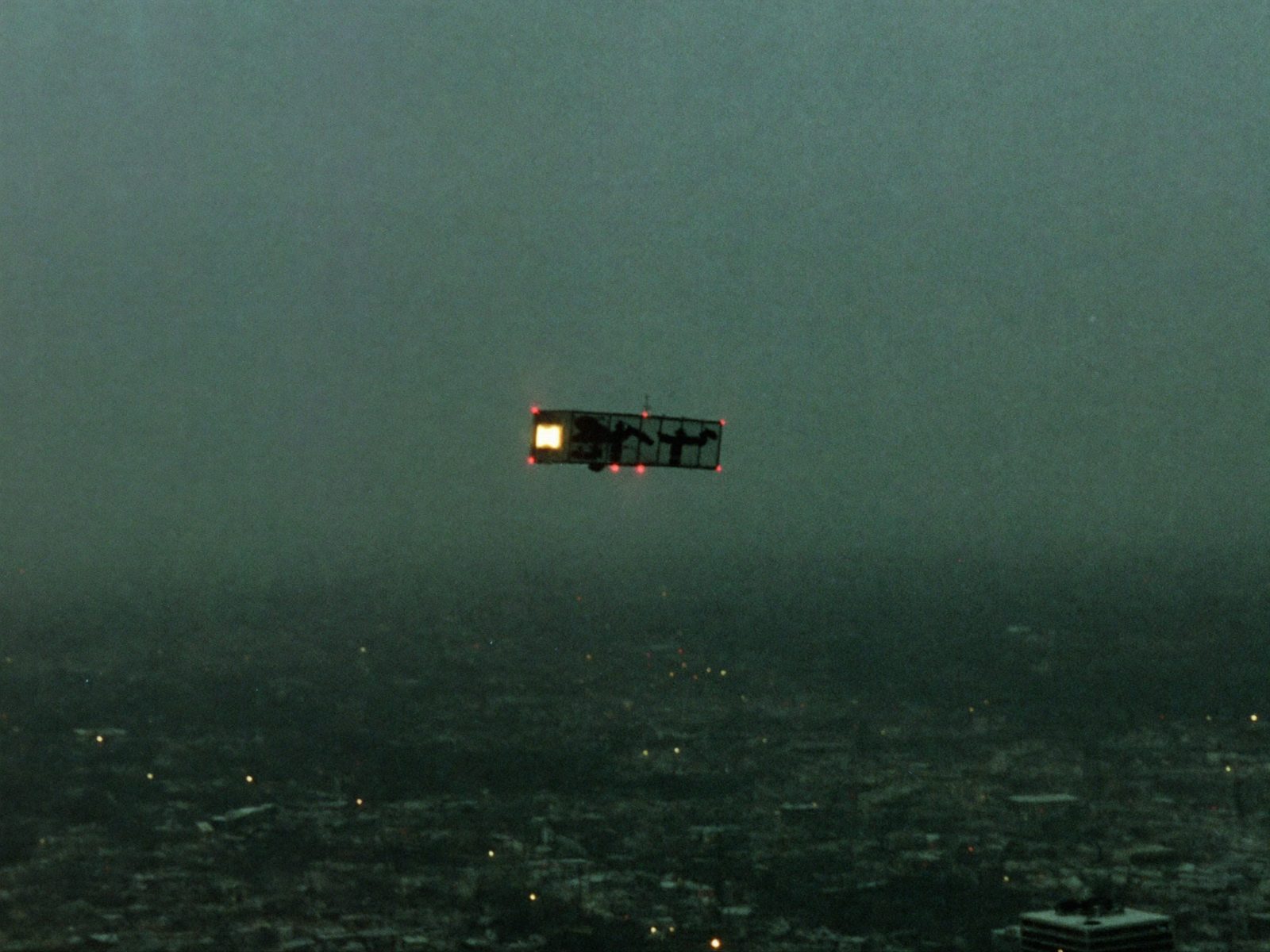
At 01:30 an F-4 went up. At 25 nautical miles the crew lost every instrument and their UHF, and got them back on turning away. A second aircraft reported a weapons-system failure while preparing to fire. A civil airliner lost radio in the same window, and the object pulled away and held its distance as the jets closed.
Klass blamed a bright planet and unrelated equipment faults. The crews never accepted it.
Citizens who telephoned the air force command post, a civil airliner crew, and two F-4 Phantom crews
Evidence
Military radar, a surviving US Defense Intelligence Agency report, and instrument, radio and weapons-system failures
Agency
Imperial Iranian Air Force; a US DIA report survives
Assessment
A · instrumented (radar + avionics effects)
The full file
Shortly after half past midnight on 19 September 1976, the Imperial Iranian Air Force command post in Tehran took four telephone calls from residents of the Shemiran district, in the north of the city. Callers described a bird-like object or a lit helicopter; none was flying. The duty officer, Brigadier General Yousefi, assistant deputy commander of operations, first told callers they were seeing stars. After speaking to the tower at Mehrabad airport he went outside, saw a light like a star but bigger and brighter, and ordered an F-4 Phantom scrambled from Shahrokhi air base to investigate.
Two Phantoms
The first F-4 took off at 01:30. According to the US report, the light was visible from some 70 miles away. As the jet closed to 25 nautical miles, the crew lost all instruments and their UHF radio and intercom. They broke off and turned for home, and the systems came back.
A second F-4 left at 01:40. Its back-seater obtained a radar lock at 27 nautical miles, the return described as comparable in size to a 707 tanker. At 25 miles the target pulled away and held that distance on the scope. Visually, the crew saw strobe-like lights in a rectangular pattern, cycling through blue, green, red and orange. South of Tehran a second, smaller light appeared to separate from the first and head straight for the jet. The pilot tried to fire an AIM-9 missile; at that moment, the report says, his weapons control panel went off and he lost all communications. He turned away in a negative-g dive, and the smaller light rejoined the larger one. A further light then appeared to descend and come to rest on the ground, lighting an area two to three kilometres across.
On the way back the crew lost radio and saw their inertial navigation fluctuate each time they crossed a particular bearing from Mehrabad. The report adds that a civil airliner approaching Mehrabad lost communications in the same area at about the same time but saw nothing. The pilot was later identified publicly as Parviz Jafari, who retired as a general and described the encounter at a press panel in Washington in November 2007.
The paper trail
The account survives because of a four-page teletype from the US Defense Attaché Office in Tehran, released by the Defense Intelligence Agency under the Freedom of Information Act. It was sent on 23 September, not on the day itself, over the name of Colonel Frank B. McKenzie, the defence attaché, and its distribution included the White House, the Secretary of State, the CIA and the NSA. The attaché's own comment is plain about its basis: the information came from a source in conversation with a sub-source and an Iranian pilot of one of the F-4s. It is a second-hand summary, not a crew statement or a radar record.
A DIA evaluation form attached to the release rated the report "confirmed by other sources" and of high value. Its remarks note that visual sightings were confirmed by radar and that similar electromagnetic effects were reported by three separate aircraft. A later Air Force newsletter article by Captain Henry S. Shields follows the teletype closely and is not independent evidence. No Iranian radar tapes, flight logs or maintenance records have been published. The teletype says the aircraft and the supposed landing site were to be checked for radiation; no result appears in the released file.
What was found on the ground
The next day the crew flew by helicopter to the spot where they believed the object had come down, a dry lake bed, and found nothing. Circling to the west they picked up a strong beeper signal near a small house, whose occupants spoke of a loud noise and a bright light during the night. Sceptical accounts attribute the beeper to a locator beacon from an American transport aircraft, of a type known to shake loose over the mountains north of Tehran.
The conventional explanation
The fullest sceptical case came from the aviation journalist Philip Klass, who interviewed American contractors on Iran's F-4 fleet. He argued that the first light was most likely Jupiter, bright in the sky that night, and that the failures were ordinary faults: the second F-4, his sources said, had a long history of intermittent electrical outages that had not been cured, and the first was never sent in for maintenance. The brief falling lights fit the meteor activity of mid-September, and airliners do lose radio contact from time to time.
Its strength is that it finds a mundane candidate for each element. Its weakness is that the elements arrived together. A planet does not hold station on an airborne radar at 25 miles while the fighter closes, and Jupiter does not account for the lights seen separating from the main object.
What remains open
No crew statement from 1976 is public, only an attaché's summary of a conversation. The radar lock, the failures on two aircraft and the airliner's radio loss cannot now be tested against instruments. Later retellings add details the teletype does not contain. The DIA's own evaluator treated the report as a model case; Klass treated it as a chain of coincidences. With no Iranian file released, neither reading can be closed.
The U.S. Government and the Iran Case — International UFO Reporter article in the NSA's declassified UFO collection, c. 1977. How the teletype was obtained under FOIA, and the agencies' statement that distribution was routine.
Corrected The full file: Klass's contractor sources were said to have named only 'one of the two aircraft' as having a fault history, and retellings were said to disagree on which; Skeptoid's summary of Klass says it was the second F-4 and that the first was never sent for maintenance, so the text now says so and the unsupported disagreement has been removed.
Corrected The full file: A claim that later retellings have the object outrunning the jets at Mach 2 could not be found in any cited source and has been removed.
Corrected The witnesses no longer include an air traffic controller or a general watching from his balcony, neither found in the primary record; the first reports came from citizens who telephoned the air force command post.
Corrected The object is now said to have pulled away and held its distance as the jets closed; the file previously said it outpaced them even at Mach 2, which no primary source supports.
Sources The source on file is now the Defense Intelligence Agency's own copy of the 1976 teletype, in its reading room, rather than an encyclopedia article.
Added The full file, a long-form write-up with its sources, added.

 INDEPENDENT FIELD ARCHIVE